The San Silvestre Vallecana is not just a race. It is the biggest running celebration in Spain, a tradition that has taken place every December 31 since 1964, turning the streets of Madrid into the stage for a one-of-a-kind party. Over 40,000 runners in costumes, roughly one million spectators cheering from the sidewalks, and the unmatchable energy of closing out the year with a run through the heart of the Spanish capital.
If you are thinking about running the San Silvestre Vallecana 2026, this guide covers everything you need to know: from registration and the course analysis to training tips and everything that makes this race absolutely unique. Whether you are an experienced runner chasing a 10K personal best or someone who simply wants to experience the fun of running in costume, the San Silvestre has a place for you.
Why the San Silvestre Vallecana is special
There are races you run for the time, others for the course, and some for the atmosphere. The San Silvestre Vallecana has all three, but above all it has something no other race in Spain can replicate: it is a national tradition. Since 1964, when the first edition was held with just a handful of athletes, the race has grown into the most popular running event in the country, with over 40,000 participants and live national television coverage.
What truly sets the San Silvestre apart is its spirit. This is not a race where everyone is obsessing over their GPS running watch guide (though you certainly can if you want). It is a party on the move. Thousands of runners show up dressed as Santa Claus, superheroes, movie characters, animals, and just about anything imaginable. The spectators, numbering in the hundreds of thousands along the entire route, form a human corridor of cheering, laughter and celebration. It is the only day of the year when running through central Madrid becomes a festive experience for the entire city.
The San Silvestre also has a fascinating dual identity. On one hand, there is the Popular race, open to everyone, where the goal is to enjoy yourself and ring out the year running. On the other hand, there is the International race, an elite event featuring world-class athletes competing at the highest level. This duality gives the San Silvestre a character that very few races worldwide can match: the combination of a popular street party and top-tier athletics.
For many Spaniards and runners from across the country, the San Silvestre is an unmissable ritual. It is the perfect way to close the year: running, laughing, celebrating and starting New Year's Eve with endorphins flowing. If you have never run it, this is your year.
Key facts for 2026
| Detail | Information |
|---|---|
| Date | Thursday, December 31, 2026 |
| Start time (Popular) | Approximately 5:30 - 6:00 PM |
| Distance | 10K |
| Categories | Popular (open to all) + International (elite) |
| Route | Point-to-point: Santiago Bernabeu → Estadio de Vallecas |
| Elevation | Net downhill (slightly descending) |
| Participants (Popular) | 40,000+ |
| Spectators | ~1,000,000 along the route |
| Temperature | 2 - 10 °C (35 - 50 °F) |
| Running since | 1964 (one of Spain's oldest races) |
| Official website | sansilvestrevallecana.com |
The route: Bernabeu to Vallecas
The San Silvestre Vallecana course is one of the most iconic in Spanish running. It is a point-to-point 10K that cuts through central Madrid from north to south, starting near the Santiago Bernabeu stadium and finishing at the Estadio de Vallecas in Puente de Vallecas.
The course profile is slightly net downhill, making it a fast and pleasant route. There are no significant climbs to break your rhythm, and the natural descent from Bernabeu toward Vallecas lets you maintain a strong pace without extra effort. If you are looking for a 10K personal best, this is a favorable course.
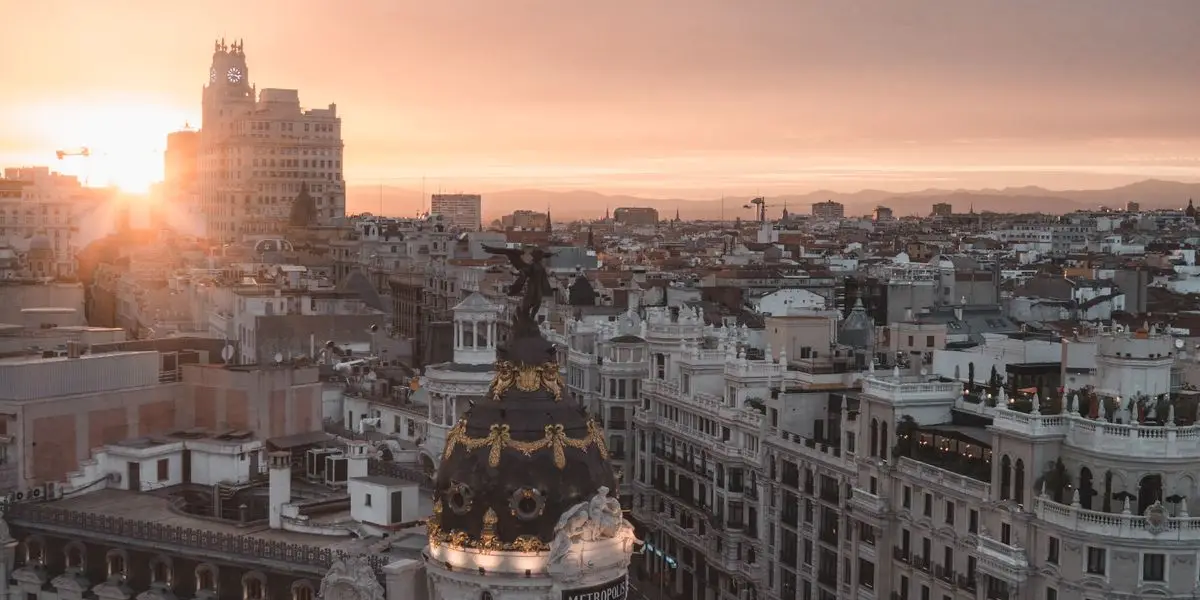
The route heads down the Paseo de la Castellana, one of Madrid's main avenues, before reaching Cibeles, one of the loudest cheering points on the course where thousands of spectators create an absolute wall of sound. From there, the course continues through central Madrid before heading south toward Puente de Vallecas, where the finish line awaits near the stadium.
The atmosphere along the entire route is extraordinary. Since it is the afternoon of December 31, Madrid is already in full celebration mode. Spectators wear their own costumes, there is live music at several points along the route, drumming groups, batucadas, and a constant roar that accompanies you from the first meter to the last. There is not a single dull stretch: every kilometer has its own energy.
If you want to discover other training options in the capital, check out our best running routes in Madrid, perfect for your training sessions leading up to the race.
Registration and categories
Registration for the San Silvestre Vallecana Popular is done through the official website: sansilvestrevallecana.com. This is probably the most critical step of the entire process, because spots sell out incredibly fast. We are talking about a race with over 40,000 participants that has a waiting list every year. As soon as registration opens (usually in autumn), do not delay.
Registration for the Popular race typically costs between 15 and 30 euros depending on the registration phase. Compared to other major races, this is a very affordable price for an experience that has no equal.
Popular vs. International race
The San Silvestre Vallecana has two completely separate categories:
- Popular: Open to all adult runners. This is the mass participation race with over 40,000 runners, a festive atmosphere, costumes and celebration. No qualifying time is required. This is the option for 99% of participants.
- International: An elite race with invited world-class athletes. They compete for prizes and this is the race broadcast on national television. Athletes are selected by the organizers and compete at an extremely high level, with a separate start.
Bib pickup
Your race bib is collected in the days before the race at a designated location (usually at the Runner's Expo). It cannot be picked up on race day. You will need your passport or ID and your registration confirmation. Take advantage of the Runner's Expo to collect your bib at a relaxed pace, browse the brand stands and soak up the pre-race atmosphere.
- Bib: In-person collection required in the days before the race.
- Timing chip: Included with your bib for official timing.
- Runner's bag: Includes a commemorative t-shirt and sponsor gifts.
How to train for a New Year's Eve 10K
The good news is that training for a 10K is much more accessible than preparing for a marathon. You do not need months of training or 30K long runs. If you already run regularly, 6 to 8 weeks of specific preparation will get you to the San Silvestre in good shape. If you are a beginner and want to make this your first race, we recommend starting your training at least 10-12 weeks before.
Training plan for the San Silvestre
A 10K training plan includes 3-4 training days per week, combining different types of sessions:
- Easy runs (2 days): Comfortable pace runs of 30 to 50 minutes. These form the base of your aerobic training. If you can hold a conversation while running, you are at the right pace.
- Speed work (1 day): Intervals, fartlek or tempo runs. For example: 5x1000m at target race pace with 2 minutes recovery, or a 20-minute tempo run at 10K pace. For more detail, check our guide on zone training for running.
- Weekly long run (1 day): A longer run at an easy pace, from 10 to 14 km. The goal is to get your body used to sustaining effort for a duration similar to or longer than the race.
- Rest (2-3 days): Days off from running or with cross-training like swimming, cycling or yoga. Recovery is essential for absorbing training.
If this is your first race and you need a more detailed plan from scratch, our guide on Couch to 5K is a great starting point, or try our complete 10K training plan.
Training in the cold
The San Silvestre takes place on December 31 in Madrid. That means cold. Temperatures between 2 and 10 degrees Celsius (35-50 F), possible wind, and occasionally rain or even frost. Your body needs to adapt to running in these conditions, so do not always train indoors on a treadmill: get outside, feel the cold and learn to manage it. Check our tips for running in winter and our guide on what to wear running by temperature.
Injury prevention
Although a 10K is an accessible distance, do not neglect injury prevention. Add strength exercises (squats, lunges, core work) at least twice a week, do stretching before and after running, and do not increase your training volume by more than 10% per week. If you feel any persistent pain, stop and get it checked before it becomes a full injury. Our guide on preventing running injuries will help.
Train with others for the San Silvestre
Find runners in Madrid (or your city) also training for this race. On CorrerJuntos you can find training partners at your pace.
Race day tips
Race day at the San Silvestre is unlike any other. It is New Year's Eve, Madrid is in full celebration mode, and you are about to run 10K with tens of thousands of people through the center of the capital. These tips will help you make the most of it.
Arrive well in advance
Do not underestimate the logistics. Madrid on the afternoon of December 31 is organized chaos. The metro stations near Bernabeu fill up, streets are closed and over 40,000 people are trying to reach the same spot. Plan to arrive at the start area at least 90 minutes before the start time. That gives you time to drop off your gear bag, visit the restrooms (the queues are legendary), warm up and find your start wave.
Bundle up for the wait, not for the run
One of the most common running mistakes is overdressing for the run itself. With temperatures of 2-10 degrees Celsius and the heat your body generates while running, a long-sleeve thermal top and tights are usually enough. But during the wait before the start, which can last 30 to 60 minutes standing in the cold, you will need something extra. The classic trick: bring a large garbage bag as a disposable windbreaker. Put it over your clothes while you wait, it keeps you warm, and you toss it right before the start. The organizers typically collect all discarded clothing at the start area.
- Thermal base layer: Long-sleeve technical top, tights and thermal socks.
- Gloves and neck gaiter: Hands and neck are the areas that get coldest. Bring lightweight gloves you can stash in a pocket if they get too warm.
- Garbage bag: For the wait. Free and effective.
- Nothing new on race day: The golden rule. Everything you wear should have been tested in training.
If you need guidance on what to wear, read our complete guide on what to wear running by temperature.
Nutrition and hydration
A 10K does not require the same nutrition strategy as a marathon, but do not neglect it either. Eat something light and carbohydrate-rich 2-3 hours before the start: toast with jam, a banana, oatmeal with honey. Do not experiment with new foods. Stay well hydrated throughout the day, but avoid drinking too much right before the start to prevent needing a stop during the race. For specific ideas, check what to eat before running.
During the race, the organization provides water stations. For a 10K, most runners do not need gels or extra nutrition if they have eaten well beforehand. If you expect to take over an hour, a gel at the halfway point can help, but make sure you have tested it in training.
Manage your pace
The San Silvestre start is an overwhelming sensory experience. The adrenaline, the noise, the crowd, the costumes... everything pushes you to go out hard. Resist the temptation. The first 2-3 km will be slower than usual due to the density of runners, so use that stretch to find your rhythm without forcing. From km 4-5 onward, when the pack thins out, you can pick it up if you feel good. For more guidance, read our running pace for beginners guide.
The New Year's Eve tradition: costumes, party and grapes

The San Silvestre Vallecana cannot be understood without its context: it is New Year's Eve. On December 31, all of Spain is in celebration mode, and the race is the perfect appetizer for the most festive night of the year. This gives it a unique character that you will not find in any other race on the calendar.
The costumes: the defining feature
If there is one thing that defines the San Silvestre Popular, it is the sheer number of runners in costume. It is not mandatory, but it is such an ingrained tradition that those not wearing one are almost the exception. Costumes range from the classic Santa Claus outfit (the most popular) to absurd and brilliant creations: entire groups in coordinated outfits, tributes to the year's biggest movies, political parodies, animal suits, superheroes, video game characters... creativity has no limits.
If you decide to wear a costume, keep one practical detail in mind: you need to be able to run 10K in it. Avoid outfits that are too bulky, that make you sweat excessively, or that restrict your movement. The best costumes combine originality with functionality: a Santa hat with red running gear, reindeer antlers with tights, a superhero cape with a technical shirt underneath. The key is to have fun without suffering.
The party after the race
Crossing the San Silvestre finish line is just the beginning of the night. Many runners head straight to their New Year's Eve dinner with tired legs but with the satisfaction of having started the last night of the year in the best possible way.
A widespread tradition among participants is eating the twelve grapes at midnight with the running with a group they ran the race with. In Spain, it is customary to eat twelve grapes, one with each chime of the clock at midnight, to bring good luck for the new year. Some groups gather at Puerta del Sol (Madrid's central square), others at private homes, and many simply celebrate in the streets. The San Silvestre builds community, and that community extends well beyond the 10 km of the course.
Television broadcast
The San Silvestre Vallecana is broadcast live on national television, making it a major media event. The elite International race gets the main coverage, but the images of the Popular race with its thousands of costumes are a staple of New Year's Eve programming in Spain. If you cannot run it this year, you can at least watch it from the sofa while you plan for next year.
History and tradition
The first San Silvestre Vallecana was held in 1964, inspired by the famous Sao Silvestre race in Sao Paulo, Brazil. Since then, it has never stopped growing. What started as a local race has become Spain's most attended running event and one of the most important year-end popular races in the world. The tradition is passed down from generation to generation: there are entire families who run the San Silvestre every year as their end-of-year ritual.
Train with others for the San Silvestre
The San Silvestre is, by definition, a social race. You run in a group, enjoy it with friends and celebrate as a community. It makes complete sense for the preparation to be the same way. Training with others for this race not only helps you stay motivated during the weeks leading up to it, but it allows you to live the full experience: from preparation to the race itself and the celebration that follows.
If you are looking for beginner running groups in Madrid, there are plenty of options. And if you do not live in Madrid but are traveling for the San Silvestre, you can train with people in your city who are also preparing for it. The important thing is not to do it alone.
When you train with other people who are also preparing for the San Silvestre, the dynamic changes completely. On the days you do not feel like going out, they pull you along. Speed sessions are more bearable when you have someone beside you with a similar goal. And the motivation feeds itself: watching your training partners progress week after week pushes you to give your best.
Training in a group also gives you collective knowledge. There is always someone who has already run the San Silvestre, who knows which costume works best, who knows the course, who can tell you where to meet before the start or how to get home afterward. That shared information is invaluable.
If you are in Madrid or nearby, you might enjoy reading about how to find running partners or our guide on how to join a running group. And if you want a perfect training partner at your pace, try our meetups map.
Training for the San Silvestre?
Find runners who are also preparing for this race. Join group runs, discover routes and train together. Ring out the year running with others who share your passion.
Find running partners on CorrerJuntosFrequently asked questions
When is the San Silvestre Vallecana 2026?
The San Silvestre Vallecana 2026 takes place on Thursday, December 31, 2026, as it does every New Year's Eve since 1964. The Popular race starts in the late afternoon, typically between 5:00 and 6:00 PM, while the elite International race has a separate start. It is Spain's most attended running event with over 40,000 participants in the Popular category alone.
What is the route of the San Silvestre Vallecana?
The course is a point-to-point 10K. It starts near the Santiago Bernabeu stadium, runs down the Paseo de la Castellana, passes through Cibeles and central Madrid, and finishes at the Estadio de Vallecas in Puente de Vallecas. The course has a slight net downhill, making it fast and enjoyable. Around one million spectators line the streets, creating an incredible atmosphere throughout.
What is the difference between the Popular and International races?
The San Silvestre has two completely separate categories. The Popular is open to all runners (over 40,000 participants), with a festive atmosphere featuring costumes and celebration. The International is an elite race with invited world-class athletes competing for prizes, with a separate start and live national television coverage. Both share the same 10K route from Bernabeu to Vallecas.
How much does it cost to register for the San Silvestre Vallecana?
Registration for the Popular race typically costs between 15 and 30 euros depending on the registration phase. Since the race is extremely popular, all 40,000+ spots sell out every year, so it is essential to register as soon as the period opens, usually in autumn. Check the official website sansilvestrevallecana.com for updated prices and dates.
Can you run the San Silvestre in costume?
Yes, and it is actually one of the most beloved traditions of the race. Thousands of participants run dressed as Santa Claus, superheroes, movie characters, animals and all kinds of creative outfits. There are no costume restrictions as long as you can run safely. The festive atmosphere and costumes are precisely what make the San Silvestre Vallecana unique: it is a running party, not just a race.
How do I get to the start of the San Silvestre Vallecana?
The start is near the Santiago Bernabeu stadium. The closest metro stations are Santiago Bernabeu (line 10) and Nuevos Ministerios (lines 6, 8, and 10). It is recommended to arrive at least 90 minutes early because the crowds are massive. Public transport is the best option since many streets in central Madrid are closed to traffic. Remember that the finish is in Vallecas, so you will need the metro to get back.
What is the weather like at the San Silvestre Vallecana?
Since the race takes place on December 31 in Madrid, temperatures typically range between 2 and 10 degrees Celsius (35-50 Fahrenheit). It can be quite cold, especially during the wait before the start. Wear thermal base layers, gloves and an extra layer you can remove once you warm up. The classic trick is to wear a large garbage bag as a disposable windbreaker while waiting at the start line. Check our tips for running in winter and running at night.
Running tips straight to your inbox
Training plans, strategies and tips to prepare your next race. No spam.
Join 1,100+ runners