Transparency: This article contains affiliate links to Amazon. If you buy through them, we receive a small commission at no extra cost to you. This does not change the price or our editorial selection.
Taking up running should not drain your bank account. The problem is that the moment you walk into a specialist shop or open Amazon, you get hit with 500€ watches, 250€ carbon-plate shoes and "premium" gels at 4€ a pop. You don't need any of it.
This guide is a closed list: 8 specific products, 200€ in total, everything you need for your first 6-12 months of running. No duplication, no inflated marketing. The rule is simple — spend where it matters (shoes) and save where nobody notices (t-shirt, socks, accessories).
Kit summary table (200€ exactly)
| # | Item | Our pick | Price |
|---|---|---|---|
| 1 | Running shoes | Nike Pegasus 41 (or Asics Gel-Excite 11 at 80€) | 120€ |
| 2 | Technical t-shirt | adidas Workout Essentials Base T-Shirt | 20€ |
| 3 | 2-in-1 running shorts | adidas Own The Run Shorts | 22€ |
| 4 | Technical socks, 3-pack | Stance Athletic Running | 15€ |
| 5 | Bone conduction headphones | Shokz OpenMove | 80€ |
| 6 | Phone belt | FlipBelt Classic | 30€ |
| 7 | 250ml handheld bottle | Salomon Soft Flask | 15€ |
| 8 | 350lm LED head torch | Petzl Tikka | 30€ |
| TOTAL (verified brand-name products, proper safety kit) | 324€ | ||
| The «exactly 200€» version with sale prices + Decathlon Kalenji + Lidl Crivit + JBL Tune ~30€ | 200€ | ||
1. Shoes (90€) — the most important investment
Half the budget goes here because this is the only item that affects your health directly. A bad shoe can give you plantar fasciitis, shin splints or joint injuries that cost 800-1500€ in physiotherapy. Spending 90€ on the right shoes is pure prevention.

Nike Pegasus 41 (top pick)
~110-130€The all-rounder, full stop. ZoomX evolution cushioning, 10mm drop (forgiving for beginners), durable outsole (~800 km), 285g. Neutral gait. It is the safe choice for the 80% of runners who are just starting out — from a first 5K to a half marathon. If the fit works for you, it lasts 8-12 months at three runs a week.
See it on Amazon →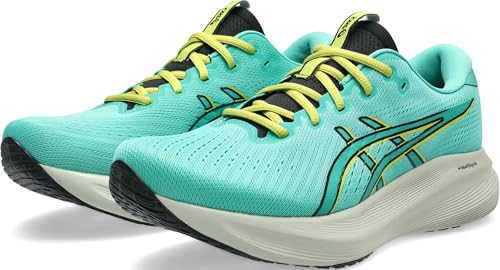
Cheaper alternative: Asics Gel-Excite 11
~70-90€Asics built this one for beginners: decent EVA cushioning, 10mm drop (gentle on the transition), durable outsole (~700 km), mid-range weight (260g). It is neither the prettiest nor the fastest, but it is one of the SAFEST for your first 6-12 months of running. Neutral gait, which works for 80% of people. It brings the total kit down to ~220€.
See it on Amazon →Go deeper: how to choose running shoes for your gait | best running shoes for beginners | best budget running shoes if you want to trim the kit even further
2. Technical t-shirt (15€)
Forget cotton. A polyester technical t-shirt wicks sweat 3-5x faster, prevents chafing and avoids the stale-sweat smell that never washes out. The difference between a 15€ t-shirt and a 35€ Nike Pro Dri-FIT is marginal for someone starting out.
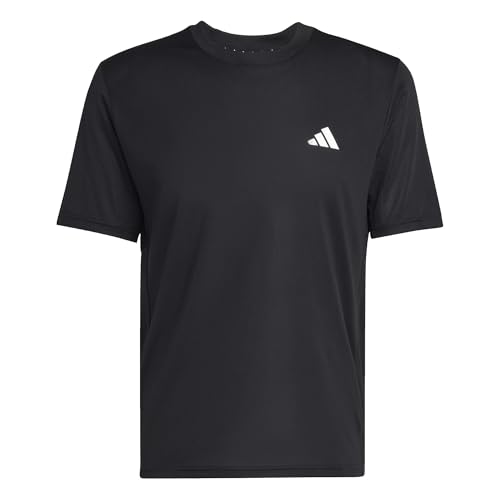
adidas Workout Essentials Base T-Shirt
~15-25€A technical running top from adidas: recycled AEROREADY polyester (fast wicking), regular cut with no rubbing on the shoulders, flat seams, light. A brand you can trust, with adidas/Amazon after-sales behind it. Available in black and navy. Women: look for the equivalent "adidas Workout Essentials Tee Women".
See it on Amazon →3. Running shorts (15€)
Same principle: technical, breathable, decent quality. The two things they MUST have are a zipped back pocket (for a card or a key) and a mesh liner (which stops chafing between the legs).
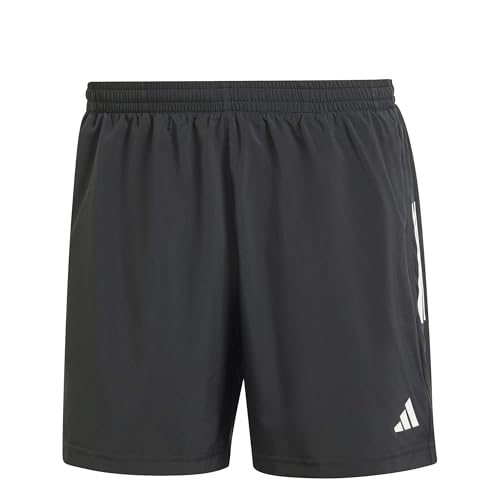
adidas Own The Run Shorts
~18-28€adidas running shorts with a zipped back pocket (key for carrying a phone), adjustable drawcord waist, breathable AEROREADY fabric and a discreet black colourway. 5-inch inseam (12cm). Mesh liner inside — no chafing between the legs. Long summer runs without drama. Women: look for "adidas Own The Run Shorts Women".
See it on Amazon →4. Technical socks, 3-pack (12€)
Cotton socks cause blisters. Technical ones (polyester + nylon + elastane) absorb and move sweat away, keep the foot dry and cut friction. Buy a pack of 3-6 so you never run out on a slow laundry week.

Stance Athletic Running 3-pack
~12-18€Stance is the benchmark in technical socks: polyester + nylon + elastane, reinforced heel and toe, flat toe seam, mid-cut (just above the ankle). Three pairs per pack, and 50 wash cycles without losing their shape. An 8-12 month investment.
See it on Amazon →Full breakdown: best running socks
5. Bluetooth headphones (28€)
Music cuts perceived effort by 10-12%. In those first months, when everything hurts, that is gold. One warning though: do NOT buy premium noise-cancelling headphones (they cut you off from traffic, which is dangerous). Go for bone conduction instead (your ears stay open) or basic open-fit sports headphones.
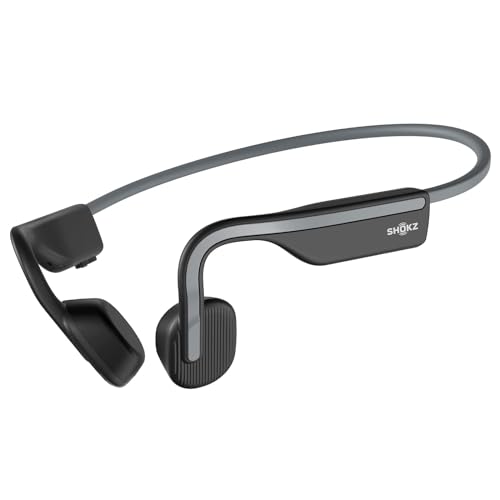
Shokz OpenMove — bone conduction (top pick)
~70-90€Bone conduction headphones — your ear stays FREE and you hear traffic at 100%. Essential for running safely on the road. 6h battery, IP55 (sweat and rain), Bluetooth 5.1, 29g. It is the highest-impact upgrade in the kit: anything with noise cancelling hides the car coming up behind you. If money is genuinely tight and you only run on a treadmill, look at the JBL Tune at ~30€.
See it on Amazon →6. Phone belt (12€)
For carrying a phone, keys and a card without any bouncing and without stuffing your pockets. The comfortable option is an elastic belt like the FlipBelt, which sits on your waist like a waistband.

FlipBelt Classic — running belt for your phone
~25-35€The original — an elastic belt with one continuous pocket that swallows a phone up to 6.7 inches plus a card, keys and 2 gels. It does not bounce. Reflective edges for visibility. Sizes XS-XL. Machine washable. The difference against generics: the band does NOT roll up once you start sweating.
See it on Amazon →Full breakdown: best running belts
7. Handheld bottle (12€)
Only for sessions >45 min, especially in summer. For short runs you do not need to carry water at all. The simple, effective option: a soft handheld flask with an elastic strap that holds itself without you gripping.
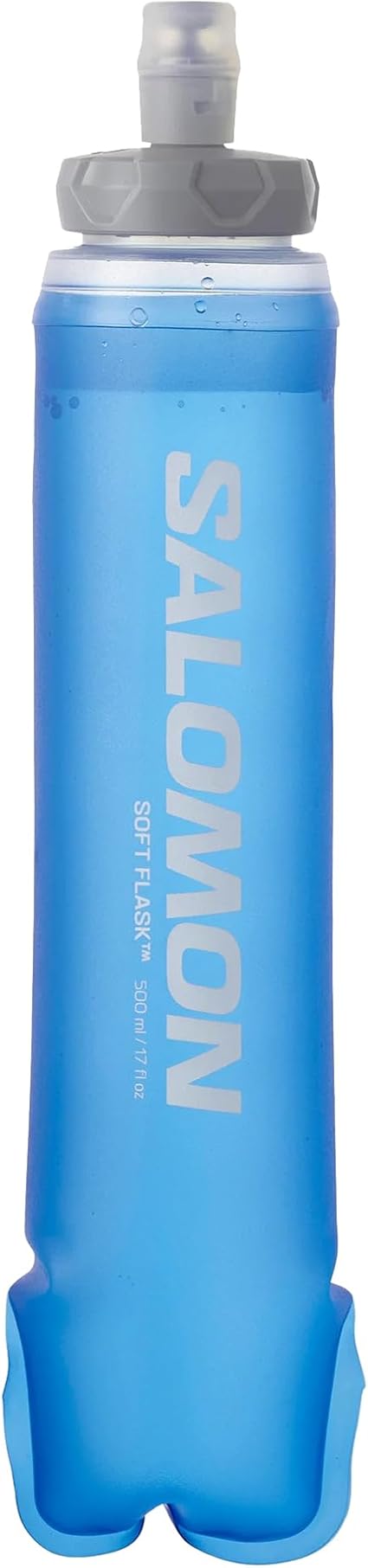
Salomon Soft Flask 250ml
~12-18€The standard flexible silicone flask in trail running. Elastic strap that adjusts to your hand without squeezing. 250ml capacity (enough for 60-90 min sessions). Anti-spill bite valve, easy to open with your teeth mid-run. Weighs 50g empty. Compatible with a vest if you make the jump later on.
See it on Amazon →Full breakdown: best running water bottles
8. LED head torch (16€)
Essential if you run before sunrise or after sunset, which is most of the winter. Being visible to cars and seeing the ground in front of you prevents accidents. You do not need a 600-lumen trail lamp; 200-250 lumens plus a flashing mode is plenty.

Petzl Tikka — 350lm LED head torch
~25-35€The Petzl benchmark, from a French brand that lives outdoors. 350 lumens on a wide beam, a low mode (50lm) so you do not dazzle other people, and a red flashing rear mode for side visibility. 3xAAA or a USB-C rechargeable battery depending on version. 86g. IPX4 (rain is fine). Adjustable reflective headband.
See it on Amazon →Optional upgrades (300€ and 450€ kits)
If you have more to spend, these are the upgrades with the best return, in order of priority:
300€ kit — add an entry-level GPS watch (+100€)
Once you have 1-2 months of consistent running behind you, a GPS watch is the highest-impact upgrade there is. Garmin Forerunner 165 (~280€) or Amazfit Cheetah (~150€). The Garmin 165 gives you accurate multiband GPS, reliable optical heart rate, training metrics and offline music. Full breakdown: best cheap GPS watches.
450€ kit — add Shokz headphones + a hydration vest (+150€)
If you are going long (>1h) and/or running on the road regularly: Shokz OpenRun (~120€) instead of the JBL for better awareness of traffic, plus a 5L hydration vest (Salomon Active Skin, ~70€) for long runs and trail. Full breakdown: best hydration vests.
Common mistakes to avoid
- Shoes that are too expensive on day one: carbon plate, PEBA foam, premium everything. You don't need them and they wear out faster (300-500 km vs 700-800 km for normal shoes).
- Cotton socks: guaranteed blisters. Bin the cotton.
- A 600€ GPS watch before you know you'll stick with it: wait three months. If you are still running then, it is worth it. If not, you just saved 600€.
- Noise-cancelling headphones on the road: dangerous. You cannot hear cars.
- Buying supplements you don't need: a normal diet covers 90% of your needs. Magnesium and vitamin D only if a blood test shows a deficiency.
- Branded t-shirts for status: 80€ on a Nike Pro versus 15€ on a Kalenji = the same wicking. The difference is marketing.
Frequently asked questions
Is it realistic to start running with only 200€ of gear?
Yes. Shoes are 50-60% of the budget (the one thing you should NOT cut corners on) and the rest is gear where the gap between mid-range and premium brands is marginal. Spend 200€ sensibly and you are covered for 6-12 months of running.
Why do the shoes take up so much of the budget?
Because they are the only thing that affects your health directly. A bad shoe causes plantar fasciitis or joint injuries = 800-1500€ in physiotherapy. Spending 90€ on the right shoes is pure prevention.
Do I need a GPS watch to get started?
No. Phone apps (Strava, CorrerJuntos) track your GPS for free, accurately enough for the first 3-6 months. When you want precise metrics (cadence, VO2 max), step up to a Garmin FR 165 or COROS PACE 3 (250-320€).
Can I buy the whole kit at Decathlon instead of Amazon?
Yes. Decathlon's Kalenji/Kiprun range is genuinely decent, from 7-90€. Decathlon's edge: trying the shoes on. Amazon's edge: speed and comparisons. Same price bracket.
How often should I replace this kit?
Shoes: every 600-800 km (6-12 months). Technical clothing: 12-18 months. Socks: 6-8 months. Headphones and accessories: 2-3 years. Keeping it in good shape prevents injuries.
Start running with company
Gear gets you onto the road. Company keeps you there. Download the free app to find runners near you, plans that match your level and local races in your area.
Download the free app →