Running socks are the most underrated piece of running gear there is. Most runners invest 150 or 200 euros on a high-end pair of shoes and then stuff their feet into cotton socks that cost 2 euros from a ten-pack at the supermarket. The result is predictable: blisters, soaking wet feet, friction and discomfort that ruin workouts and races alike. A technical running sock is not a luxury -- it is a necessity. And the good news is that the best models on the market cost between 8 and 25 euros, a fraction of what any other piece of gear costs. If you want to round out your running kit properly, check out our running apparel guide where we cover every layer (World Athletics).
In this guide, we are doing something that very few comparisons do: analyzing each sock in depth. We do not just say a model is good or bad. For each of the 8 selected socks, we break down the fabric composition, the type and level of cushioning, the height, the moisture management, the blister prevention, the estimated durability and the arch support. We also include educational sections on why socks matter so much, a complete guide to fabrics, heights and cushioning levels, and care tips to make them last as long as possible.
To pick the right running shoes, you need to consider the sock you will be wearing with them. A sock with too much cushioning can make the shoe feel tight. One that is too thin can leave extra room. The shoe-sock combination is a system, and both pieces need to work together.
Why socks matter for running
Every time you take a stride while running, your foot generates an impact force of between 2 and 3 times your body weight. That force repeats roughly 800 to 1,000 times per kilometer. On a 15-kilometer run, we are talking about 12,000 to 15,000 impacts. The sock is the only barrier between your skin and the shoe, and that barrier has to manage three things simultaneously: friction, moisture and temperature.
Friction is the direct cause of blisters. When your foot moves inside the shoe, the skin rubs against the sock fabric. If the sock is soaked in sweat, friction multiplies because wet skin has a higher coefficient of friction than dry skin. A good running sock is designed so that friction occurs between the layers of fabric, not between the fabric and your skin. It is a simple but fundamental concept.
Moisture is the second critical factor. A foot produces between 100 and 200 milliliters of sweat during one hour of running under normal conditions. In summer, that figure can double. If the sock absorbs that moisture and holds it, your feet stay in a sweat bath that softens the skin, increases friction and creates the perfect breeding ground for fungi and bacteria. Technical running socks are made with fibers that transport moisture from the skin to the outside of the sock, where it evaporates. This process is called wicking, and it is the main reason you should never wear cotton for running.
Temperature is the third pillar. In winter, a sock that is too thin leaves the foot cold, which reduces circulation and increases the risk of injury. In summer, a sock that is too thick traps heat and accelerates sweating. The thickness and composition of the fabric determine the sock's thermoregulation, which is why it is important to have at least two types of socks: a lightweight one for summer and a more insulating one for winter. Our running in winter guide explains in detail how to manage each layer according to the temperature.
The consequences of a bad sock
- Blisters: The number one cause of DNFs in long-distance races. A soaking cotton sock can cause blisters from the 8-10 km mark onward.
- Fungal infections and athlete's foot: Retained moisture for hours creates the ideal environment for fungal infections that can take weeks to heal.
- Black toenails: A sock with too much room allows the foot to slide and the toes to slam against the toe box on downhills.
- Plantar fasciitis: The lack of arch support over thousands of repeated impacts contributes to inflammation of the plantar fascia.
- Achilles tendon chafing: A sock with a poorly fitting heel or prominent seams can generate chronic friction in a very sensitive area.
Fabric guide: merino, Coolmax, nylon and polyester
Not all fabrics are created equal, and the composition of a running sock determines about 80 percent of its performance. Understanding what each fiber does will help you choose the right sock for your type of run and climate.
Merino wool
Merino wool is the most advanced natural fiber for running. It comes from the merino sheep, whose wool has extraordinarily fine fibers (between 15 and 24 microns, compared to 30-40 microns for conventional wool). This makes it soft, itch-free, and allows manufacturers to create socks that are thin yet highly insulating. Its main advantages: natural thermoregulation (keeps the foot warm in winter and cool in summer), natural antibacterial properties (you can wear them several times before they smell), the ability to absorb up to 30 percent of its weight in moisture without feeling wet, and exceptional softness. Its main disadvantage is durability: pure merino wool wears out faster than synthetic fibers, which is why most running socks blend merino with nylon to reinforce the highest-wear zones.
Coolmax and rapid-wicking fibers
Coolmax is a polyester fiber with a special four-channel cross-section that maximizes the surface area in contact with air. This allows it to wick moisture 30 to 50 percent faster than conventional polyester. It is the go-to synthetic fiber in summer running socks because it dries very quickly and is lightweight. However, it does not have the antibacterial properties of merino, so it tends to accumulate odor more quickly. Brands like Balega and Stance use it extensively in their warm-weather models.
Nylon (polyamide)
Nylon is the reinforcement fiber par excellence. It is used in the highest-wear zones of the sock (heel, toe, sole) because it is extraordinarily resistant to abrasion. A sock with 20-30 percent nylon in its composition will last significantly longer than one made of 100 percent polyester or merino. Nylon also provides a soft, slightly silky feel that reduces friction against the skin. The downside is that it retains slightly more moisture than pure polyester.
Polyester
It is the base synthetic fiber in most running socks. It is affordable, durable, lightweight and manages moisture reasonably well. Recycled polyester (made from plastic bottles) is increasingly common in running socks as a sustainable alternative with identical performance. Low-end socks tend to be mostly polyester, while mid-range and high-end models combine polyester with nylon, elastane and sometimes merino.
Elastane (Spandex/Lycra)
Present in virtually every running sock at a percentage of between 2 and 8 percent. Its function is to provide elasticity and fit. Without elastane, the sock would not conform to the foot, would lose its shape after washing and would not provide arch support. The amount of elastane directly influences how compressive the sock feels: more elastane means more compression and a tighter fit.
Cushioning levels in running socks
Cushioning in a running sock refers to the thickness of the padded fabric (usually terry-loop knit) in certain areas of the sock. Not all socks have the same amount of cushioning, nor do they need it. Choosing the right level depends on your type of running, your shoe and your personal sensitivity.
Find your running with a group
1,100+ runners already train together. Free on iOS.
No cushioning (ultralight)
Extremely thin socks, practically a second skin. They add the least bulk inside the shoe and are the most breathable. Ideal for speed sessions, extremely hot days or runners who prefer a direct connection with the shoe. Downside: they offer zero impact protection and may be insufficient on long runs for runners with sensitive feet.
Light cushioning
Subtle padding in the heel area and the metatarsal pad. This is the most popular middle ground because it adds a layer of protection without significantly increasing bulk or temperature. These are the most versatile socks on the market and the ones we recommend as a first purchase if you can only have one type.
Medium cushioning
Denser terry-loop knit covering the entire sole and sometimes extending across the instep. They provide notable protection against repeated impacts and are ideal for long runs, heavier runners or hard surfaces. They add some bulk, so you need to be mindful of shoe fit: if your shoes are already snug, a medium-cushion sock can make them feel too tight.
Maximum cushioning
The highest level of padding available. Thick terry-loop fabric across the entire sole and often the instep as well. These are thick, warm and highly protective socks. They are used mainly in winter, on technical trail terrain or by runners who need maximum impact protection. They are not recommended for summer because they trap too much heat. They also require shoes with a more generous fit.
Height guide: no-show, ankle, crew and compression
Sock height is not just a style choice. Each height serves a specific functional purpose and is better suited to certain types of running and conditions.
No-show (invisible)
The sock sits below the shoe collar and is not visible. It is the coolest and lightest option, ideal for summer and short races. The downside is that it does not protect the ankle against shoe rubbing and can slip down if the silicone heel grip is not high quality. A no-show sock that constantly slides down is worse than wearing no sock at all.
Ankle
Covers the ankle bone with a centimeter or two of fabric above the shoe. It is the most versatile height and the one we recommend as the standard. It protects against chafing, does not accumulate too much heat and works well in any season. Most road runners use this height as their daily sock.
Crew (mid-calf)
Reaches the mid-calf. It is the preferred option for trail running because it protects against pebbles, branches and debris that could get inside the shoe. It is also a good option for winter because it covers more skin and insulates better. In summer, it can be excessive for road running.
Knee-high compression
Extends to just below the knee and applies graduated compression to the calf. Its main goal is not protection but improving blood circulation, reducing muscle vibration and aiding recovery. They are more popular for post-workout use than during the run itself, although many ultratrail runners wear them throughout the entire event. Graduated compression means it is strongest at the ankle and decreases toward the knee.
The 8 best running socks in 2026
After analyzing dozens of models, these are the 8 running socks we recommend in 2026. We have ranked them by overall score considering performance, durability, comfort, value for money and versatility. For each one, we detail the fabric composition, cushioning level, available height, moisture management, blister prevention, estimated durability and arch support.

1 Balega Hidden Comfort
The Balega Hidden Comfort is probably the most recommended running sock in the world, and for good reason. Its construction is impeccable: a proprietary Drynamix fabric that wicks moisture at an exceptional rate, deep cushioning in the heel and metatarsal area that absorbs impact without feeling excessive, and an elastic arch band that keeps the sock in place without compressing. The interior finish is completely seamless, eliminating any potential friction point. It is a no-show sock with a rear tab that protects the Achilles tendon from shoe rubbing.
- Fabric: Drynamix (rapid-wicking polyester), nylon, elastane
- Cushioning: Medium-high in heel and metatarsal pad
- Height: No-show with rear tab
- Moisture management: Excellent (Drynamix dries 40% faster than standard polyester)
- Blister prevention: Exceptional (seamless interior, precise fit)
- Durability: 700-900 km estimated
- Arch support: Medium compression elastic band
- Exceptional comfort from the first wear
- Seamless interior, zero friction points
- Balanced cushioning: protects without adding excessive bulk
- Wide range of colors and sizes
- Only available in no-show height
- Fabric may pill after many washes
- Mid-to-high price for a running sock

2 Stance Run Feel 360
Stance has brought a design approach to the running world that was previously only seen in fashion brands: premium fabrics, impeccable construction and a fit that feels custom-made. The Run Feel 360 uses Feel360 technology, a fiber that combines nylon and open-channel Coolmax to create a sock that wicks moisture three-dimensionally: not just outward but in every direction within the fabric. The result is a foot that stays dry even in extreme conditions. Cushioning is selective, concentrated in the impact zones without dulling the sensation of contact with the shoe.
- Fabric: Feel360 (nylon + open-channel Coolmax), elastane
- Cushioning: Light-medium, strategic in impact zones
- Height: Available in no-show and ankle
- Moisture management: Excellent (three-dimensional wicking)
- Blister prevention: Very good (flat seams, snug fit)
- Durability: 600-800 km estimated
- Arch support: Anatomical compression band
- Exceptional second-skin fit
- Three-dimensional moisture wicking
- Attractive and varied designs
- Multiple heights available
- High price (20 euros per pair)
- Cushioning may be insufficient for heavier runners
- Durability slightly lower than brands like Darn Tough

3 Darn Tough Run No Show Tab
Darn Tough is the brand that offers something no other brand on the market does: an unconditional lifetime warranty. If the sock breaks, wears out or fails for any reason, they send you a new pair for free. And it is not an empty promise: the build quality of these socks is extraordinary. Manufactured entirely in Vermont (USA) with fine 17.5-micron merino wool blended with high-tenacity nylon, these socks are designed to withstand thousands of kilometers. The merino wool provides natural thermoregulation and antibacterial properties, while the nylon delivers the abrasion resistance that merino alone cannot offer.
- Fabric: Merino wool (41%), nylon (55%), Lycra (4%)
- Cushioning: Light (Tab version) or medium (Cushion version)
- Height: No-show with tab, ankle, crew
- Moisture management: Very good (merino regulates naturally)
- Blister prevention: Very good (precise fit, dense construction)
- Durability: 1,000+ km (lifetime warranty)
- Arch support: Strong compression in the arch zone
- Unconditional lifetime warranty
- Extraordinary durability (1,000+ km)
- Antibacterial merino wool (no odor)
- Natural thermoregulation: suitable for summer and winter
- High initial price (22 euros)
- Longer drying time than 100% synthetic fibers
- Limited availability in Europe
4 Nike Multiplier
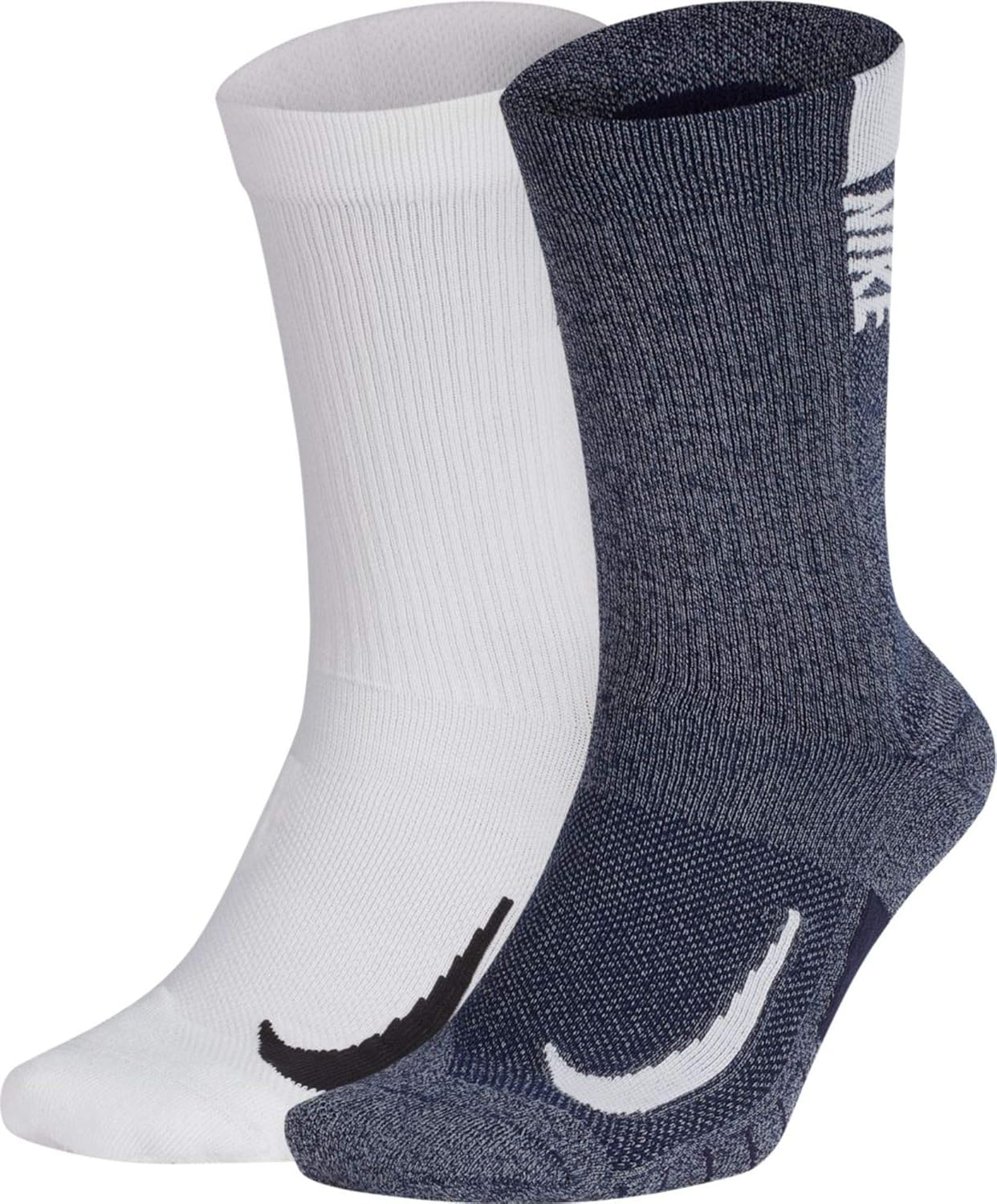
The Nike Multiplier is proof that you do not need to spend 20 euros to get a competent running sock. For around 12 euros (and frequently on sale for less in two or three-packs), you get a sock with Dri-FIT technology that manages moisture effectively, sole cushioning that softens impacts, and a snug fit with arch support. It does not have the premium construction of a Balega or the durability of a Darn Tough, but for the runner who wants a reliable sock without overthinking it, it is an excellent choice. It is sold in two-packs, which further reduces the cost per unit.
- Fabric: Dri-FIT polyester (75%), nylon (23%), elastane (2%)
- Cushioning: Medium across the entire sole
- Height: No-show, ankle, crew
- Moisture management: Good (Dri-FIT is competent without being exceptional)
- Blister prevention: Good (flat seams, good fit)
- Durability: 500-700 km estimated
- Arch support: Medium-support elastic band
- Unbeatable price (6 euros per pair in packs)
- Universal availability: found in any store
- Three heights available
- Dri-FIT works well for standard workouts
- Durability lower than specialist brands
- Cushioning flattens sooner than premium models
- Tends to accumulate odor after a few wears

5 Compressport Pro Racing Socks V4.0 Run
Compressport is a Swiss brand specializing in sports compression, and the Pro Racing V4 is its flagship running sock. It is a high-end technical sock at a surprisingly contained price. Its 3D Dots construction adds micro-massage points on the sole that stimulate circulation and reduce fatigue. The fabric is ultralight and extremely breathable, designed for races and high-intensity training. The arch compression is firm but not aggressive, and the sock includes specific protection for the Achilles tendon and the malleoli (ACSM).
- Fabric: Polyamide (79%), polypropylene (12%), elastane (9%)
- Cushioning: Light with 3D Dots massage zones
- Height: No-show, ankle, crew
- Moisture management: Excellent (ultra-fast drying)
- Blister prevention: Very good (seamless, anatomical fit)
- Durability: 600-800 km estimated
- Arch support: Anatomical 3D compression
- Ultralight and breathable
- 3D Dots technology for circulation
- Excellent performance-to-price ratio
- Specific Achilles tendon protection
- Minimal cushioning: not for those seeking a plush feel
- Sizing can run slightly small
- Compression may irritate sensitive feet
6 Decathlon Kiprun Run900
Decathlon has proven with the Kiprun range that you can manufacture quality running products at prices well below the competition. The Run900 is a sock that, for 8 euros, delivers specifications that others charge double for. It features anatomically differentiated construction for the left and right foot, ventilation zones on the instep, selective cushioning in the heel and metatarsal area, and a compression band around the arch. The fabric is a polyamide and polyester blend that manages moisture competently. It does not have the artisanal construction of a Balega or the premium fabric of a Stance, but at 8 euros it is extremely hard to find anything better.
- Fabric: Polyamide (48%), polyester (40%), elastane (12%)
- Cushioning: Light-medium in heel and metatarsal area
- Height: No-show, ankle
- Moisture management: Good (instep ventilation)
- Blister prevention: Good (anatomical construction, flat seams)
- Durability: 400-600 km estimated
- Arch support: Medium-support elastic band
- Exceptional price: 8 euros for a technical sock
- Anatomical construction (left/right foot)
- Available in any Decathlon store
- Well-placed ventilation zones
- Durability lower than premium brands
- Arch elastic loses tension faster
- Only two heights available
7 Injinji Run Lightweight No-Show
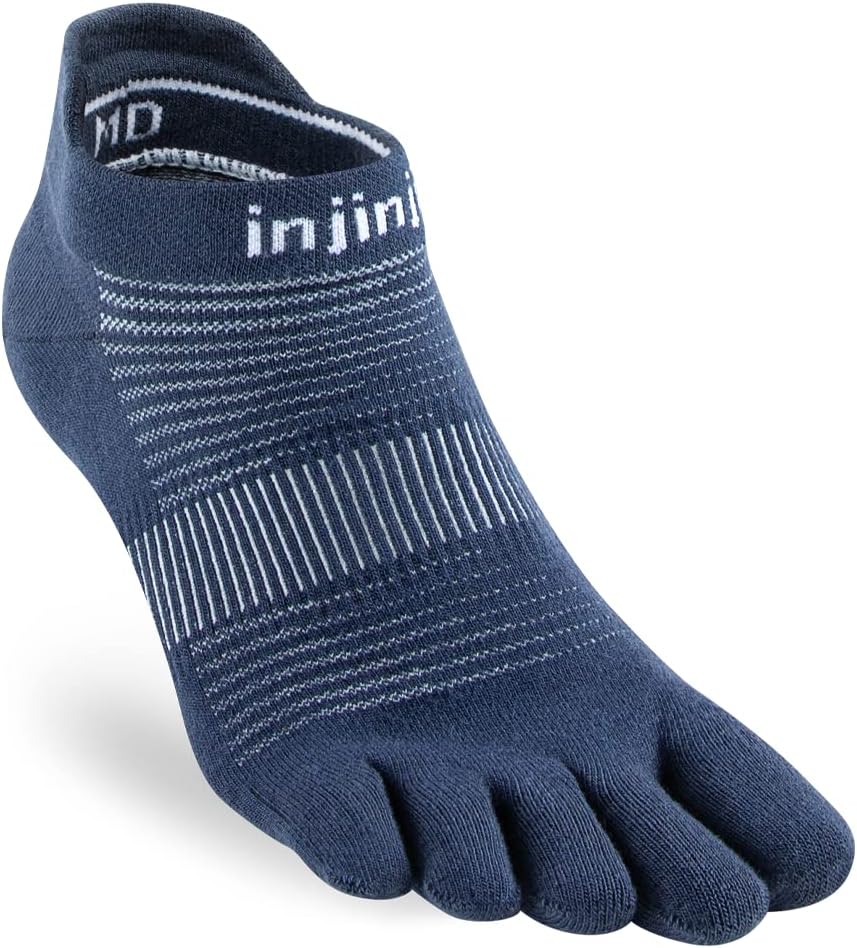
Injinji is the brand that popularized five-toe socks in the running world, and the Run Lightweight is their best-selling model. The concept is simple but effective: each toe has its own compartment, just like a glove. This completely eliminates friction between the toes, which is one of the most common sources of blisters in long-distance runners. Additionally, by separating the toes, it improves the natural alignment of the foot, allows full toe splay during the push-off phase and wicks moisture from the interdigital zones, which are the areas that accumulate the most sweat. The Coolmax fabric keeps feet dry, and the sock is surprisingly thin and comfortable once you get past the adaptation period.
- Fabric: Coolmax (68%), nylon (29%), Lycra (3%)
- Cushioning: Minimal (ultralight)
- Height: No-show, ankle, crew
- Moisture management: Excellent (Coolmax + toe separation improves evaporation)
- Blister prevention: Exceptional between toes, good elsewhere
- Durability: 500-700 km estimated
- Arch support: Light elastic band
- Complete elimination of interdigital blisters
- Improves natural toe alignment
- Superior moisture wicking in the toe zone
- Ideal for ultratrail and long distance
- Adaptation period of 1-2 weeks
- Takes longer to put on than a conventional sock
- Not everyone finds them comfortable

8 CEP The Run Compression Socks
CEP is a German brand with medical origins: it was born from medi, one of the world's largest manufacturers of therapeutic compression stockings. That heritage shows in the quality of compression offered by The Run model, which is the most precise and graduated on the running market. Compression is strongest at the ankle (between 18 and 21 mmHg) and progressively decreases toward the knee, which promotes venous return and reduces blood pooling in the lower extremities. The fabric is a polyamide and elastane blend that provides a snug but breathable fit. The sole cushioning is generous, making them a complete sock for both running and post-run recovery.
- Fabric: Polyamide (85%), elastane (15%)
- Cushioning: Medium-high across the entire sole
- Height: Knee-high compression
- Moisture management: Good (compression can generate slightly more heat)
- Blister prevention: Good (very snug fit reduces movement)
- Durability: 600-800 km estimated (compression degrades gradually)
- Arch support: Strong anatomical compression
- Medical-grade graduated compression (18-21 mmHg)
- Excellent for post-run recovery
- Reduces calf muscle vibration
- Generous sole cushioning
- High price (25 euros per pair)
- Can feel hot in summer
- Putting them on and taking them off requires effort
- Compression loses effectiveness over time
Find the perfect sock for you
We have selected the best running socks available on Amazon with fast shipping and free returns.
View socks on AmazonQuick comparison table
This table summarizes the key characteristics of all 8 socks so you can compare at a glance. If you need more detail on any model, scroll back to the ranking section.
| Model | Price | Main fabric | Cushioning | Height | Durability | Arch |
|---|---|---|---|---|---|---|
| Balega Hidden Comfort | ~16 EUR | Drynamix + Nylon | Medium-high | No-show | 700-900 km | Medium |
| Stance Run Feel 360 | ~20 EUR | Feel360 + Coolmax | Light-medium | No-show / Ankle | 600-800 km | Medium |
| Darn Tough Run No Show | ~22 EUR | Merino + Nylon | Light | No-show / Ankle / Crew | 1,000+ km | High |
| Nike Multiplier | ~12 EUR | Dri-FIT (Polyester) | Medium | No-show / Ankle / Crew | 500-700 km | Medium |
| Compressport Pro Racing V4 | ~15 EUR | Polyamide + Polypropylene | Light | No-show / Ankle / Crew | 600-800 km | High |
| Kiprun Run900 | ~8 EUR | Polyamide + Polyester | Light-medium | No-show / Ankle | 400-600 km | Medium |
| Injinji Run Lightweight | ~15 EUR | Coolmax + Nylon | Minimal | No-show / Ankle / Crew | 500-700 km | Light |
| CEP The Run Compression | ~25 EUR | Polyamide + Elastane | Medium-high | Knee-high compression | 600-800 km | High |
Blister prevention: what actually works
Blisters are every runner's nightmare. According to studies at marathons and ultramarathons, between 30 and 70 percent of participants suffer blisters during the race. It is the most common dermatological problem in running, and also one of the most preventable. The blister formula is simple: friction + moisture + time = blister. Eliminate any of the three factors and you drastically reduce the likelihood.
The role of the sock in prevention
A well-designed running sock attacks all three factors simultaneously. First, it reduces friction thanks to a snug fit that minimizes foot movement inside the shoe and a seamless interior that does not rub the skin. Second, it actively wicks moisture to keep the skin dry and reduce the friction coefficient. Third, it adds a layer of cushioning that absorbs impact and distributes pressure more evenly across the sole.
Complementary strategies
- Petroleum jelly or anti-friction cream: Apply a thin layer to the areas where you tend to get blisters before putting on the sock. It is the simplest and most effective strategy for long distances.
- Anti-friction powder: Talcum powder or running-specific powders absorb moisture and reduce friction. They are especially useful in summer.
- Double sock: Some runners wear a thin liner sock underneath a thicker one. Friction occurs between the two socks rather than between the sock and the skin. Brands like Wrightsock make double-layer socks based on this principle.
- Preventive sports tape: In the highest-friction zones (heel, toe tips, edge of the foot), applying Kinesio tape or specific patches before the race can prevent blisters in specific spots.
- Correct shoe size: An excellent sock cannot compensate for a shoe that is too big or too small. If the foot moves inside the shoe, there will be friction no matter how much you invest in socks.
Toe socks: why and for whom
Five-toe socks, popularized by Injinji, are a product that divides opinions. There are runners who cannot imagine going out without them and others who tried them once and switched back to conventional socks. Both positions are valid, because toe socks are not for everyone.
The principle behind toe socks is eliminating friction between the toes. In a conventional sock, the toes are all together in a single compartment, and when the foot sweats, the toes rub against each other with every stride. This rubbing is the main cause of interdigital blisters, which are especially painful because the skin between the toes is very thin and sensitive.
Who are they ideal for
- Ultratrail and long-distance runners: The more kilometers, the higher the risk of interdigital blisters. In 50, 80 or 100 km races, toe socks can be a lifesaver.
- Runners with overlapping toes or bunions: The individual separation of each toe reduces pressure and friction on feet with deformities.
- Runners prone to blisters between the toes: If you have already tried everything else and still get interdigital blisters, toe socks are the most direct solution.
- Users of minimalist or barefoot shoes: Toe socks complement the natural foot-movement philosophy.
Adaptation period
It is important to know that toe socks require an adaptation period of one to two weeks. The sensation of having fabric between your toes is unusual at first, and some runners find it uncomfortable during the initial wears. The advice is to start using them on short, easy workouts until your brain gets used to the sensation. Do not debut them in a race.
How to care for your running socks
A 20-euro pair of running socks can last 800 km or 300 km depending on how you care for them. Proper care not only extends the life of the sock but maintains its technical properties (moisture wicking, elasticity, cushioning) for longer. This is something every runner should know, just as you know how to care for your running apparel.
Washing
- Temperature: Always in cold water or at 30 degrees maximum. Heat degrades elastic fibers (elastane/Lycra) and shrinks merino wool.
- Inside out: Turn the sock inside out before putting it in the washing machine. This cleans the area in contact with your skin better and protects the exterior from drum wear.
- No fabric softener: Fabric softener leaves a waxy residue on the fibers that drastically reduces moisture-wicking capacity. It is the most common and most damaging mistake you can make with your technical socks.
- No bleach: Bleach destroys elastic fibers and accelerates fabric deterioration.
- Mild detergent: A sports laundry detergent or a mild liquid detergent is ideal. Avoid detergents with aggressive phosphates.
Drying
- Never tumble dry: Dryer heat is the worst enemy of technical socks. It shrinks merino wool, destroys elastane and can deform terry-loop cushioning. Always air dry.
- Lay flat to dry: If you can, dry socks flat on a drying rack or towel. Hanging them by the elastic can deform it over time.
- Away from direct sunlight: UV rays degrade synthetic fibers and fade merino wool. Dry in the shade whenever possible.
Between uses
Ideally, do not wear the same pair of socks two days in a row. Give them at least 24 hours for the elastic fibers to recover their shape and residual moisture to fully evaporate. If you run daily, having a rotation of 3-4 pairs of socks is the minimum recommended. This is not only more hygienic but significantly extends the life of each pair.
When to replace your socks
Running socks do not last forever, even though it sometimes seems like they do. Unlike shoes, where sole wear is visible, socks degrade in less obvious ways. The key is to pay attention to the signs before the loss of sock performance causes you a problem.
Signs that you need new socks
- The fabric is see-through: If you can see skin through the sock at the heel or toe, the fabric is too thin to protect you adequately.
- The elasticity is gone: If the sock no longer hugs the foot, if the arch band does not compress, or if the sock slides down while running, the elastane has degraded.
- New blisters appear: If you start getting blisters where you did not have them before with the same sock and the same shoe, the sock has likely lost its moisture management and friction reduction capabilities.
- The fabric has pilled: Pilling on the interior surface of the sock increases friction and reduces comfort. It indicates that the fabric is reaching the end of its useful life.
- It takes longer to dry: If you notice the sock takes significantly longer to dry than when it was new, the fibers have lost their moisture-wicking properties.
- The cushioning is flat: If comparing the used sock with a new one of the same model you notice the padded area is much thinner, the cushioning has compacted.
How to choose the perfect sock for you
With eight excellent models on the table, the question is which is the best for your specific case. The answer depends on four factors: your type of running, your usual climate, your foot sensitivity and your budget. Here is a quick decision guide so you know exactly which direction to go.
By type of running
- Daily road training: The Balega Hidden Comfort or Nike Multiplier are the most balanced options. Comfort, protection and reasonable durability for everyday use.
- Races and competitions: The Compressport Pro Racing V4 is the race sock par excellence: ultralight, breathable and with technical support without adding weight.
- Long runs and marathons: The Stance Run Feel 360 or Darn Tough with antibacterial merino are ideal for distances where moisture management over several hours is critical.
- Ultratrail and ultra distance: The Injinji Run Lightweight for those who suffer interdigital blisters, or the CEP The Run if you want calf compression for efforts lasting many hours.
By climate
- Summer and heat: Compressport Pro Racing V4, Injinji Run Lightweight or Nike Multiplier in no-show. Prioritize lightness and breathability.
- Winter and cold: Darn Tough with merino wool in ankle or crew. Merino thermoregulates naturally and keeps the foot warm without overheating.
- Year-round: The Balega Hidden Comfort works well in any season thanks to its Drynamix fabric that adapts to different temperatures.
By budget
- Under 10 EUR: The Kiprun Run900 from Decathlon is the only serious option at this price. Do not go any cheaper than that.
- 10-16 EUR: The Nike Multiplier (12 EUR), Compressport Pro Racing V4 (15 EUR) and Balega Hidden Comfort (16 EUR) offer excellent value for money.
- 16-25 EUR: Darn Tough (22 EUR) with their lifetime warranty is the best long-term investment. CEP (25 EUR) if you need compression.
Whatever your choice, remember that a good running sock is one of the most cost-effective investments you can make in your gear. For 15-20 euros you protect your feet over hundreds of kilometers. If you want to see our full selection of running apparel, you will find recommendations for every layer and weather condition.
Shop your running socks
All models in this guide are available on Amazon with fast shipping. Click to see updated prices and choose your size.
View deals on AmazonFrequently asked questions about running socks
Is it worth spending more than 15 euros on running socks?
Yes, absolutely. Good technical running socks cost between 12 and 25 euros and can last between 600 and 1,000 kilometers. The difference compared to a 3-euro cotton sock is enormous in moisture management, blister prevention and arch support. The cost per kilometer is minimal and the benefit in comfort and foot health is very high. That said, models like the Kiprun Run900 (8 EUR) or the Nike Multiplier (12 EUR) prove that you do not need to reach 20 euros to get a competent sock.
Do compression socks really improve performance?
The scientific evidence on direct performance improvement is limited and mixed. What is more supported is that graduated compression can help with post-exercise recovery, reduce muscle vibration during the run and improve the subjective perception of comfort. Many runners notice less calf fatigue on long runs. They are not miraculous, but if you notice a benefit when using them, they are worth it. The CEP The Run is the model with the most precise compression on the market.
How often should you replace running socks?
The average lifespan is 600 to 800 km, although brands like Darn Tough can exceed 1,000 km. Signs of wear include: the heel or toe fabric has become see-through, the arch elasticity is gone, new blisters appear where you did not have them before, the fabric has pilled, and it takes longer to dry. If you notice any of these signs, it is time to replace them.
Do toe socks prevent blisters between the toes?
Yes. Five-toe socks like Injinji eliminate direct friction between the toes, which is one of the most common causes of blisters in long-distance running. By wrapping each toe individually, they improve interdigital moisture wicking. They require an adaptation period of one to two weeks, but many ultramarathoners consider them essential.
Can I wear cotton socks for running?
Not recommended. Cotton absorbs moisture but does not wick it, leaving your feet soaked. This multiplies friction, softens the skin and drastically increases the risk of blisters, fungal infections and athlete's foot. Synthetic fibers (nylon, polyester, Coolmax) or merino wool actively wick moisture and keep the foot dry. The difference is enormous, especially beyond 10 km.
What sock height is best for running?
It depends on the time of year and your preference. No-show socks are ideal for summer and short races. Ankle socks are the most versatile for year-round use. Crew socks protect on trails against pebbles and debris. Knee-high compression socks are used more for recovery or very long runs. Most runners have at least two different heights. For daily road training, ankle is the safe bet.
Do running socks need special washing?
If you want them to last: machine wash in cold water (30 degrees maximum), inside out, no fabric softener and no tumble dryer. Fabric softener leaves a residue that reduces moisture wicking, and dryer heat degrades elastic fibers and shrinks merino wool. Air dry in the shade. If you care for them this way, good running socks will easily last more than a year of regular use.
Break in your new gear on a group run
Find runners near you and put your equipment to the test in good company. Free.
Join 1,100+ runners
Running tips in your inbox
Routes, training plans and tips to run better. No spam.
We respect your privacy. Unsubscribe anytime.