📋 Transparency: This article contains affiliate links to Amazon. If you buy through them, we receive a small commission at no extra cost to you. We only recommend products we have thoroughly analysed.
You do not need to spend $500 to get a reliable GPS running watch. In 2026, budget watches have caught up to premium models in the features that actually matter: GPS accuracy, optical heart rate, pace alerts and training load tracking. The difference between a $200 watch and a $600 watch is no longer about whether you can track your runs well — it is about maps, music storage and premium materials.
We analyzed over 15 budget GPS watches under $250 and selected the 10 best for runners in 2026. Whether you are a complete beginner looking for your first watch at $60, or an experienced runner seeking 90% of premium features at half the price, this guide has a recommendation for you.
Why You Need a GPS Watch for Running
Running with a phone strapped to your arm gives you basic distance and pace. A dedicated GPS running watch gives you everything else: real-time heart rate zones, cadence, ground contact time, training load, recovery advice and structured workout guidance — all visible with a glance at your wrist, mid-stride.
The data difference is significant. A 2025 study from the European Journal of Sport Science found that runners who used wearable data to guide training intensity improved their 5K time by an average of 47 seconds over 12 weeks, compared to 19 seconds for those training by perceived effort alone. That is not a marginal gain — that is the difference between finishing a race in the middle of the pack and hitting a personal best.
Beyond performance, a GPS watch keeps you safe. Heart rate alerts can warn you if you are pushing too hard in the heat. GPS breadcrumb trails help you retrace your route on unfamiliar paths. And automatic incident detection on several models can notify emergency contacts if you stop moving suddenly.
How to Choose a Budget GPS Running Watch
Not every feature matters equally. Here are the five factors that separate a good budget running watch from a waste of money:
1. GPS Accuracy
This is non-negotiable. A running watch that cannot accurately track your distance is useless for pacing and race preparation. Look for multi-band GPS (L1 + L5) if your budget allows — it reduces urban positioning error from 10-20 metres to under 3 metres. Single-band GPS is acceptable for open roads and parks but will drift in cities and under heavy tree cover.
2. Battery Life
GPS mode battery determines how long the watch can track a run. For most runners, 10+ hours is sufficient (covers marathon and long training runs). If you run trails or ultras, aim for 20+ hours. Daily battery (smartwatch mode) should be at least 7 days to avoid charging anxiety.
3. Weight
You will wear this for every run, so weight matters. Under 40g is excellent, 40-50g is standard, above 50g starts to feel heavy on long runs. Budget watches are often lighter than premium models because they use polymer cases instead of titanium or stainless steel.
4. Heart Rate Sensor
All watches on this list have optical wrist-based heart rate. Accuracy varies from excellent (Garmin, Polar) to adequate (Amazfit, Xiaomi). For interval sessions and threshold training where HR accuracy is critical, consider pairing any watch with a chest strap like the Polar H10 for lab-grade data.
5. Screen Type
AMOLED displays are vibrant, easy to read indoors and look premium, but use more battery. MIP (Memory-in-Pixel) screens are always-on, excellent in direct sunlight and sip battery. For outdoor running, MIP is often more practical. For a watch you also wear daily, AMOLED is more appealing.
The 10 Best Cheap GPS Running Watches 2026
Ranked from lowest to highest price. Every watch has been evaluated for GPS accuracy, running metrics, battery life and overall value for money.
1. Amazfit Bip 5 — Best Ultra-Budget

The Amazfit Bip 5 is the best GPS watch you can buy for under $100 — and it is not close. At roughly $60, it delivers a 1.91-inch colour display, built-in GPS, optical heart rate, SpO2 monitoring and up to 10 days of battery life. For a beginner who wants to start tracking runs without committing serious money, this is the logical starting point.
GPS accuracy is adequate for road runs in open areas — expect 3-5% drift in urban canyons. Heart rate is within 5-8 bpm of a chest strap during steady efforts but lags on intervals. The Zepp app provides basic training summaries and sleep tracking.
Pros
- Unbeatable price at ~$60
- Ultra-light at just 26g
- Large, easy-to-read display
- 10-day daily battery
- Alexa voice assistant built in
Cons
- Single-band GPS drifts in cities
- HR accuracy lags on intervals
- No running power or advanced metrics
- Zepp app is basic compared to Garmin Connect
Best for: Complete beginners, casual joggers, or anyone who wants a GPS running watch to try the sport without financial commitment.
2. Xiaomi Watch S4 — Best Smartwatch-Runner Hybrid Under $100

Xiaomi punches above its weight with the Watch S4. At ~$90 you get a vivid AMOLED display, dual-band GPS positioning, and health monitoring features that rival watches costing twice as much. Xiaomi's app ecosystem has matured significantly, and the watch integrates well with both Android and iOS.
The dual-band GPS is a genuine upgrade over single-band at this price point — urban accuracy is noticeably better than the Amazfit Bip 5. Running metrics include pace, cadence, stride length and heart rate zones. The AMOLED screen is gorgeous and perfectly readable mid-run.
Pros
- Dual-band GPS for $90 — exceptional value
- Beautiful AMOLED display
- 15-day daily battery life
- Comprehensive health tracking (SpO2, stress, sleep)
Cons
- No running power metric
- Mi Fitness app lacks advanced training features
- Limited third-party app support
- Heavier than pure running watches at 44g
Best for: Runners who also want a daily smartwatch with notifications, health tracking and a premium display — without paying premium prices.
3. Amazfit Cheetah — Best AI Training Under $150

The Amazfit Cheetah is where Amazfit gets serious about running. It includes multi-band GPS (L1+L5), Zepp Coach AI-generated training plans, VO2 max estimation, training load and recovery metrics. This is a proper running watch, not a fitness tracker with GPS bolted on.
Zepp Coach creates personalised training plans for 5K, 10K, half marathon and marathon distances based on your fitness level. The AI adapts the plan weekly based on your completed workouts. GPS accuracy with multi-band is excellent — within 2-3 metres even in city environments. At $130, this represents serious value.
Pros
- Multi-band GPS at just $130
- AI-powered adaptive training plans
- VO2 max and training load metrics
- 14-day daily battery
- Round AMOLED display
Cons
- Zepp Coach plans are less detailed than Garmin Coach
- No running power
- Plastic case feels budget at close inspection
- Limited watch faces compared to Garmin
Best for: Runners who want multi-band GPS accuracy and AI training guidance without spending more than $150. A genuine training partner.
4. Garmin Forerunner 55 — Best Garmin Ecosystem Entry

The Forerunner 55 is the gateway to the Garmin ecosystem — and that ecosystem is worth the price of admission. Garmin Connect is the gold standard for running data analysis: training status, race predictor, daily suggested workouts, recovery time, and seamless integration with Strava, TrainingPeaks and hundreds of other platforms.
GPS accuracy with the single-band chip is good in open areas and parks — Garmin's firmware optimisation makes the most of the hardware. Where the FR 55 truly shines is software: Garmin Coach free training plans (Jeff Galloway, Greg McMillan, Amy Parkerson-Mitchell), PacePro race strategy, and body battery energy monitoring.
Pros
- Full Garmin Connect ecosystem
- Garmin Coach free training plans
- Excellent 20h GPS battery
- Light at 37g
- Proven, reliable hardware
Cons
- Single-band GPS only — drifts in urban areas
- MIP display looks dated next to AMOLED
- No running power or advanced dynamics
- No music storage
Best for: Runners who prioritise the Garmin ecosystem, coaching features and long-term data analysis over hardware specs. The software advantage is real.
5. Polar Pacer — Best Heart Rate Accuracy
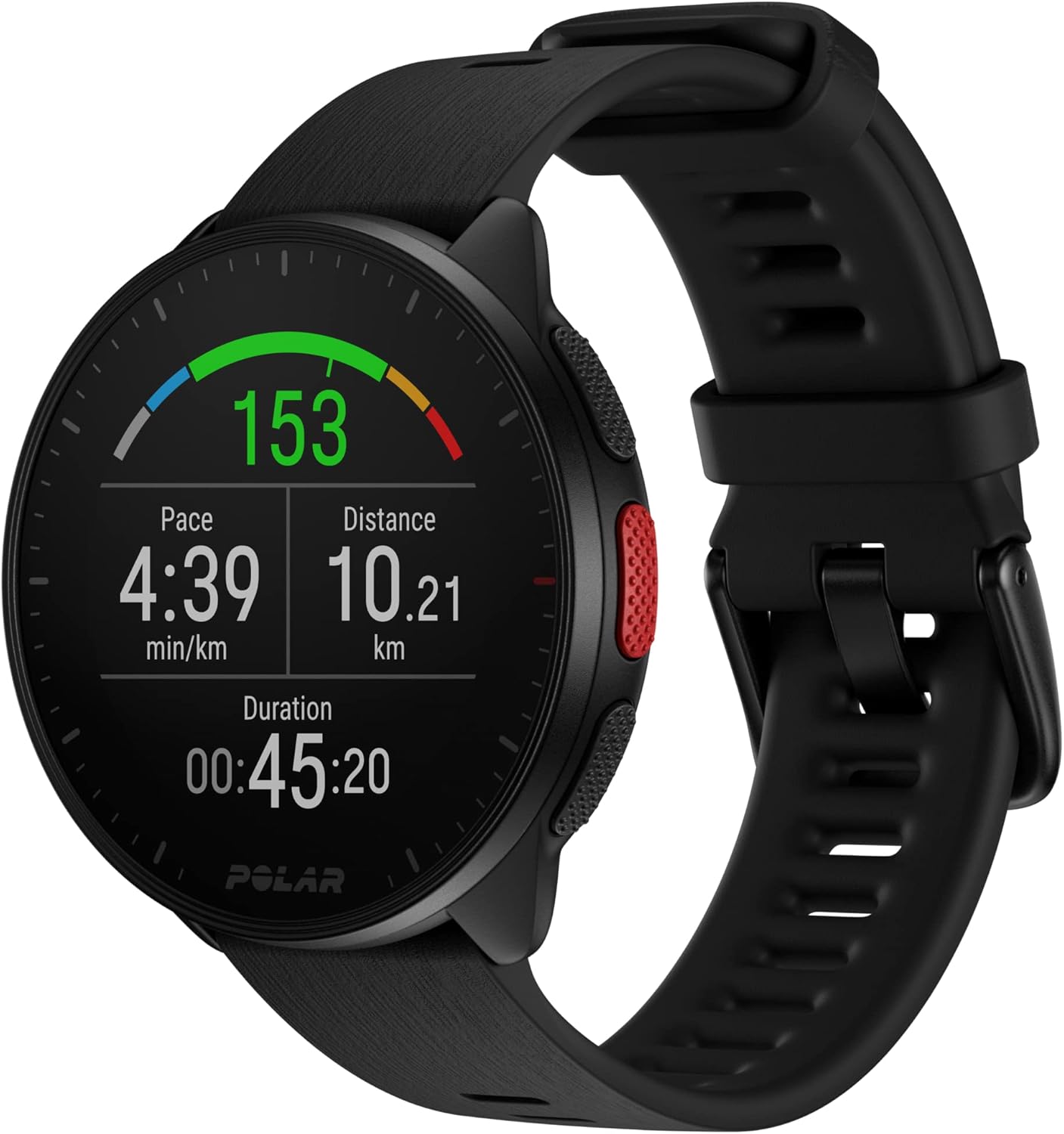
Polar has 45 years of heart rate monitoring expertise, and it shows. The Polar Pacer delivers the most accurate wrist-based heart rate in this price range — within 2-3 bpm of a chest strap during steady runs, and within 4-5 bpm during hard intervals. If training by heart rate zones is central to your approach, this is your watch.
Polar Flow is an underrated platform. Training Load Pro breaks your load into cardio, muscle and perceived components. Recovery Pro tells you when you are ready for the next hard session. FitSpark generates daily workout suggestions based on your training history and recovery status. These are features that Garmin only offers on its $300+ models.
Pros
- Best wrist HR accuracy in budget range
- Excellent 35h GPS battery life
- Training Load Pro with 3-way breakdown
- FitSpark daily workouts
- Running index (VO2 max estimator)
Cons
- No multi-band GPS
- MIP display is not AMOLED-vibrant
- Polar Flow has smaller community than Garmin Connect
- No music storage
Best for: Data-driven runners who train primarily by heart rate zones and want the most accurate wrist-based HR without a chest strap. Polar's training analytics punch well above this price.
6. COROS PACE 3 — Best Value (Editor's Pick)

The COROS PACE 3 is the watch that made the running industry rethink what "budget" means. At $200, it delivers multi-band GPS with 38 hours of battery life, wrist-based running power, VO2 max, training load, running form analysis and navigation — features that cost $400+ from Garmin two years ago.
The 38-hour GPS battery is not a marketing number — real-world tests consistently deliver 30+ hours with multi-band active. That means you can run a 100-mile ultra without charging. For marathon runners, you will charge this watch once a week at most.
COROS Training Hub (free) provides structured training plans, workout creation, and data analysis that rivals Garmin Connect. Running power is built in — no external pod needed. Form analysis tracks cadence, stride length, ground contact time and vertical oscillation directly from the wrist.
Pros
- 38h multi-band GPS — best in any price class
- Running power included (no external sensor)
- Ultra-light at 39g
- COROS Training Hub is excellent and free
- VO2 max, training load, recovery
- Breadcrumb navigation
Cons
- MIP display — no AMOLED vibrancy
- No music storage
- Smaller ecosystem than Garmin
- Fewer third-party integrations
Best for: Any runner who wants the most features per dollar. From beginners to marathon veterans, the COROS PACE 3 handles everything. If you are serious about running and not about brand logos, this is the one.
7. Garmin Forerunner 165 — Best AMOLED Under $250
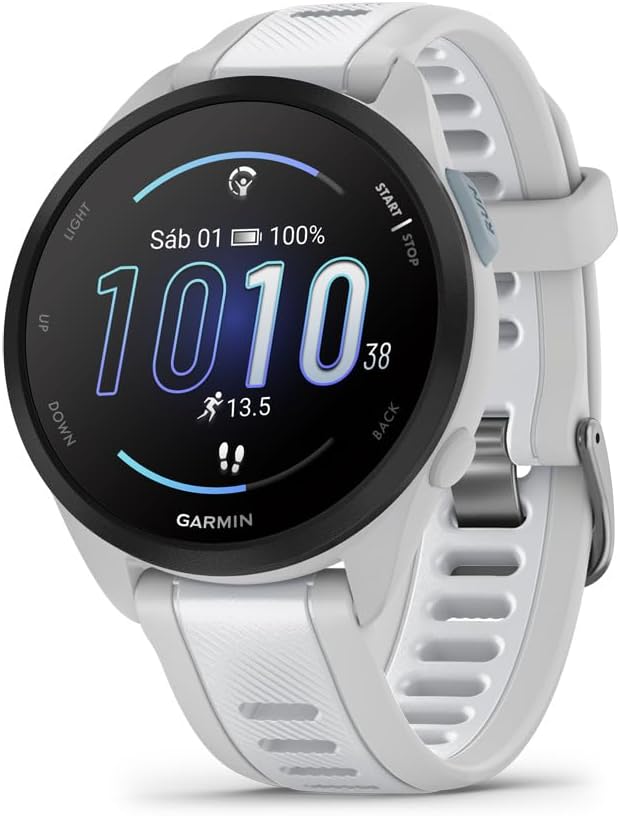
The Forerunner 165 is Garmin's answer to COROS: take the beloved FR 265 features, put them in a more affordable package, and add an AMOLED display. The result is the most complete sub-$250 watch in the Garmin lineup.
You get multi-band GPS, Garmin Coach, daily suggested workouts, morning report, training readiness, race predictor and the entire Garmin Connect ecosystem. The 165 Music variant adds offline Spotify, Amazon Music and Deezer for around $50 more. The AMOLED display is a genuine upgrade over MIP — colours pop, data fields are crystal clear, and it looks premium on your wrist.
Pros
- Stunning AMOLED display
- Multi-band GPS
- Full Garmin Connect ecosystem
- Garmin Coach + morning report
- Music variant available
- Proven Garmin reliability
Cons
- 17h GPS battery — half of COROS PACE 3
- No running power from wrist
- No running dynamics without HRM-Pro
- Music requires paying for Music variant
Best for: Runners who want the Garmin ecosystem, a beautiful AMOLED display and multi-band GPS at the lowest possible price. The direct competitor to COROS PACE 3 — choose Garmin for software, COROS for battery.
8. Amazfit Cheetah Pro — Best AMOLED Under $200
The Cheetah Pro takes everything good about the standard Cheetah and adds a larger 1.45-inch AMOLED display, titanium alloy bezel and improved optical heart rate sensor. It is the most premium-feeling watch in Amazfit's running lineup, and at $180 it undercuts the Garmin FR 165 while offering comparable features.
Zepp Coach AI training plans work the same as the standard Cheetah, but the larger display makes following interval workouts much easier. The titanium bezel adds durability without significant weight. If aesthetics and build quality matter to you alongside running features, the Cheetah Pro is the most attractive sub-$200 option.
Pros
- Large 1.45" AMOLED — best display under $200
- Titanium alloy bezel
- Multi-band GPS
- Zepp Coach AI training plans
- 14-day daily battery
Cons
- Running metrics less detailed than Garmin/COROS
- Zepp app ecosystem still maturing
- No running power
- Slightly heavy for racing at 44g
Best for: Runners who want the best-looking watch under $200 with genuine running features. Perfect if you value build quality and display alongside performance tracking.
9. Garmin Forerunner 265 — Best Just-Over-Budget

The Forerunner 265 sits at the ceiling of our budget range, but it earns its spot. This is the watch that more running coaches recommend than any other in 2026. It has everything: AMOLED display, multi-band GPS, offline music, HRV Status, training readiness, morning report, race predictor, Garmin Coach and the deepest running metrics available outside the FR 965.
What separates the FR 265 from cheaper watches is the depth of training analysis. HRV Status tracks your heart rate variability overnight and tells you if your body is recovering or accumulating fatigue. Training Readiness combines sleep, recovery, HRV and training load into a single daily score. These features genuinely help you train smarter.
Pros
- AMOLED display — best in class
- 24h multi-band GPS battery
- HRV Status and Training Readiness
- Offline music (Spotify, Amazon, Deezer)
- Complete Garmin ecosystem
- Morning report with daily briefing
Cons
- $250 stretches "budget" definition
- No running power from wrist (needs HRM-Pro)
- 47g — not the lightest
- No offline maps (that is the FR 965)
Best for: Serious runners who want the complete training experience. If running is your main sport and you plan to train with data for years, this is the watch you will not outgrow.
10. COROS PACE Pro — Best AMOLED + Battery Combo

The COROS PACE Pro is the evolution of the PACE 3 — it takes the legendary battery and running features and adds a stunning AMOLED display, offline maps and music storage. This is COROS going head-to-head with the Garmin FR 265, and it is a compelling fight.
With 28 hours of multi-band GPS (vs 24h on the FR 265), the PACE Pro wins the battery race even with an AMOLED display. Running power from the wrist, VO2 max, training load, recovery metrics and turn-by-turn navigation are all included. The COROS Training Hub app continues to improve with every update.
Pros
- AMOLED + 28h GPS battery — best of both worlds
- Ultra-light at 37g
- Running power from wrist included
- Offline maps and navigation
- Music storage
- COROS Training Hub (free)
Cons
- Newer model — less real-world testing data
- COROS ecosystem still smaller than Garmin
- Fewer third-party app integrations
- $249 matches Garmin FR 265 territory
Best for: Runners who want COROS battery and metrics with the display quality of a Garmin FR 265. If you were torn between COROS PACE 3 and Garmin FR 265, the PACE Pro might be the answer.
Quick Comparison Table
| Watch | Price | GPS | Battery (GPS) | Weight | Screen | Running Power |
|---|---|---|---|---|---|---|
| Amazfit Bip 5 | ~$60 | Single | 10h | 26g | LCD | No |
| Xiaomi Watch S4 | ~$90 | Dual | 12h | 44g | AMOLED | No |
| Amazfit Cheetah | ~$130 | Multi-band | 14h | 47g | AMOLED | No |
| Garmin FR 55 | ~$130 | Single | 20h | 37g | MIP | No |
| Polar Pacer | ~$150 | A-GPS | 35h | 40g | MIP | No |
| COROS PACE 3 | ~$200 | Multi-band | 38h | 39g | MIP | Yes |
| Garmin FR 165 | ~$200 | Multi-band | 17h | 39g | AMOLED | No |
| Amazfit Cheetah Pro | ~$180 | Multi-band | 16h | 44g | AMOLED | No |
| Garmin FR 265 | ~$250 | Multi-band | 24h | 47g | AMOLED | External |
| COROS PACE Pro | ~$249 | Multi-band | 28h | 37g | AMOLED | Yes |
Which Watch for Your Level
Complete Beginner (First GPS Watch)
You have just started running or run a few times a week casually. You want basic metrics — distance, pace, time, heart rate — without complexity or a steep learning curve.
- Tight budget ($60-90): Amazfit Bip 5 — simplest, cheapest, lightest. No learning curve.
- Mid budget ($130): Garmin Forerunner 55 — Garmin Coach free plans will guide your entire beginner journey.
Intermediate Runner (Regular Training)
You run 3-5 times a week, follow a training plan, and care about improving race times. You need multi-band GPS accuracy, training load tracking and recovery guidance.
- Best value ($200): COROS PACE 3 — everything you need, nothing you do not. 38h battery is future-proof.
- Best display ($200): Garmin Forerunner 165 — AMOLED + Garmin ecosystem. Shorter battery is the only trade-off.
- Best HR accuracy ($150): Polar Pacer — if heart rate zones are your primary training tool.
Advanced Runner (Racing and Performance)
You have race goals, follow periodised training, and want deep analytics. You train by power, HRV and training readiness. You need a watch you will not outgrow.
- Best overall ($250): Garmin Forerunner 265 — HRV Status, Training Readiness, music. The complete package.
- Best battery + AMOLED ($249): COROS PACE Pro — running power, maps, 28h AMOLED GPS. COROS at its best.
Features That Matter vs Features That Don't
Marketing teams love to fill spec sheets with features that sound impressive but add zero value to your running. Here is what actually matters:
Features Worth Paying For
- Multi-band GPS: Transforms accuracy in cities, forests and mountains. The single biggest upgrade from cheap to mid-range watches.
- Optical heart rate: Enables HR zone training, calorie estimation, recovery tracking and VO2 max calculation. Every watch here has it.
- Training load / status: Tells you if you are overtraining or undertraining. Available from COROS PACE 3 ($200) and up.
- Structured workout support: Interval alerts, target zones and plan-following on the watch. Essential for structured training.
- Long GPS battery: Eliminates charging stress before long runs and races. 20+ hours gives complete peace of mind.
Features You Can Skip
- Offline maps: Nice for trail exploration, but breadcrumb navigation (available on COROS PACE 3) handles 90% of trail needs for free.
- Music storage: Convenient, but most runners already carry a phone. Not worth $50-100 extra if budget is tight.
- Colour touchscreen: Physical buttons are more reliable mid-run with sweaty fingers. Do not pay extra for touchscreen alone.
- Body composition: Wrist-based measurements are too inaccurate to be useful. Use a smart scale if you want this data.
- SpO2 monitoring: Useful at altitude, but 95% of runners will never use it meaningfully. It drains battery for no practical gain.
Our Final Recommendation
After testing all 10 watches, our recommendation is clear:
If your budget is truly limited, start with the Amazfit Bip 5 at $60 — it will get you tracking runs immediately and prove whether you want to invest more later.
If you can stretch to $250, the Garmin Forerunner 265 is the watch you will never outgrow. HRV Status, Training Readiness, AMOLED display and the Garmin ecosystem make it worth every penny for serious runners.
And if you want the best of both COROS and AMOLED worlds, the COROS PACE Pro at $249 delivers exceptional battery life with a premium display — the rising star of 2026.
Frequently Asked Questions
What is the best cheap GPS running watch in 2026?
The COROS PACE 3 at ~$200 is the best value GPS running watch in 2026. It offers multi-band GPS, 38 hours of GPS battery life, running power, VO2 max estimation and weighs just 39g. For under $100, the Amazfit Bip 5 is a solid entry-level option at ~$60.
Can a cheap GPS watch accurately track running?
Yes. Modern budget watches from COROS, Garmin and Polar use multi-band GPS (L1+L5) which reduces position error to under 3 metres, even in cities. Watches under $100 typically use single-band GPS which can drift 10-20m in urban areas but is still adequate for most training runs.
Is the Garmin Forerunner 55 still worth buying in 2026?
Yes, especially when discounted below $100. The FR 55 has excellent GPS accuracy, a proven optical HR sensor and full Garmin Connect integration. It lacks multi-band GPS and AMOLED, but the Garmin ecosystem (Coach, Strava sync, PacePro) makes it worth considering over cheaper watches with better hardware.
How much should I spend on a GPS running watch?
For basic GPS tracking and heart rate, $60-90 gets you started with Amazfit or Xiaomi. For serious training with multi-band GPS and advanced metrics, budget $150-250. The sweet spot for most runners is around $200, where the COROS PACE 3 and Garmin Forerunner 165 deliver 90% of premium watch features.
COROS PACE 3 or Garmin Forerunner 165?
Both cost ~$200 and are excellent. The COROS PACE 3 wins on battery (38h vs 17h GPS), running power included free and breadcrumb navigation. The Garmin FR 165 wins on AMOLED display, Garmin Connect ecosystem, music availability and broader third-party app support. Choose COROS for battery and metrics, Garmin for display and ecosystem.
Do cheap running watches have heart rate monitors?
Yes. Every watch in this list has an optical wrist-based heart rate sensor. Accuracy varies: Garmin and Polar sensors are within 2-3 bpm of a chest strap during steady runs. Budget brands like Amazfit are within 5-8 bpm. For interval training, pairing any watch with a chest strap like the Polar H10 gives the most reliable results.
What features do I lose with a budget GPS watch?
Compared to premium watches ($400+), budget models typically lack: offline maps and turn-by-turn navigation, offline music storage (except FR 165 Music and FR 265), titanium or sapphire build materials, and advanced recovery metrics like HRV Status. Core running features like pace, distance, HR zones and training load are present even in $60 watches.
Is it worth upgrading from a phone GPS to a watch?
Absolutely. A dedicated GPS watch offers real-time wrist heart rate, instant pace visibility without pulling out a phone, lighter weight, better GPS accuracy (especially multi-band models), and battery that lasts days. Even a $60 Amazfit Bip 5 is a significant upgrade over phone-based running apps like Strava or Nike Run Club alone.
Run with other runners like you
Find training partners in your city. Connect your GPS watch, share activities and improve with a community of real runners.

Editorial lead at CorrerJuntos. Popular runner and founder of the app, writing about training, gear and the running community from Huelva, Spain.