📋 Transparency: This article contains affiliate links to Amazon. If you buy through them, we receive a small commission at no extra cost to you. We only recommend products we have thoroughly analysed.
A GPS running watch is not just a stopwatch with a map. It is your personal coach, performance analyst and recovery guide — all on your wrist. Runners who train with data improve 23% faster than those who run by feel, according to studies from Garmin Connect and Strava.
The market is overwhelming: Garmin has 15+ models, COROS has disrupted the space, Apple Watch dominates smartwatches and Polar remains the benchmark for training metrics. We analysed over 20 watches and selected the 8 best for runners in 2026 — from premium to real multi-band GPS under €230.
How to choose a GPS running watch
- Multi-band GPS (L1+L5): reduces positioning error to under 3 m in cities. Without it, drift can reach 15-20 m under buildings or trees. All models in this list have it.
- GPS battery: minimum 15 hours for most runners. For ultra-trail, look for 30+. Multi-band GPS uses 30-40% more battery than standard.
- Optical heart rate: accuracy varies. Garmin Elevate 5 and COROS are the most reliable on the wrist. For max accuracy, use a chest strap.
- Training metrics: VO2 max, training load, recovery status and daily suggestions are the most useful.
- Weight: under 50 g is ideal. Above 60 g you notice it on long runs.
- Display: AMOLED is vivid but drains battery. MIP is perfect in direct sunlight and uses less power.
Top 8 Best GPS Running Watches 2026
1. Garmin Forerunner 265 — Best overall GPS running watch

🏉 Ideal for: intermediate and advanced runners, marathon, half marathon, structured training
The Forerunner 265 is the watch we recommend to most runners. The 1.3” AMOLED display is bright and sharp even in direct sunlight, multi-band GPS delivers excellent accuracy (under 10 m drift even between buildings) and the training metrics are the most comprehensive on the market at this price.
What sets it apart is the combination of Training Readiness (0-100 daily score based on HRV, sleep and previous load), Daily Suggested Workouts (adapted to your current fitness) and HRV Status (long-term heart rate variability tracking). These three features together form the most complete coaching system under €500.
Offline music from Spotify, Deezer or Amazon Music is a huge advantage for runners who leave their phone at home. Garmin Pay lets you pay without a wallet. With 24 hours of GPS battery, it handles any marathon with room to spare.
✅ Pros
- Bright, sharp AMOLED display
- Most complete training metrics
- Offline music (Spotify/Deezer)
- Very accurate multi-band GPS
- 47 g — light for all it offers
❌ Cons
- No turn-by-turn maps
- High price (~€420)
- Shorter battery vs COROS/Polar
- Relies on Garmin Connect ecosystem
2. COROS PACE 3 — Best value GPS running watch

🏉 Ideal for: runners seeking maximum value, ultralight watches, long battery, first serious GPS watch
COROS has disrupted the market with the PACE 3: 39 grams with nylon band, 38 hours of GPS battery and comprehensive training metrics for €230. On paper, it matches or beats the Garmin FR 265 in the features that matter most for running — at half the price.
The digital crown lets you navigate menus without touching the screen with sweaty fingers. Metrics include VO2 max, training load, native Running Power without accessories, running form analysis and adaptive training plans in the free COROS Training Hub — which is excellent.
The weakness vs Garmin is the MIP display: less visually impressive than AMOLED, but perfectly readable in direct sunlight. No offline music, smaller app ecosystem. But for pure running, it is unbeatable at its price.
✅ Pros
- 38h GPS battery — best in class
- 39 g — ultralight
- Native Running Power
- Free COROS Training Hub
- Unbeatable price (~€230)
❌ Cons
- MIP display (not AMOLED)
- No offline music
- Smaller app ecosystem
- Limited smartwatch features
3. Garmin Forerunner 965 — Best premium GPS watch with maps

🏉 Ideal for: advanced runners, trail, triathlon, turn-by-turn navigation with integrated maps
Garmin's flagship running watch includes everything in the FR 265 plus colour TopoActive maps with turn-by-turn navigation, a titanium DLC bezel, a 1.4” AMOLED display and 31 hours of GPS battery. The most complete watch for runners who also trail.
Plan routes in Garmin Connect, Komoot or Strava, send them to the watch and follow turn-by-turn instructions in real time. The map shows elevation, the drawn route and points of interest with hiking GPS detail. Essential for trail in unfamiliar terrain. All advanced metrics from FR 265 plus trail-specific analysis included.
✅ Pros
- TopoActive maps with turn-by-turn
- Best AMOLED (1.4")
- Most complete Garmin metrics
- Titanium DLC bezel
- 31h multi-band GPS
❌ Cons
- Very high price (~€570)
- 53 g — heavier than COROS/Polar
- For 90% of runners, FR 265 is enough
4. Garmin Forerunner 165 — Best GPS watch for beginners
🏉 Ideal for: first GPS watch, beginners, casual runners, running gift
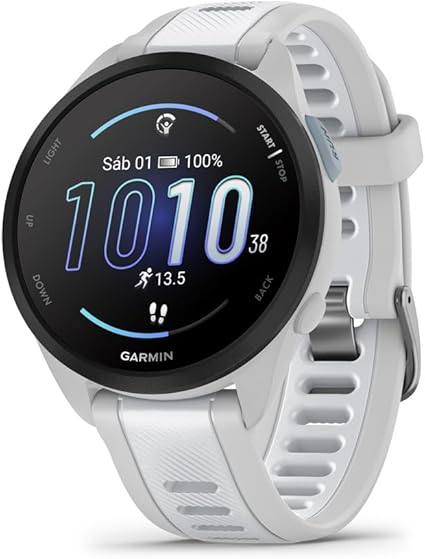
The FR 165 is the first Garmin with an AMOLED display under €300. Previously that vivid, bright display was exclusive to €400+ models. In a 39 g watch it is perfect for getting started, with everything a beginner needs: multi-band GPS, optical HR, VO2 max, daily training suggestions, Body Battery and adaptive training plans.
✅ Pros
- AMOLED under €300
- Very light (39 g)
- Adaptive Garmin training plans
- Body Battery + Stress tracking
- Mature Garmin Connect ecosystem
❌ Cons
- 19h GPS (tight for ultras)
- No offline music
- No full Training Readiness
- No maps
5. Apple Watch Ultra 2 — Best smartwatch for runners
🏉 Ideal for: iPhone users, one watch for everything, triathlon, adventure sports
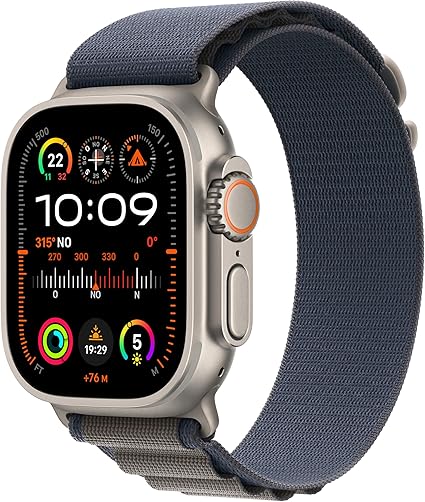
If you live in the Apple ecosystem, the Ultra 2 is the best option for one watch for everything: running, daily smartwatch, payments, notifications, calls and apps. The 3,000-nit display is the brightest on the market. Running Power with watchOS 10+, accurate multi-band GPS, VO2 max and the Action Button for lapping without looking down.
✅ Pros
- Best smartwatch available
- 3,000-nit display — unmatched
- Accurate multi-band GPS
- Native Running Power (watchOS 10+)
- 100 m water resistance
❌ Cons
- iPhone only
- Short GPS battery (~17h)
- Very high price (~€850)
- 61 g — heaviest in this list
6. Polar Pacer Pro — Best training metrics

🏉 Ideal for: data-driven runners, structured training, trail, active recovery
Polar has the strongest reputation in HR accuracy and training metrics, and the Pacer Pro upholds it. 35 hours of GPS, only 36 grams, native Running Power, Hill Splitter, FuelWise (in-run nutrition alerts) and Orthostatic Test for autonomic nervous system recovery. Polar Flow offers the most personalised adaptive training plans on the market.
✅ Pros
- Running Power + FuelWise unique
- 35h GPS battery
- 36 g — lightest in this list
- Polar Flow: highly personalised plans
- Competitive price (~€250)
❌ Cons
- MIP display
- No offline music
- Basic smartwatch
- Less visually premium
7. Suunto Race S — Best design and display at its price

🏉 Ideal for: runners wanting AMOLED + long battery, premium design on a mid-range budget
Unique proposition: 1.69” AMOLED (largest in this comparison), offline maps with route navigation, in a 34-gram body for €299. The most visually impressive mid-range running watch available. Training metrics are more basic than Garmin or Polar, but if design, display and maps are your priority under €300, it is hard to beat.
✅ Pros
- AMOLED 1.69" — largest here
- Offline maps included
- 34 g — ultralight
- Premium elegant design
- 26h multi-band GPS
❌ Cons
- Basic training metrics
- Limited Suunto ecosystem
- No offline music
- App less complete than Garmin/Polar
8. Amazfit T-Rex Ultra — Best for extreme adventure

🏉 Ideal for: extreme trail, outdoor adventure, runners who need maximum durability
50 hours of multi-band GPS, MIL-STD-810H certification (extreme resistance to shock, temperature and pressure) and 100 m water resistance for €299. The most extreme durability proposition on the market. Includes offline maps, barometric altimeter, compass and wrist temperature. Running metrics are basic — this is a survival watch first, running watch second.
✅ Pros
- 50h multi-band GPS — longest here
- Extreme MIL-STD-810H durability
- 100 m water resistance
- Offline maps included
- Competitive price (~€300)
❌ Cons
- 66 g — heaviest in this list
- Basic training metrics
- Limited Amazfit ecosystem
- Bulky for everyday wear
Full comparison: 8 best GPS running watches 2026
| Watch | Price | GPS Battery | Weight | Display | Maps | Music | Score |
|---|---|---|---|---|---|---|---|
| Garmin FR 265 | ~€419 | 24 h | 47 g | AMOLED 1.3" | No | Yes | 9.0 |
| COROS PACE 3 | ~€230 | 38 h | 39 g | MIP 1.2" | No | No | 8.7 |
| Garmin FR 965 | ~€569 | 31 h | 53 g | AMOLED 1.4" | Yes | Yes | 9.2 |
| Garmin FR 165 | ~€289 | 19 h | 39 g | AMOLED 1.2" | No | No | 8.2 |
| Apple Watch Ultra 2 | ~€849 | ~17 h | 61 g | OLED 49mm | Yes | Yes | 8.2 |
| Polar Pacer Pro | ~€250 | 35 h | 36 g | MIP 1.2" | No | No | 8.7 |
| Suunto Race S | ~€299 | 26 h | 34 g | AMOLED 1.69" | Yes | No | 8.5 |
| Amazfit T-Rex Ultra | ~€299 | 50 h | 66 g | AMOLED 1.39" | Yes | No | 8.4 |
Buying guide by runner profile
- Starting to run / first GPS watch: Garmin FR 165 (~€289).
- Regular runner on a budget: COROS PACE 3 (~€230). Best GPS for the money.
- Serious runner — marathon or half marathon: Garmin FR 265 (~€419).
- Trail and ultra-trail: Polar Pacer Pro for data; Amazfit T-Rex Ultra for extreme durability.
- You want integrated maps: Garmin FR 965 (~€569) most complete; Suunto Race S (~€299) on a budget.
- Apple user / one watch for everything: Apple Watch Ultra 2 (~€849).
Frequently asked questions
What is the best GPS running watch in 2026?
The Garmin Forerunner 265 for most runners: AMOLED, 24h GPS, advanced metrics and offline music for ~€420. On a budget, the COROS PACE 3 (~€230) delivers 80% for half the price.
Garmin or COROS for running?
Garmin has the most complete ecosystem. COROS delivers better value: more battery, less weight, lower price. For value: COROS PACE 3. For the full package: Garmin FR 265.
What is the difference between standard GPS and multi-band GPS?
Multi-band GPS (L1+L5) reduces positioning error to under 3 m in cities. Standard GPS can drift 10-20 m. All watches here have multi-band GPS.
Is the Apple Watch Ultra 2 good for serious running?
Yes, but GPS battery (~17h) falls short of Garmin/COROS. Ideal if you already have an iPhone and want one watch for everything. If running is the priority, Garmin FR 265 delivers more for €430 less.
How much should I spend on a GPS running watch?
Multi-band GPS + optical HR + solid metrics starts at ~€230 with the COROS PACE 3. Most runners will be well served at €250-420.
AMOLED or MIP — which is better for running?
AMOLED is more vibrant indoors but uses ~30% more battery. MIP is perfect in direct sunlight and lighter on battery. For outdoor running in bright conditions, MIP is functionally superior.
Is the COROS PACE 3 good for marathon running?
Excellent. With 38 hours of multi-band GPS, you will never run out of battery. Running Power, VO2 max, form analysis and free adaptive plans in COROS Training Hub. Hard to beat at €230 for long-distance.
Which GPS watch has the best battery for trail running?
Mid-distance trail: COROS PACE 3 (38h) and Polar Pacer Pro (35h) are best in their price range. Extreme ultra-trail: Amazfit T-Rex Ultra (50h multi-band GPS).
Run with other runners like you
Find training partners in your city. Connect your GPS watch, share activities and improve with a community of real runners.
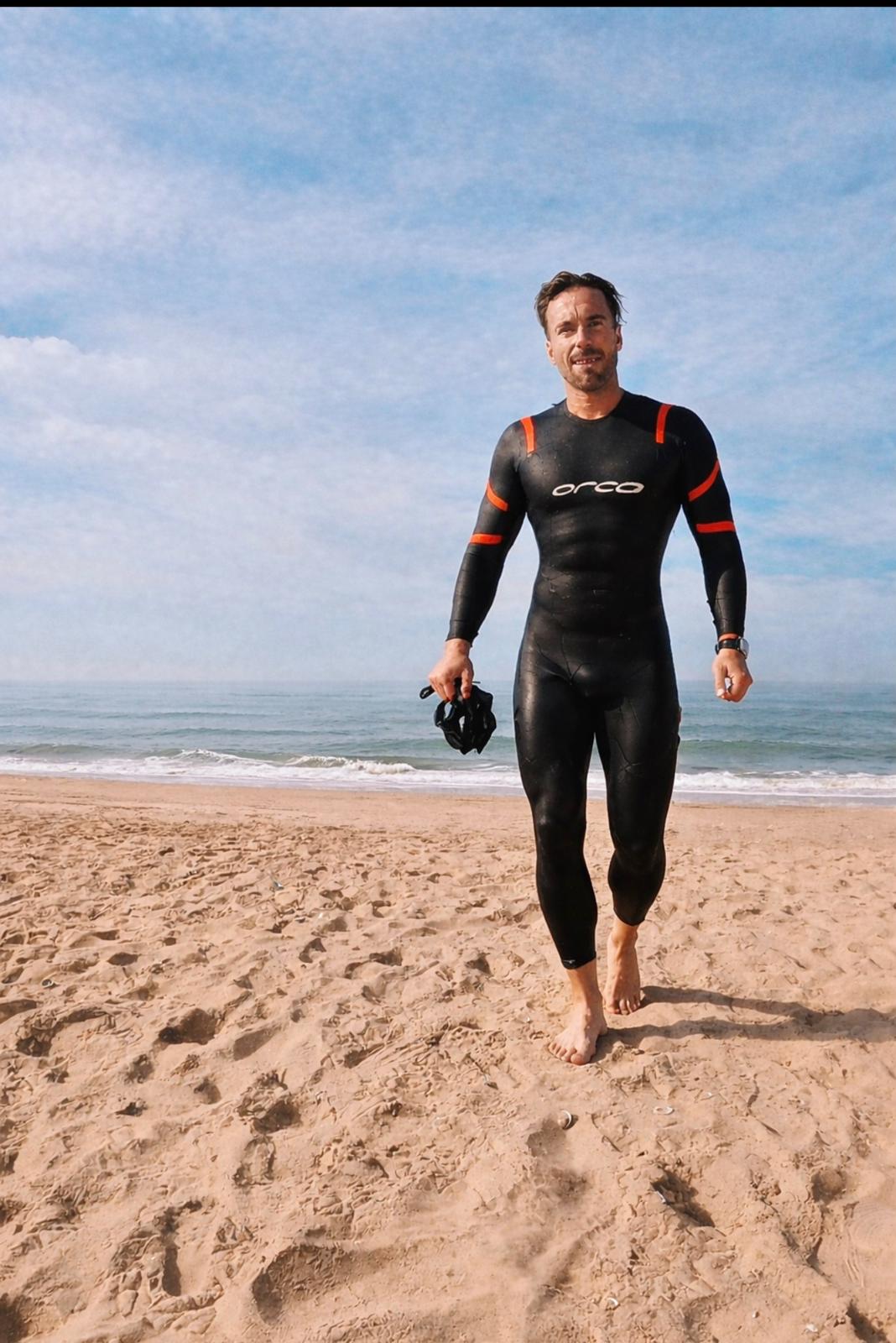
Editorial lead at CorrerJuntos. Popular runner and founder of the app, writing about training, gear and the running community from Huelva, Spain.