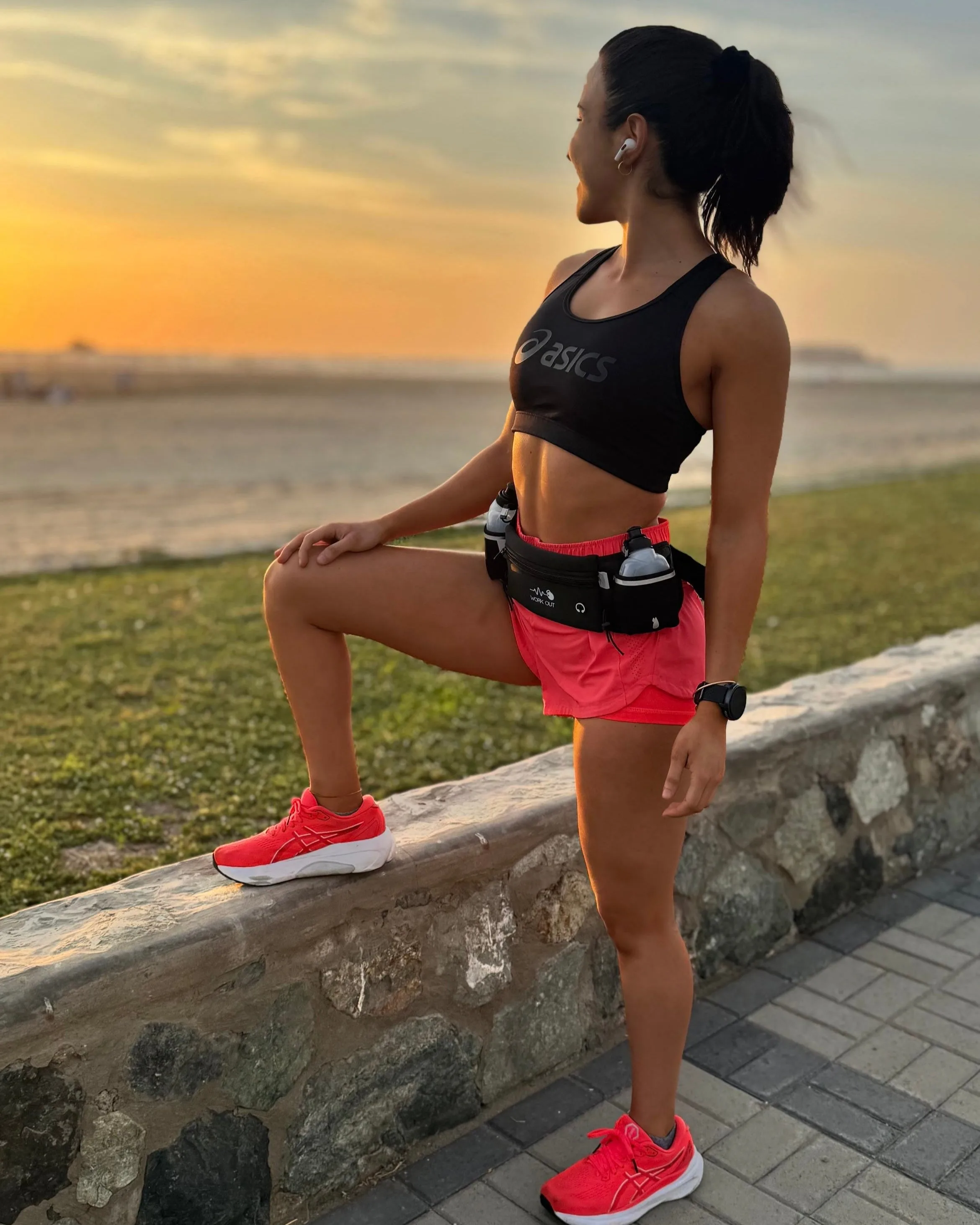
A running belt is one of those accessories you don't think you need until you try one. Once you've run with your phone, gels and keys securely strapped to your hips without bouncing, there's no going back to stuffing things in your legging pockets or running with your phone in your hand (World Athletics).
The problem is that the running belt market has exploded and it's not easy to choose. There are tubular belts, belts with pockets, belts with bottles, minimalist bands and everything in between. We've tested over 15 models in recent months, running with them from 5K to marathon, in summer heat and winter rain, to bring you this ranking of the 8 best running belts you can buy in 2026.
📋 Transparency: This article contains affiliate links to Amazon. If you buy through them, we receive a small commission at no extra cost to you. This helps us keep CorrerJuntos free. We only recommend products we have tested or thoroughly analyzed.
Top 8 running belts ranking

1. FlipBelt Classic
Price: ~30 EUR · Weight: 80 g · Type: Tubular band · Pockets: 4 (360-degree access)
The FlipBelt Classic is the running belt that redefined the category. Its tubular design wraps around your waist like a second skin, with four access points where you slide your items through slits into the interior of the band. There are no zippers that can snag, no bulky pockets that bounce, and no buckles to adjust.
It fits phones up to 6.7 inches, distributes weight evenly around the entire waist and has virtually zero bounce when properly sized. It's machine washable, dries fast and has survived two full years of daily use in our tests without losing its elasticity. The only downside is that pulling items out mid-run takes a second longer than a zippered pocket, but with practice it becomes second nature.
- Pros: Zero bounce, 360-degree storage, phone compatible, machine washable, great price
- Cons: Access slightly slower than zippers, no bottle support, can feel warm in summer

2. Naked Running Band
Price: ~45 EUR · Weight: 48 g · Type: Wide elastic band · Pockets: 2-3 (depending on model)
The Naked Running Band takes minimalism to the extreme. Weighing just 48 grams, it's the lightest running belt on the market. It's a wide elastic band that you pull on over your hips with no buckles, zippers or Velcro. Items are held in place by compression alone, with small fabric dividers separating your phone from gels and keys.
The fit is exceptional: the band distributes weight so evenly that many runners report forgetting they're wearing it. The downside is that items aren't fully enclosed, so in theory something could slip out during a tumble. In practice, with the right size, this hasn't happened in our testing. The brand recommends hand washing with mild soap.
- Pros: Ultralight (48 g), no bounce, extremely comfortable, perfect for minimalist runners
- Cons: No zippers (items held by compression only), hand wash recommended, limited capacity

3. SPIbelt Large Pocket
Price: ~25 EUR · Weight: 57 g · Type: Single expandable pocket · Pockets: 1 main + 1 small
The SPIbelt is the stretchy pocket belt that runners have trusted for over a decade. Its single expandable pocket goes from virtually flat when empty to large enough to hold a phone, multiple gels, keys and cash when loaded. The elastic waistband uses a buckle clasp for secure sizing.
Its greatest strength is its versatility: whether you're carrying just a key or a fully loaded marathon kit, it adapts. At just 25 EUR, it's the best value option in our ranking. The only issue is that all items share one pocket, so you'll need to dig around to find your gel at km 30 if you have 6 items stuffed in there.
- Pros: Great price, expandable capacity, fits any phone (even with case), proven design
- Cons: Single pocket (everything mixed), slightly more bounce than tubular belts when heavily loaded

4. Salomon Pulse Belt
Price: ~35 EUR · Weight: 120 g · Type: Belt with bottle holder · Pockets: 1 zippered + bottle slot
The Salomon Pulse Belt bridges the gap between a simple running belt and a hydration while running vest. It includes a 250 ml soft flask and a zippered pocket big enough for a phone and a few gels. Salomon's SensiFit adjustment system keeps everything snug against your body.
It's ideal for runs of 10-20 km where you need some hydration but don't want the bulk of a vest. The 250 ml flask is enough for an hour in mild conditions. For summer or longer distances, you'll need to supplement at water fountains or carry a second flask.
- Pros: Includes 250 ml flask, good storage, SensiFit adjustment, trusted brand
- Cons: Heavier than non-hydration belts, 250 ml may not be enough for long runs, flask position takes getting used to

5. Nathan Zipster
Price: ~28 EUR · Weight: 65 g · Type: Zippered waistband · Pockets: 1 zippered (360-degree)
The Nathan Zipster is a stretchy waistband with a continuous zippered pocket that wraps around the entire circumference. This gives you easy access from any angle and lets you distribute items evenly. The zip runs smoothly and hasn't jammed in our testing.
It's a great middle ground between the FlipBelt (no zippers) and the SPIbelt (single expandable pocket). The zipper adds security while the full-wrap pocket provides flexible storage. It's machine washable and competitively priced.
- Pros: 360-degree zippered access, secure storage, good price, machine washable
- Cons: Zipper can let in some sweat, slightly bulkier than non-zippered belts

6. CamelBak Flash Belt
Price: ~40 EUR · Weight: 140 g · Type: Hydration belt · Pockets: 1 zippered + bottle holder
CamelBak brings its hydration expertise to the running belt category. The Flash Belt includes a 500 ml Podium Chill bottle with an ergonomic grip and a zippered pocket for essentials. The wider waistband distributes weight well and the bottle holder angle is designed for easy one-handed access.
The 500 ml capacity is notably more than the Salomon Pulse's 250 ml, making it better for longer runs or hot weather. The trade-off is a slightly higher weight and a more noticeable profile when running.
- Pros: 500 ml bottle, excellent CamelBak quality, comfortable waistband, easy bottle access
- Cons: Heavier than minimalist belts, bottle can feel asymmetric, bulkier profile

7. Fitletic Bolt
Price: ~22 EUR · Weight: 70 g · Type: Dual pocket belt · Pockets: 2 zippered
The Fitletic Bolt is a no-frills, functional running belt with two zippered pockets. One fits your phone, the other holds gels, keys and cash. The dual-pocket design lets you keep items organized and access them independently.
At 22 EUR, it's the most affordable belt in our ranking and a great entry point for runners who want to try a belt before investing more. The elastic waistband adjusts with a buckle and the fit is decent, though not as snug as the FlipBelt or Naked Band.
- Pros: Very affordable, two separate pockets, zippered security, good for beginners
- Cons: More bounce than premium belts, buckle can dig in, less premium feel
8. Decathlon Kalenji Belt
Price: ~10 EUR · Weight: 55 g · Type: Elastic belt · Pockets: 1 expandable
For runners who want to try a belt without spending much, the Decathlon Kalenji belt is hard to beat. At just 10 EUR, it does the basics well: holds your phone and keys without excessive bounce, and the elastic material is surprisingly durable for the price.
Don't expect FlipBelt-level comfort or zero bounce, but for casual training runs and beginners, it punches well above its weight. It's also a good backup belt to throw in your suitcase when traveling (ACSM).
- Pros: Incredibly affordable, lightweight, decent for beginners, great as a backup belt
- Cons: More bounce than premium options, basic materials, limited capacity
Quick comparison table
| Belt | Type | Weight | Phone | Bottle | Price | Best for |
|---|---|---|---|---|---|---|
| FlipBelt Classic | Tubular | 80 g | Up to 6.7" | No | ~30 EUR | Best overall |
| Naked Running Band | Elastic band | 48 g | Up to 6.5" | No | ~45 EUR | Ultralight |
| SPIbelt Large Pocket | Expandable | 57 g | Any size | No | ~25 EUR | Best value |
| Salomon Pulse | Hydration | 120 g | Up to 6.5" | 250 ml | ~35 EUR | Short hydration |
| Nathan Zipster | Zippered | 65 g | Up to 6.5" | No | ~28 EUR | Secure storage |
| CamelBak Flash | Hydration | 140 g | Up to 6.5" | 500 ml | ~40 EUR | Long hydration |
| Fitletic Bolt | Dual pocket | 70 g | Up to 6.5" | No | ~22 EUR | Budget runner |
| Decathlon Kalenji | Elastic | 55 g | Up to 6.1" | No | ~10 EUR | Absolute budget |
How to choose the right running belt
With so many options, choosing the right belt comes down to understanding what you actually need. Here are the key factors to consider.
Find your running with a group
1,100+ runners already train together. Free on iOS.
Sizing is everything
The number one reason runners hate their belt is choosing the wrong size. A belt that's too big bounces, rides up and ruins the experience. A belt that's too small digs in and is uncomfortable. Always measure your waist at the hip bones (where you'll wear it, not your natural waist) and follow the manufacturer's size chart exactly. If you're between sizes, go smaller.
Hip placement, not waist
Wear the belt on your hips, not your waist. Your waist moves with breathing and your stride. Your hips are stable. Placing the belt on the hip bones is the single biggest improvement you can make to reduce bounce, regardless of which belt you choose.
What do you need to carry?
- Phone + keys only: Minimalist belt (FlipBelt, Naked Band, SPIbelt)
- Phone + gels + keys: Multi-pocket or expandable belt (FlipBelt, Nathan Zipster, SPIbelt Large)
- Phone + gels + hydration: Hydration belt (Salomon Pulse, CamelBak Flash)
- Everything + extended hydration: Consider a hydration vest instead
Belt vs. hydration vest
This is one of the most common questions. The answer depends on distance, hydration needs and how much gear you need to carry.
Choose a belt if...
- You run under 15 km and don't need much hydration
- You just need phone, keys and a few gels with nothing else
- You run in the city with public fountains where you can refill
- You race events with aid stations where they provide water and fruit
Choose a vest if...
- You run 20+ km distances where you need more than 500 ml of hydration
- You train trail or mountain where you need to carry mandatory gear (windbreaker, whistle, emergency blanket)
- You run in summer with extreme heat where dehydration is a real risk
- You race ultras or events without aid stations where self-sufficiency is mandatory
- You need capacity for solid food beyond gels (bars, nuts, etc.)
For many runners, the best solution is to have both: a minimalist belt for short workouts and road races, and a hydration vest for long runs and trail. Check our complete guide to running accessories to find the perfect complement for every situation.
Care and maintenance
A running belt is an accessory that gets soaked in sweat every workout. If you don't take care of it, it will end up smelling bad, the elastic will lose tension and the zippers will jam prematurely. Here are the basic care tips to make your belt last years.
Regular washing
Wash your belt after every intense use or at least once a week if you use it daily. Most belts (FlipBelt, SPIbelt, Nathan, Fitletic) can go in the washing machine on a delicate cycle at 30 degrees inside a mesh laundry bag. The Naked Running Band recommends hand washing with mild soap. Never use bleach or fabric softener: both will damage the elastic fabrics. Always air dry, never tumble dry.
Zippers
Zippers are the weak point of any belt. To make them last, keep them free of sand and salt (rinse with fresh water after running on the beach). If a zipper starts sticking, apply a little candle wax or zipper-specific lubricant to the teeth. Never force a stuck zipper: you'll break it.
Elasticity
Elastic band belts (FlipBelt, Naked) gradually lose elasticity with use. To prolong their life, don't store them stretched and don't leave them in direct sunlight for extended periods. Store them rolled up in a cool, dry place. When you notice the belt no longer fits properly even at the correct size, it's time to replace it. With normal use of 3-4 times per week, a good elastic belt lasts between 1 and 2 years.
Common mistakes with running belts
After watching hundreds of runners at races and workouts, these are the most frequent mistakes we make with running belts. Avoid them and your experience will improve drastically.
- Size too large: This is the number one mistake. A large belt bounces, rotates and bothers you. If you're between two sizes, choose the smaller one. A slightly snug belt is preferable to one that slides around.
- Placing it on the waist instead of the hips: The waist moves with breathing and your stride. The hips are stable. Lower the belt to the hip bones for maximum stability.
- Overloading the belt: A belt is not a backpack. Carry only the essentials. The more weight you add, the more bounce you'll get. If you need to carry lots of things, a vest is a better option.
- Not testing it before race day: Never debut a belt on race day. Use it in at least 3-4 training runs to make sure it doesn't chafe, doesn't bounce and is comfortable at different paces.
- Ignoring chafing: If you notice a spot that rubs, act before it becomes a wound. Apply petroleum jelly, change the belt position or put a shirt underneath. Belt chafing soaked in sweat during a marathon is especially painful.
- Not washing it: Accumulated sweat degrades materials, causes bad odor and can irritate your skin. Wash your belt regularly. It's a sports accessory, not a dress belt.
Frequently asked questions about running belts
What is the best running belt that doesn't bounce?
The FlipBelt Classic and the Naked Running Band are the two running belts with the least bounce on the market. Both fit like a second skin thanks to their tubular design (FlipBelt) or wide elastic band (Naked). The key to avoiding bounce is choosing the correct size and placing the belt on the hips, not the waist. A well-fitted belt on the hip area stays motionless even at paces of 4:00/km. If you also distribute item weight evenly around the band, bounce becomes virtually non-existent.
Can I carry my phone in a running belt?
Yes, most current running belts are designed to carry smartphones. The FlipBelt Classic fits phones up to 6.7 inches, the SPIbelt Large Pocket expands for any phone on the market, and the Naked Running Band has a specific pocket for phones up to 6.5 inches. Before buying, check that the belt indicates compatibility with your phone size. If you use a protective case, add 3-5 mm to your phone's dimensions. Expandable pocket models like the SPIbelt are the most versatile for large phones with thick cases.
Running belt or hydration vest?
It depends on the distance and the amount of fluid you need. For runs up to 15-20 km or one-hour workouts, a belt with a 250-500 ml bottle is sufficient. For longer distances, half marathons, marathons or ultra trail, a hydration vest with 1-2 liter capacity is more practical because it distributes weight over the shoulders and lets you carry extra gear. If you only need to carry a phone, keys and a gel without hydration, a minimalist belt without a bottle is the best option for comfort and lightness.
How to prevent chafing with a running belt?
Chafing is caused by friction between the belt and the skin, especially with sweat. To prevent it: choose a belt with a soft interior or moisture-wicking material, always wear a technical shirt under the belt (never belt on bare skin for long sessions), apply petroleum jelly or anti-chafe cream to contact areas before running, and make sure the size is correct. Wide belts like the Naked Running Band distribute pressure better and cause less chafing than narrow models with sharp edges.
Is a running belt worth it or are legging pockets enough?
Legging or shorts pockets work for carrying a key and not much more. If you need to carry a phone, gels, cash or a bottle, a belt is essential. Plus, weight in legging pockets pulls the garment down and creates bounce with every stride, while a well-fitted belt on the hips distributes weight stably and independently from your clothing. If you only run 30 minutes without needing a phone or gels, pockets are fine. For workouts over 45 minutes or races, a belt significantly improves the experience.
What running belt to use for a marathon?
For a marathon you need a belt that can carry energy gels (between 4 and 8 units depending on your fueling strategy), optionally a small bottle, and your phone. The SPIbelt Large Pocket is a popular choice for its expandable capacity that fits all the gels you need. The FlipBelt Classic lets you distribute gels around your waist for perfect balance. If you also want your own hydration, the Salomon Pulse Belt or CamelBak Flash Belt include bottle support. Most importantly, test it on training runs over 20 km before race day to make sure it doesn't chafe or bounce at your marathon pace.
Can you machine wash a running belt?
Most running belts can be machine washed on a delicate cycle with cold water (30 degrees max). It's recommended to put them in a mesh laundry bag to protect zippers and elastics from snagging on other garments. Don't use a dryer or bleach, as they would damage the elastic materials and zippers. Let it air dry on a rack. The FlipBelt, SPIbelt and Nathan Zipster have specific instructions confirming machine wash compatibility. The Naked Running Band recommends hand washing with mild soap. Washing your belt regularly prevents salt buildup from sweat and bad odors, and significantly extends its lifespan.