
Running at 70 is not only possible — it is one of the best decisions you can make for your health. Science backs it up with powerful data: it reduces cardiovascular risk by up to 45%, improves bone density, protects against cognitive decline, and strengthens social bonds. With the right adaptations, running is a safe, accessible, and deeply rewarding activity for people over 70.
This guide brings together scientific evidence, a 12-week progressive program, nutrition advice, injury prevention strategies, and specific equipment recommendations for senior runners. Because your age does not define your limits: your attitude does.
Benefits of running after 70
The scientific evidence on the benefits of running for older adults is overwhelming. We are not talking about minor improvements — we are talking about profound transformations in quality and length of life.
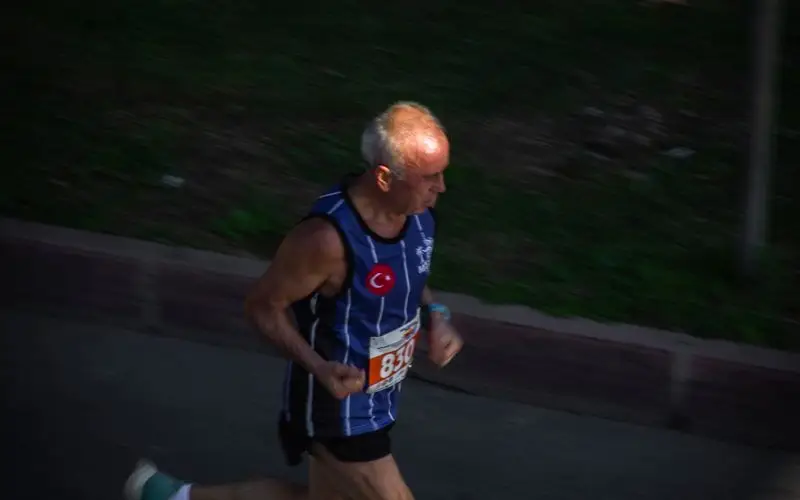
Cardiovascular health
Regular running significantly reduces cardiovascular mortality, even at low speeds and with few weekly sessions. A study published in Progress in Cardiovascular Diseases concluded that runners have a 45-70% lower risk of cardiovascular death and live an average of 3 years longer than non-runners, regardless of pace or distance (Lee DC et al., 2017).
For a 70+ runner, this means that even jogging 20-30 minutes three times a week provides measurable cardiovascular benefits: better blood pressure, healthier lipid profile, and a more efficient heart. Following adapted training plans helps you structure these sessions correctly.
Bone density
Osteoporosis affects millions of people over 65. Running, as a weight-bearing activity, stimulates bone formation and helps maintain mineral density. Unlike swimming or cycling, the repeated foot strike generates micro-stimuli that strengthen bone tissue, especially in the hips and spine.
Cognitive health
One of the most studied benefits of aerobic exercise in older adults is its neuroprotective effect. A study from the University of Pittsburgh demonstrated that aerobic exercise increases the size of the hippocampus — the brain region responsible for memory — and improves cognitive function in older adults (Erickson KI et al., PNAS 2011). This has direct implications for the prevention of Alzheimer’s and other dementias.
Running does not just keep the body fit: it keeps the brain young. The mental health benefits of running extend well beyond cognitive protection.
Social and emotional wellbeing
Running in a community offers something no medication can: a sense of belonging and purpose. At CorrerJuntos, 12% of our community is over 55 years old, and our most senior runner is 74 and joins weekly group runs in Madrid. Our easy-pace runs (7:00+/km) represent 35% of our events — designed to be accessible to all levels and ages. You can find running companions who match your pace and schedule.
Medical considerations
Before starting to run at 70, there are steps that should not be skipped. Being cautious is not a barrier: it is what allows you to run safely for many years.
Mandatory medical check-up
A stress test with electrocardiogram is essential before starting a running program. This test evaluates the heart’s response to exercise and rules out hidden conditions such as arrhythmias or ischemic heart disease. Your doctor should also assess joint health (knees, hips, ankles) and bone density.
Medication and running
Many people over 70 take daily medication that affects performance and safety while running:
- Beta-blockers: limit maximum heart rate. Do not use standard HR zones — train by perceived effort instead.
- Anticoagulants: increase bruising risk from falls. Take extra care on uneven terrain.
- Antihypertensives: may cause low blood pressure when standing up or stopping abruptly. Always transition smoothly.
Always consult your doctor about how your medication will interact with exercise.
Common conditions
According to a review by Pedersen and Saltin published in the Scandinavian Journal of Medicine & Science in Sports, regular exercise is an effective intervention for more than 26 chronic diseases, including osteoarthritis, osteoporosis, and hypertension (Pedersen BK, Saltin B, 2015).
- Osteoarthritis: low-volume running does NOT worsen osteoarthritis. It strengthens the muscles surrounding the joint and can reduce pain.
- Osteoporosis: the controlled impact of running stimulates bone formation. Combining it with strength exercises multiplies the benefit.
- Hypertension: 30 minutes of moderate aerobic exercise lowers blood pressure for the following 12-24 hours.
How to start running at 70
Patience is your greatest ally. If you are completely new to running, our guide on how to start running covers the fundamentals. A 12-week program allows the body to adapt safely, strengthening tendons, ligaments, and the cardiovascular system without overload.

12-week program: from walking to jogging
Weeks 1-4 (Active walking): 4 weekly sessions of brisk walking for 20-30 minutes. The goal is to build an aerobic base and accustom the joints to regular movement.
Weeks 5-8 (Walk-Jog): Introduce gentle jogging intervals of 1-2 minutes alternated with 3-4 minutes of walking. Keep a comfortable cadence — short, quick steps are easier on the joints than long strides. Gradually increase the jogging proportion each week.
Weeks 9-12 (Continuous jogging): Gentle continuous jogging for 15-25 minutes. If you need to walk, walk. There is no rush and no failure in respecting your own pace.
Sample week (Weeks 5-8)
| Day | Activity | Duration |
|---|---|---|
| Monday | Brisk walking | 30 min |
| Tuesday | Rest or gentle stretching | 15 min |
| Wednesday | Jog/walk intervals (2:3) | 20 min |
| Thursday | Rest | — |
| Friday | Brisk walking | 30 min |
| Saturday | Rest or strength training | 20 min |
| Sunday | Jog/walk intervals (2:3) | 25 min |
The 10% rule
Never increase total volume (time or distance) by more than 10% per week. This classic running rule is even more important for people over 70 because connective tissues need more time to adapt. Ignoring this rule is one of the main causes of overtraining.
Surface choice
Not all surfaces are equal for your joints:
- Grass: the most forgiving surface. Absorbs impact, reduces joint load.
- Packed dirt: excellent option in parks and trails. Natural surface with good cushioning.
- Asphalt: the most common but the hardest. Use well-cushioned shoes if you regularly run on asphalt.
- Avoid: concrete (sidewalks), very uneven terrain, or steep inclines when starting out.
Complementary strength training
Strength training is essential for runners over 70. A systematic review published in Ageing Research Reviews confirmed that strength exercise significantly improves muscle mass, power, and functional capacity in older adults (Peterson MD et al., 2010).
Dedicating 2 sessions per week of 20 minutes to strength work reduces injury risk, improves stability, and enhances running capacity.
Recommended exercises
- Supported squats: using a chair or wall for support. 3 sets of 8-10 reps. Strengthens quads and glutes.
- Glute bridges: lying face up, raise hips. 3 sets of 10-12 reps. Key for pelvis stability.
- Single-leg balance: stand on one leg, 30 seconds per side. Prevents falls and improves proprioception. Strong pelvic muscles also contribute to stability — see our pelvic floor guide.
- Calf raises: standing, rise and lower on toes. 3 sets of 12 reps. Protects the Achilles tendon.
- Modified plank (knees): 3 sets of 15-20 seconds. Basic core to maintain posture while running.
Nutrition for senior runners
Nutritional needs change with age, and a 70+ runner should pay special attention to several key areas.
Protein: more than you think
Active older adults need 1.2-1.5 grams of protein per kilogram of body weight per day, more than the standard recommendation of 0.8 g/kg. Good post-workout recovery nutrition is especially important at this age. Sarcopenia (age-related muscle loss) is combated with strength exercise plus adequate protein intake. Distribute protein across every meal: eggs, fish, legumes, dairy, chicken. Also review our guide on pre-run nutrition to fuel your sessions properly.
Hydration
With age, the sensation of thirst decreases, increasing dehydration risk. Establish a routine: follow a proper hydration plan — drink water before, during, and after running even if you do not feel thirsty. For sessions over 30 minutes, carry a small bottle. On hot days, add mineral salts.
Vitamin D and calcium
Essential for bone health. Many people over 70 are vitamin D deficient, especially in winter. Consult your doctor about whether you need supplementation. Natural sources: oily fish, dairy, moderate sun exposure.
Omega-3 and natural anti-inflammatories
Omega-3 fatty acids (found in salmon, sardines, walnuts, flaxseed) have anti-inflammatory properties that aid muscle recovery and protect joints. Incorporate them regularly into your diet.
Injury prevention
Prevention is always more effective than treatment. With some basic precautions, runners over 70 can stay injury-free for years.
Extended warm-up
A minimum of 15 minutes of warm-up before any session. Include progressive walking, joint mobility (ankles, knees, hips), and gentle activations. Proper stretching is a non-negotiable part of this routine. Mature tissues need more time to reach optimal temperature.
Cool-down and stretching
Dedicate 10 minutes after each session to gentle walking and static stretching. Pay special attention to calves, quads, hamstrings, and hips. Stretching improves flexibility and accelerates recovery.
Cross-training
Alternate running with low-impact activities: swimming, stationary cycling, or walking. This maintains cardiovascular fitness without overloading the joints. A good pattern: 2-3 days of running, 1-2 days of cross-training. Our adapted training plans structure this balance for you.
Warning signs
Stop immediately and consult a doctor if you experience:
- Chest pain or tightness during effort
- Dizziness or fainting
- Acute joint pain that does not subside when you stop
- Unusual breathing difficulty (beyond normal fatigue)
- Irregular heartbeat
Recommended equipment
The right equipment makes a real difference in comfort and safety for senior runners.
Maximum cushioning shoes
The number one priority. Look for models with generous cushioning and good stability:
- Hoka Bondi 9: the benchmark in maximum cushioning. Wide sole, smooth transition, ideal for roads.
- Brooks Glycerin 21: DNA LOFT v3 cushioning, comfortable from the first kilometre.
- New Balance Fresh Foam 1080v13: excellent combination of cushioning and lightness.
Replace your shoes every 600-800 km or when you notice the cushioning has lost its responsiveness.
Reflective clothing
If you run early in the morning or at dusk, visibility is critical. Wear a reflective vest or clothing with built-in reflective elements. In winter, add a small headlamp.
GPS watch with fall detection
A GPS watch lets you monitor your pace (to avoid going too fast) and track your progress. Models like the Apple Watch or Garmin Venu 3 include fall detection and emergency alerts, an especially valuable feature for runners who go out alone.
Trekking poles for gentle trails
If you enjoy walking or jogging on trails, lightweight trekking poles provide additional stability on descents and uneven terrain. They reduce knee load by up to 25%.
Inspiring stories
Age is just a number. These runners prove it.
Ed Whitlock: sub-3h marathon at 73
Canadian Ed Whitlock completed a marathon in 2 hours and 54 minutes at age 73, a record that remains nearly unbeatable. His secret: going out for a jog every day around a cemetery near his home, with no structured plans or technology. Pure love of running.
Fauja Singh: marathon at 100
Fauja Singh, born in India in 1911, completed the Toronto Marathon at 100 years old. He started running at 89 after losing his wife, searching for a new purpose. His story is the ultimate proof that it is never too late.
The CorrerJuntos community
You do not need to break records to be inspiring. At CorrerJuntos, we have runners aged 65-75 who regularly join group runs, share their progress, and motivate others. Every kilometre counts, every outing matters.
Find your running group
1,100+ runners already train together. Free on iOS.
Frequently asked questions
Is it safe to start running at 70?
Yes, as long as you have medical clearance after a stress test. With a progressive walk-to-jog program, the body adapts safely. The key is to start slowly, respect rest days, and listen to your body's signals.
How many times per week should a 70+ runner train?
Between 2 and 3 running sessions per week is ideal. Complement with 1-2 days of walking or low-impact activity (swimming, cycling) and at least one full rest day. Recovery is as important as training.
Does running make knee osteoarthritis worse?
Not necessarily. Recent scientific studies show that low-volume running does not accelerate joint wear and may even improve cartilage health by stimulating joint nutrition. Consult your doctor to adapt the volume to your specific case.
What pace should I run at when starting?
Your pace should allow you to hold a conversation. If you cannot speak comfortably, you are going too fast. For most people over 70, a pace of 7:30-9:00 min/km is perfectly adequate. There is no 'wrong' pace if it is sustainable.
Do I need special shoes?
Yes. Use maximum-cushioning running shoes (Hoka Bondi, Brooks Glycerin, New Balance 1080). Avoid fashion sneakers or generic sports shoes. Good running shoes protect your joints and reduce injury risk.
Can I run if I take blood pressure or heart medication?
Yes, but with medical supervision. Beta-blockers limit maximum heart rate (train by perceived effort, not heart rate zones). Anticoagulants require caution regarding falls. Your doctor can adjust medication timing to be compatible with exercise.
What benefits can I expect in the first few weeks?
In the first 4-6 weeks, you will notice improved mood and energy, better sleep quality, and a greater sense of wellbeing. From 8-12 weeks, measurable improvements in cardiovascular endurance, leg strength, and balance.
Is it better to run alone or in a group?
Group running provides motivation, safety, and social connection. For 70+ runners, easy-pace group runs are ideal because the pace is not competitive and the company makes the kilometres pass faster. At CorrerJuntos, we organise group runs accessible to all levels.
Conclusion
Running at 70 is not reckless: it is one of the smartest decisions you can make for your physical, mental, and emotional health. Science confirms with compelling data that regular aerobic exercise reduces cardiovascular risk, strengthens bones, protects the brain, and significantly improves quality of life.
You do not need to run fast or far. You need to be consistent, patient, and respectful of your body. A gradual program, good shoes, proper medical supervision, and — if possible — the company of other runners are all it takes. Find running companions near you and make every outing more enjoyable.
If Ed Whitlock ran a sub-3h marathon at 73 and Fauja Singh completed one at 100, your 30 minutes of gentle jogging in the park are not just possible: they are extraordinary. Every step counts. Every outing is a victory.
Your age does not define your limits. Your attitude does.