
The pelvic floor is one of the most overlooked aspects of running training. Yet its role is fundamental: it supports the pelvic organs, contributes to core stability, and absorbs part of the impact with every stride. When it fails, the consequences range from stress urinary incontinence to chronic lower back pain. Beyond the physical dimension, addressing pelvic floor health also supports the mental health benefits of running by removing barriers to training consistently.
This guide brings together the most current scientific evidence, practical strengthening exercises, and training adaptations so you can continue running safely and with optimal performance. Whether you are looking to start running or you already have years of experience, understanding your pelvic floor is essential.
What is the pelvic floor and why it matters in running
The pelvic floor is a group of muscles, ligaments, and connective tissue that forms a sling-like structure at the base of the pelvis. Its primary function is to support the pelvic organs (bladder, uterus, rectum) and control urinary and fecal continence. But its role extends far beyond that: it is an essential component of the core stabilization system, working in synergy with the respiratory diaphragm, the deep abdominal muscles (transversus abdominis), and the lumbar multifidus. This is why strength training that targets the entire core is so important for runners.
The pubococcygeus muscle, the central component of the pelvic diaphragm, is the structure most affected during running. It extends from the pubic bone to the coccyx and functions as a muscular trampoline that absorbs and redistributes impact forces.
The impact of running on the pelvic floor
Running is a high-impact sport. Every time the foot strikes the ground, the body receives a ground reaction force equivalent to 2.5–3 times body weight. For a 60 kg runner, this means between 150 and 180 kg of force with every stride. At an cadence of 170 steps per minute, the pelvic floor receives more than 10,000 impacts in one hour of running.
According to the landmark study by Novacheck published in Gait & Posture (1998), ground reaction forces during running reach 2–3 times body weight, depending on speed and technique (Novacheck TF, 1998). A strong pelvic floor absorbs these impacts efficiently. A weak pelvic floor becomes overwhelmed, and symptoms appear.
Common symptoms in female runners
Pelvic floor dysfunction in female runners can manifest in several ways. Recognizing the symptoms is the first step toward finding a solution.

Stress urinary incontinence (SUI)
This is the most common and most silenced symptom. It involves the involuntary loss of urine during activities that increase intra-abdominal pressure: running, jumping, coughing, or sneezing. Many runners normalize it or consider it “part of running,” but it is not.
A study by Bø and Borgen published in the British Journal of Sports Medicine (2001) found that the prevalence of stress urinary incontinence among female athletes is significantly higher than in the general population (Bø K, Borgen JS, 2001).
Pelvic heaviness
A sensation of weight or pressure in the pelvic area, especially toward the end of long runs. This may indicate significant pelvic floor weakness or, in advanced cases, the onset of pelvic organ prolapse. It is a warning sign that requires professional assessment.
Associated lower back pain
The pelvic floor works in synergy with the lumbar muscles. When the pelvic floor is weak, the lumbar muscles overcompensate, which can lead to chronic or recurrent lower back pain. Many runners with low back pain have an undiagnosed pelvic floor dysfunction component. A comprehensive approach to injury prevention should always include pelvic floor assessment.
Urinary urgency
An urgent need to urinate during running, forcing you to stop or find a restroom. While this can have various causes (bladder irritation, caffeine intake, or poor hydration habits), a weak pelvic floor contributes to worsening this symptom.
Risk factors
Not all female runners develop pelvic floor problems. Several factors increase the likelihood:
Pregnancy and childbirth
Pregnancy subjects the pelvic floor to sustained pressure for 9 months. Vaginal delivery can cause direct damage to the levator ani muscle, the pudendal nerve, and the supporting ligaments. Instrumental deliveries (forceps, vacuum) and high birth-weight babies increase the risk. Even cesarean sections, while partially protecting the pelvic floor, do not completely eliminate the risk due to the accumulated pressure during pregnancy.
Menopause
The decline in estrogen during menopause causes a loss of elasticity and strength in pelvic floor tissues. The collagen that maintains the structure of ligaments and fascia deteriorates, which can trigger symptoms in women who have never experienced them before. Perimenopausal and postmenopausal runners are especially vulnerable. Even those running at 70+ can benefit from targeted pelvic floor strengthening.
Incorrect hypopressive exercises
Paradoxically, poorly performed hypopressive exercises can worsen the situation rather than improve it. Without professional supervision, it is common to generate excessive pressure instead of the abdominal suction that is intended. Guidance from a specialized physiotherapist is essential. The same principle applies to all stretching and mobility work: proper form is more important than volume.
Excessive impact volume
Increasing training volume too quickly, running on hard surfaces without an adaptation period, or accumulating high weekly mileage without complementary pelvic floor work are factors that accelerate the onset of symptoms. The signs can overlap with those of overtraining, making it harder to identify the root cause. The 10% rule (do not increase more than 10% weekly) is especially relevant in this context.
Other factors
- Chronic constipation: repeated straining weakens the pelvic floor.
- Obesity: excess weight increases baseline intra-abdominal pressure. Runners with conditions like diabetes should also be aware of tissue healing differences; see our guide on running with chronic conditions.
- Genetics: collagen composition varies between individuals, affecting tissue resilience.
- Previous pelvic surgeries: hysterectomy or other procedures can alter the supportive anatomy.
Strengthening exercises
A well-designed pelvic floor strengthening program can reduce stress urinary incontinence by up to 70%. The Cochrane review by Dumoulin et al. (2018) confirmed that pelvic floor muscle training is significantly superior to no treatment for SUI (Dumoulin C et al., Cochrane Review, 2018).
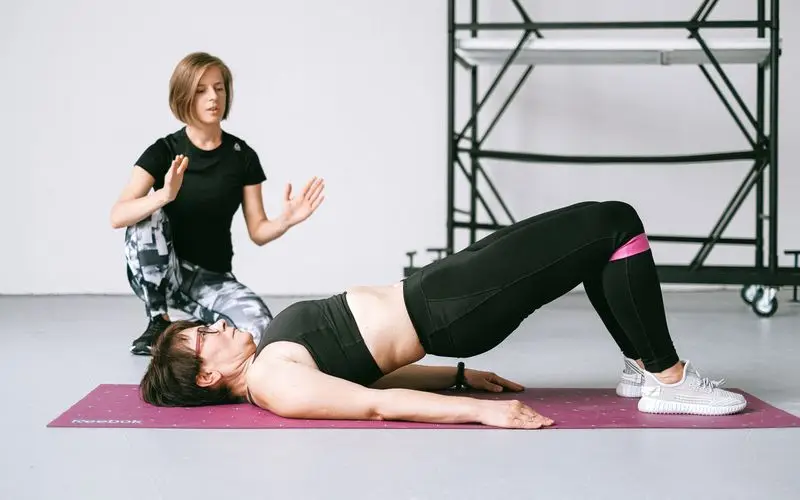
Progressive Kegel exercises
Kegel exercises are the foundation of pelvic floor strengthening. They involve voluntarily contracting the perineal muscles as if you were trying to stop the flow of urine (though it is not recommended to actually do this during urination).
Progressive protocol:
- Weeks 1–2 (Basic level): 3 sets of 8 contractions, hold for 3 seconds, rest for 6 seconds. Lying on your back with knees bent.
- Weeks 3–4 (Intermediate level): 3 sets of 10 contractions, hold for 5 seconds, rest for 5 seconds. Seated position.
- Weeks 5–6 (Advanced level): 3 sets of 10 contractions, hold for 8–10 seconds, rest for 5 seconds. Standing position.
- Week 7+ (Functional): Integrate pelvic floor contraction before and during impact activities: jumps, squats, running.
Perform the exercises twice daily. Consistency matters more than intensity. Pair them with your regular stretching routine for best results.
Hypopressive exercises
Hypopressives reduce intra-abdominal pressure and activate the pelvic floor reflexively. They are an excellent complement to Kegels.
Basic position (quadruped):
- Get on all fours (hands under shoulders, knees under hips).
- Exhale completely, emptying the lungs.
- Without inhaling, open the ribs as if you were trying to breathe in (false inhalation). You will feel the abdomen draw inward and upward.
- Hold for 5–10 seconds. Relax and inhale.
- Repeat 3–5 times.
Advanced position (standing, against a wall):
- Back against the wall, knees slightly bent.
- Follow the same expiratory apnea and false inhalation protocol.
- Hold for 8–15 seconds. 5 repetitions.
Complementary functional strength
These strength exercises activate the pelvic floor indirectly while strengthening the posterior chain and core:
- Glute bridge: Lying on your back, feet on the floor, raise the pelvis while activating glutes and pelvic floor simultaneously. 3 sets of 12. Add weight progressively.
- Deep squat: Works glutes, quadriceps, and pelvic floor. Maintain conscious pelvic activation during the ascent. 3 sets of 10.
- Dead bug: Lying on your back, arms extended toward the ceiling, knees at 90 degrees. Extend the opposite arm and leg while keeping your back pressed to the floor. 3 sets of 8 per side.
- Bird-dog: On all fours, extend the opposite arm and leg. Hold for 5 seconds with core and pelvic floor activation. 3 sets of 8 per side.
- Clamshell: Lying on your side, knees bent, open the top knee while keeping feet together. Activates hip external rotators and pelvic floor. 3 sets of 15.
Training adaptations for running
If you experience pelvic floor dysfunction symptoms, you do not have to stop running. But you do need to adapt your training intelligently while working on strengthening.
Temporarily reduce impact volume
Decrease weekly mileage by 30–50% during the first 4–6 weeks of strengthening. This reduces the load on the pelvic floor and allows the exercises to take effect. This is not a setback — it is an investment. Following a structured approach through training plans can help you manage volume safely during this phase.
Alternate running with low-impact exercise
Replace 1–2 weekly running sessions with the elliptical, stationary bike, or swimming. You maintain cardiovascular fitness without the repeated impact on the pelvic floor. Cross-training is not “less” — it is smarter. Pay attention to post-workout recovery nutrition to support tissue repair during this adaptation period.
Avoid steep hills initially
Steep inclines significantly increase intra-abdominal pressure. During the readaptation phase, prioritize flat terrain or gentle slopes. Reintroduce hills gradually as the pelvic floor strengthens. Good pre-run nutrition also helps ensure you have stable energy without gastrointestinal issues that can add pressure to the pelvic area.
Running technique: cadence as your ally
A study by Heiderscheit et al. (2011) published in Medicine & Science in Sports & Exercise demonstrated that increasing running cadence by 5–10% significantly reduces impact forces with each stride (Heiderscheit BC et al., 2011). Moving from 160 to 170–175 steps per minute can reduce the load on the pelvic floor by up to 20%.
Additional technique recommendations:
- High cadence (170–180 spm): Shorter, more frequent steps mean less impact per stride.
- Landing under center of gravity: Avoid overstriding, which increases braking forces.
- Upright posture: Slight forward lean from the ankles, not the waist. A collapsed posture increases pressure on the perineum.
- Diaphragmatic breathing: Coordinating breathing with core and pelvic floor activation improves protection during impact.
When to consult a specialist
A pelvic floor specialist physiotherapist is the go-to professional. They can assess the state of your pelvic musculature through manual evaluation and ultrasound, and design a personalized rehabilitation program.
Warning signs to consult
- Urine leakage during running or when coughing/sneezing that does not improve after 4 weeks of Kegel exercises.
- A sensation of heaviness or a bulge in the vaginal area.
- Persistent pelvic pain during or after running.
- Inability to retain a tampon or menstrual cup during running.
- Pain during sexual intercourse.
- Fecal or gas incontinence.
Do not wait for symptoms to worsen. Early intervention has significantly higher success rates, just as with any other aspect of injury prevention. Look for physiotherapists with specific training in urogynecology or pelvic floor rehabilitation (typically with a master’s degree or accredited postgraduate training).
Postpartum running: safe return
Returning to running after childbirth requires patience and a progressive plan. The clinical guidelines by Goom, Donnelly, and Brockwell (2019), published in the British Journal of Sports Medicine, establish an evidence-based framework (Goom T et al., BJSM 2019).
Recommended timeline
- 0–6 weeks postpartum: Active rest. Gentle walking, diaphragmatic breathing, basic Kegels if pain-free. Wait for the 6-week medical check-up.
- 6–12 weeks: Progressive pelvic floor and core strengthening. Brisk walking, gentle elliptical. Pelvic floor physiotherapy assessment (highly recommended, not optional).
- 12–16 weeks (3–4 months): If the physiotherapist’s assessment is positive, begin a return-to-running program. Start with walk/run intervals (e.g., 1 minute running, 2 minutes walking, repeat 8–10 times).
- 4–6 months: Gradual progression toward continuous running. Increase duration before intensity. Maximum 3 sessions per week.
- 6+ months: Return to normal training if symptom-free. Maintain pelvic floor work as a permanent part of your routine.
Criteria for starting postpartum running
Before reintroducing running, you should be able to:
- Walk briskly for 30 minutes without pain or urine leakage.
- Perform 10 bodyweight squats without symptoms.
- Hold a pelvic floor contraction for 8 seconds, 10 repetitions.
- Perform 10 single-leg hops in place without incontinence or heaviness.
- Single-leg balance for 10 seconds on each side.
If you fail any of these tests, continue working on strengthening before running.
Myths vs reality
| Myth | Reality |
|---|---|
| “Incontinence when running is normal after having children” | It is common, but not normal. It is treatable with physiotherapy and exercise in 70–80% of cases. |
| “I should stop running if I have leaks” | Not necessarily. Adapt intensity and volume while strengthening the pelvic floor. Only pause temporarily if your physiotherapist specifically advises it. |
| “Kegels are only for after childbirth” | All female runners benefit from pelvic floor strengthening, regardless of whether they have had children. |
| “Pads are the only solution” | They are a band-aid, not a solution. Pelvic floor physiotherapy has success rates of 70–80% according to Cochrane evidence. |
| “Only older women have pelvic floor problems” | It affects women of all ages. Young high-impact athletes have elevated prevalence rates. |
| “A cesarean section completely protects the pelvic floor” | It reduces risk but does not eliminate it. Pregnancy itself places significant load on the pelvic musculature. |
| “You cannot strengthen the pelvic floor after 50” | Muscle responds to training at any age. Postmenopausal women obtain clear benefits from supervised programs. |
Find your running group
1,100+ runners already train together. Free on iOS.
Frequently asked questions
Can I keep running if I have stress urinary incontinence?
Yes, in most cases you can continue running while working on pelvic floor strengthening. Temporarily reduce volume and intensity, incorporate Kegel exercises, and consult a specialized physiotherapist. You should only stop if your healthcare professional specifically advises it.
How long do Kegel exercises take to work?
Initial results are typically noticed between 4 and 6 weeks of consistent practice (twice daily). Full benefits are achieved between 3 and 6 months. The key is consistency: the exercises should be maintained as a permanent part of your routine.
When can I return to running after childbirth?
Clinical guidelines recommend no earlier than 12 weeks postpartum, and only after a positive assessment from a pelvic floor physiotherapist. Start with walk/run intervals and progress gradually. Every woman has a different recovery timeline.
Can men also have pelvic floor problems from running?
Yes, though it is much less common. Men can experience chronic pelvic pain, post-prostatectomy incontinence, or pelvic floor dysfunction. Strengthening exercises are also beneficial for male runners.
What type of professional should I consult?
A physiotherapist specialized in pelvic floor (urogynecology). They have specific training to evaluate and treat pelvic musculature. Your gynecologist or primary care doctor can also provide a referral.
Do hypopressives replace Kegel exercises?
No, they are complementary. Kegels work on voluntary pelvic floor contraction. Hypopressives activate the musculature reflexively and reduce intra-abdominal pressure. A complete program includes both, along with functional strength exercises.
Is it better to run on a treadmill or outdoors if I have pelvic floor problems?
There is no significant difference in terms of impact on the pelvic floor. What matters is running technique (high cadence, soft landing) and controlling volume and intensity. Choose whichever surface feels most comfortable.
Are there specific shoes that help protect the pelvic floor?
There are no shoes specifically designed for this purpose, but well-cushioned shoes can reduce the impact forces transmitted to the body. More important than the shoe is running technique: a cadence of 170–180 steps per minute and landing under the center of gravity.
Conclusion
The pelvic floor should not be a taboo subject among runners. The scientific evidence is clear: pelvic floor dysfunction is common in high-impact sports, but it is preventable and treatable in the vast majority of cases.
A daily 10–15 minute strengthening program — combining Kegel exercises, hypopressives, and functional strength training — can transform your running experience. It is not about stopping running, but about running better and with greater confidence.
If you experience symptoms, seek a specialized physiotherapist. Early intervention has the best success rates. And remember: you are not alone. At CorrerJuntos, thousands of female runners share experiences and support each other. Find running partners near you, join a low-pace group run, start your strengthening program, and get back to enjoying every kilometer.