Contents
There is a moment in every marathon that runners know as "the wall." It usually hits between kilometre 28 and 35, and it gives no warning. Your legs turn to lead, your mind begs you to stop and every step becomes an internal negotiation. What many runners do not realise is that this wall is not just muscular: it is, above all, an energy problem. Your body has depleted its glycogen stores and no longer has fast fuel to maintain pace (Mayo Clinic) (World Athletics) (WHO).
Energy gels exist precisely to combat that. They are the most important nutritional tool during a marathon and yet one of the aspects that most runners neglect or improvise on race day. Choosing the right gel, knowing when to take it and having trained your gut to tolerate it can be the difference between finishing strong and dragging yourself through the final kilometres.
In this guide we explain everything you need to know about energy gels for marathon: how they work, what types exist, when to take them, which are the best of 2026 and how to train your digestive system so it does not let you down. If you want a broader overview with detailed comparisons, check our complete guide to energy gels for running.
What is an energy gel and how does it work
An energy gel is a concentrated carbohydrate source in semi-liquid form, designed to deliver quick energy during exercise without the need to chew. A standard sachet contains between 20 and 30 grams of carbohydrates, roughly equivalent to the energy of a large banana, but in a format that is far easier to consume while running at race pace.
Most gels use a combination of two types of sugar: maltodextrin and fructose. This is no accident. Your intestine absorbs glucose (derived from maltodextrin) and fructose through different transporters, which means that by combining both you can absorb more carbohydrates per hour than if you used a single type of sugar. Sports science has shown that with a 2:1 ratio of maltodextrin to fructose you can absorb up to 90 grams of carbohydrates per hour, compared to a maximum of 60 grams using glucose alone.
When you take a gel, the carbohydrates pass into the stomach, are absorbed in the small intestine and enter the bloodstream as glucose. This glucose becomes immediate fuel for your muscles, delaying the point at which your muscle glycogen stores run out. In other words: gels do not make you faster, but they prevent you from slowing down due to lack of energy.
Absorption time varies by gel type. A conventional maltodextrin gel takes between 15 and 30 minutes to become available as energy. Isotonic gels, since they already have the ideal fluid concentration, absorb somewhat faster. This is why it is essential to take gels before you need the energy, not when you are already in trouble.
Types of energy gels
Not all gels are the same. There are several categories based on composition, and choosing the right one depends on your stomach, your experience and your marathon goals. Here we explain each type so you can decide which one fits you best. For a more detailed analysis with rankings and comparisons, visit our energy gels for running guide.
Maltodextrin gels (conventional)
These are the classic gels and the most widely available. They use maltodextrin as the main carbohydrate source, sometimes combined with fructose. They have a thick texture and intensely sweet flavour. Brands like GU, PowerBar and High5 dominate this segment.
- Pros: Affordable, easy to find, wide variety of flavours, tried and tested by thousands of runners over decades.
- Cons: They need water to be absorbed properly (150-200 ml per gel). The thick texture can be hard to swallow while running. Some runners report stomach issues from the high sugar concentration.
- Average price: 1.50 - 2.50 euros per unit.
If you have never used gels, conventional ones are a good starting point because they are affordable and you can try many flavours without spending too much. Just always practise with water.
Isotonic gels (Maurten, SiS)
Isotonic gels are the revolution of recent years in sports nutrition. Unlike conventional gels, these have a particle concentration similar to your body fluids, which means they do not need water to be absorbed. You can take them at any point on the course without relying on an aid station.
- Maurten Gel 100: Uses hydrogel technology. Upon contact with stomach acid, it forms a gel capsule that protects the carbohydrates and releases them gradually in the intestine. This drastically reduces stomach issues. It is the gel used by Eliud Kipchoge and most world-class elites.
- SiS GO Isotonic: A gel with a more liquid texture than conventional gels, designed to be absorbed without water. It does not use Maurten's hydrogel technology, but its isotonic formulation makes it very easy to digest.
The main downside of isotonic gels is their price: Maurten costs almost double a conventional gel. But if your stomach is sensitive or you do not want to depend on water stations, it is worth the investment.
Caffeinated gels
Many gels come in versions with and without caffeine. Caffeine is the legal supplement with the strongest scientific evidence for improving sports performance. At a dose of 3-6 mg per kg of body weight, it can improve your performance by 2% to 4%, which in a marathon can translate to several minutes.
However, you should not take caffeine throughout the entire marathon. The smartest strategy is to save caffeinated gels for the final third of the race, from kilometre 28-30 onwards, when central fatigue starts to dominate. Caffeine acts on the central nervous system by reducing your perception of effort: it does not make your legs less tired, but it makes your brain perceive it that way.
- Typical dose: Between 25 and 100 mg of caffeine per gel, depending on the brand.
- When to take them: Final third of the marathon. Maximum 2-3 caffeinated gels in the entire race.
- Caution: If you are not used to caffeine during exercise, start with low doses (25-50 mg) in training. Too much can cause nervousness, rapid heartbeat and intestinal urgency.
Natural gels
A growing trend in the running world is nutrition with natural ingredients. There are commercial gels formulated with honey, maple syrup, dates or fruit, with no artificial sweeteners or synthetic preservatives. Brands like Naak, Honey Stinger and Huma are leading this space.
In addition, many ultra and marathon runners use real food directly as an alternative to processed gels:
- Dates: 2-3 dates provide about 30g of fast-acting carbohydrates, plus potassium and magnesium. They are the favourite of many ultramarathon runners.
- Honey sachets: Quick energy, easy to swallow, pleasant taste. Individual 20-25g sachets are perfect for carrying.
- Banana: A classic, affordable option, but harder to carry and eat while running.
- Energy chews: Clif Bloks or similar. Easier to dose than a gel, with good stomach tolerance.
Real food works better at slower paces (above 5:30 min/km) where the intensity allows you to digest solids. At fast race paces, gels are still more practical.
Marathon nutrition plan with gels
Improvisation is the biggest enemy of marathon nutrition. You need a detailed plan, practised in training and tailored to your pace. Here is the protocol we recommend for a runner finishing the marathon between 3:30 and 4:30 hours:
Find your running with a group
1,100+ runners already train together. Free on iOS.
| Timing | Kilometre | Action | Gel type |
|---|---|---|---|
| Pre-race | Start line | Gel 15 min before the start (optional) | Caffeine-free, isotonic |
| Gel 1 | Km 8 | First gel + water if not isotonic | Caffeine-free |
| Gel 2 | Km 15 | Second gel at aid station | Caffeine-free |
| Gel 3 | Km 22 | Third gel. Marathon halfway point. | Caffeine-free |
| Gel 4 | Km 28 | Fourth gel. The critical zone begins here. | With caffeine (50-75 mg) |
| Gel 5 | Km 35 | Last mandatory gel. The final 7 km. | With caffeine (75-100 mg) |
| Gel 6 | Km 39 (optional) | Only if you feel you need a final push | With or without caffeine |
hydration while running with gels: If you use conventional (non-isotonic) gels, each gel should be accompanied by 150-200 ml of water. Never take a conventional gel with an isotonic sports drink, because the sugar concentration would be too high and you could suffer severe stomach distress. If you use isotonic gels like Maurten or SiS, you can take them without water and drink sports drink separately. For more on hydration, check our running hydration drinks guide (ACSM).
The amount of carbohydrates you should consume per hour varies based on your weight and pace. As a general reference, aim for 60-90 grams of carbohydrates per hour. With gels providing 25-30g each, that equals 2-3 gels per hour. Faster, lighter runners may be closer to 60g/h, while heavier or slower runners (more time on their feet) benefit from getting closer to 90g/h.
The 5 best gels for marathon in 2026
After testing dozens of gels in training and races, these are the 5 that work best for a marathon. Each has its strengths. For a complete ranking with more options, visit our best energy gels for running guide.
1. Maurten Gel 100 - The world record gel

Best for: sensitive stomachs, elite runners, anyone who wants the best regardless of price
The Maurten Gel 100 uses the hydrogel technology that has changed sports nutrition. On contact with stomach acid, the carbohydrates are encapsulated in a gel structure that passes through the stomach without causing discomfort and is gradually absorbed in the intestine. It is isotonic, so you do not need water. It contains 25g of carbohydrates per sachet with an optimised fructose-to-glucose ratio for maximum absorption.
It is the most widely used gel among world-class marathon elites. Its flavour is neutral, almost tasteless, which for many is an advantage during long races where excessive sweetness triggers aversion. The Gel 100 CAF 100 version includes 100 mg of caffeine for the final kilometres.
2. SiS GO Isotonic Energy Gel - Best value isotonic
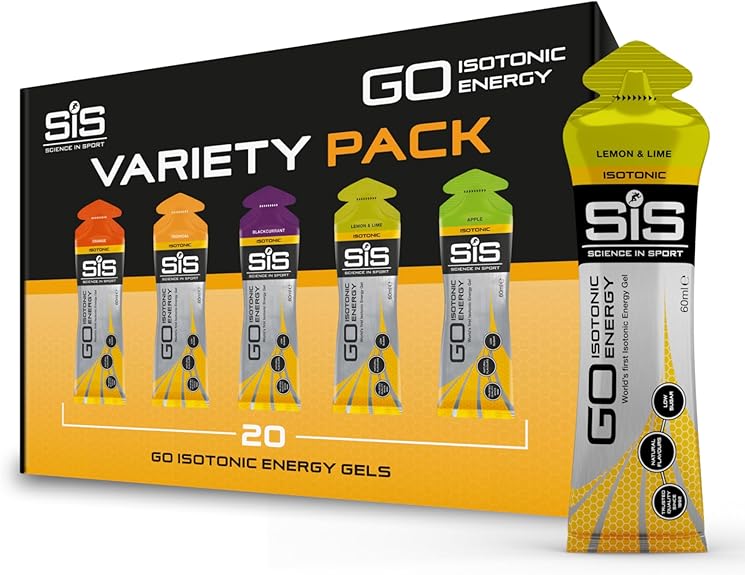
Best for: runners who want an isotonic gel without spending as much as Maurten
The SiS GO Isotonic is the most popular isotonic gel on the market and the favourite of many running clubs and professional cycling teams. Its texture is more liquid than most, making it very easy to consume while running. It does not need water for proper absorption. It provides 22g of carbohydrates per sachet.
It comes in a wide range of flavours (orange, lemon-lime, cola, apple, tropical) and there is a caffeinated version (75 mg or 150 mg). At half the price of Maurten, it is the smart choice for runners who want an isotonic gel without breaking the bank. Over 6 gels in a marathon, saving 1.50 euros per gel adds up.
3. Precision Fuel PF 30 Gel - For the data-driven runner

Best for: methodical runners who calculate grams of carbohydrate per hour
Precision Fuel & Hydration is a British brand specialising in evidence-based sports nutrition. Their PF 30 gel delivers exactly 30g of carbohydrates per sachet, making it easy to calculate your nutrition plan. If your goal is to consume 90g/h, you take exactly 3 gels per hour. Simple as that.
The texture is medium: more liquid than a GU but thicker than a SiS. It works well with a little water, although it is not strictly necessary. The flavours are mild and not cloying. The PF 30 Caffeine version includes 100 mg of caffeine. Precision Fuel also offers a free online sweat test that helps you plan your electrolyte strategy.
4. GU Energy Gel - The veteran classic

Best for: runners who prefer bold flavours and variety, budget-friendly
GU is one of the pioneering brands in energy gels and remains one of the most popular worldwide. Each gel delivers 21g of carbohydrates with the classic maltodextrin and fructose ratio. It includes amino acids (BCAAs) and electrolytes, something not all competitors offer.
Its biggest strength is flavour variety: from classics like chocolate, vanilla and strawberry to more creative options like salted caramel, espresso and birthday cake. It is a conventional gel, so it needs 150-200 ml of water. The texture is thick but manageable. GU has been on the market for decades and millions of runners have used it successfully in marathons, which inspires a lot of confidence.
5. Naak Ultra Energy Gel - The natural alternative
Best for: runners who prefer natural ingredients, ultrarunners
Naak is a Canadian brand committed to natural and sustainable sports nutrition. Their Ultra Energy Gel uses maple syrup as the main carbohydrate source, delivering 27g per sachet along with natural electrolytes. The texture is pleasant, less artificial than conventional gels, and the maple flavour is subtle and not sickly sweet.
What sets Naak apart is their philosophy: natural ingredients, sustainability and formulations designed for ultra endurance efforts. They are very popular among trail and ultra runners, but work perfectly for road marathons too. Available with and without caffeine. If you are someone who prefers to know exactly what you are eating and avoid artificial ingredients, Naak is your gel.
How to train your gut for gels
Training your gastrointestinal system is just as important as training your legs for a marathon. Your gut can adapt to absorb more carbohydrates during exercise, but it needs time and practice. Here is a progressive 8-10 week protocol to train your stomach before the marathon:
Weeks 10-8 before the marathon: adaptation phase
Start by taking a single gel during your weekend long runs. Take it around the 40-45 minute mark, at an easy pace. The goal is not to simulate the race, but to get your gut used to processing food during exercise. If it upsets your stomach, try half a gel or switch to an isotonic gel which is gentler.
Weeks 7-5 before: building phase
Increase to 2 gels per long run, separated by 30-40 minutes. Start taking note of how different brands and flavours feel. This is the time to experiment: try isotonic gels, conventional ones with water, caffeinated and caffeine-free. Your weekend long run is your nutrition laboratory.
Weeks 4-2 before: simulation phase
Now you need to simulate your race plan. On your 28-32 km long runs, take gels according to the exact plan you will use on marathon day. Same gel type, same timing, same combination of caffeinated and caffeine-free gels. If by week 3 your plan works without discomfort, you have a validated strategy.
Race week: maintain routine
In the week of the marathon, do not change anything. Eat the foods you already know work for you, use the same gels you have tested. You can do an easy 30-40 minute jog while taking one gel to maintain the routine without overloading.
If after several weeks your stomach still cannot tolerate gels, do not worry. Some runners simply do not tolerate them, and there are perfectly valid alternatives: energy chews, dates, honey, or even more concentrated isotonic drinks. The important thing is to find a carbohydrate source you can consume during a race without problems. For more ideas on nutrition and supplementation, check our article on best supplements for runners.
Common mistakes with gels during a marathon
Using a new gel on race day
This is the most frequent mistake and the easiest to avoid. Every gel brand has a different composition, texture and flavour. What works for your training partner could be terrible for you. If the marathon's official sponsor hands out a specific gel brand during the race, do not take them unless they are the same ones you have used in training. Always carry your own gels.
Taking the gel too late
Waiting until you feel fatigued to take your first gel is a serious strategic error. By the time your legs start to falter, your body has been running on an energy deficit for 20-30 minutes and the gel will take another 15-20 minutes to take effect. In that window you can lose a pace you will never recover. The first gel should come at km 7-8, when you still feel strong.
Overloading on caffeine from the start
Some runners take caffeinated gels from kilometre 1, thinking more caffeine equals more performance. Wrong. Caffeine has a half-life of 3-5 hours: if you take it at the start, the effect will be fading when you need it most. Moreover, too much caffeine can cause anxiety, rapid heartbeat and even diarrhoea. Save caffeine for km 28-35.
Not practising with water
If you use conventional gels and do not practise the logistics of taking them with water, you will face a problem on race day: how do you grab a cup, open the gel, take it and drink water without stopping? It is a skill you need to train. Practise on your long runs: gel in one pocket of your shorts or belt, water at the next aid station. If you do not want the hassle, use isotonic gels which eliminate the need for water. To plan your entire race day strategy, read our race day nutrition guide.
Eating too much too fast
In the nerves of the marathon, some runners eat two gels back to back or swallow an entire gel in one gulp. This overloads the stomach and can cause nausea, bloating or the dreaded intestinal urgency. Take each gel in 2-3 sips spread over 1-2 minutes. Give your stomach time to process it. More is not better if your digestive system cannot absorb it.
Frequently asked questions
How many gels do I need for a marathon?
It depends on your pace and body weight, but most runners need between 5 and 8 gels for a full marathon. A 70 kg runner finishing in 3:30-4:00 hours will need around 6-7 gels. If you weigh less or run faster, 5 may be enough. If you weigh over 80 kg or expect to take more than 4:30 hours, bring 7-8 gels. Always carry one or two extra in case you drop one or need a boost.
How often should I take a gel?
The general recommendation is every 30-45 minutes, which works out to roughly every 7-8 kilometres for a runner at a pace of 5:00-5:30 min/km. It is more important to go by time than distance, because your body burns energy based on the duration of effort. A runner who finishes in 3:15 and one who finishes in 4:30 need the same amount of energy per hour, but cover very different distances in that time.
Are caffeinated gels better?
They are not better for the entire marathon. Caffeine is especially useful in the final third of the race (km 28-35) because it fights central fatigue and reduces the perception of effort. The optimal strategy is to use caffeine-free gels in the first half and save 1-2 caffeinated gels for the last 12-14 km. Taking caffeine from the start offers no advantage and can cause side effects like nervousness or stomach issues.
What if gels upset my stomach?
First, train your gut progressively for at least 4-6 weeks before the marathon. Second, try isotonic gels (Maurten, SiS) which are gentler on the digestive system. Third, reduce the amount per serving: half a gel more frequently instead of a full gel every 45 minutes. If after trying multiple brands and methods you still have problems, switch to real food: dates, energy chews, honey sachets or banana. Many ultramarathon runners complete enormous distances without using conventional gels.
Can I use gels for a half marathon?
Yes, and it is in fact highly recommended. For a half marathon you will need 2-3 gels: the first around km 7-8, the second at km 14-15, and optionally a third with caffeine at km 18-19 if the race will last more than 1:45. If you run under 1:20, 2 gels may be enough. Practise the strategy on your long training runs. You can find full training plans in our half marathon training guide.
Are there natural alternatives to gels?
Yes, and more runners are using them every year. Dates are the most popular alternative: 2-3 Medjool dates provide about 30g of fast-acting carbohydrates plus potassium and magnesium. Honey in individual sachets is another practical option. Bananas work but are harder to carry. Energy chews (Clif Bloks, Haribo Sport) are easy to dose. And quince paste provides quick sugars with good stomach tolerance. The downside of real food is that it takes up more space and is trickier to consume at fast race paces.
Should I take a gel with water?
It depends on the gel type. Conventional gels (GU, PowerBar, Precision Fuel) DO need 150-200 ml of water to dilute in the stomach and absorb properly. Without water, the high sugar concentration can cause stomach distress. Isotonic gels (Maurten Gel 100, SiS GO Isotonic) do NOT need water because they already have the right fluid concentration. This is one of the big advantages of isotonic gels: you can take them at any point on the course without needing a water station nearby. If you use conventional gels, plan to take them just before an aid station.
Improve your nutrition by running with others
Share fuelling tips and find out what other runners eat. Join a free group run.
Join 1,100+ runners