Uphill & Downhill Running Technique: Master the Mountains
The technique secrets that separate smooth mountain runners from those who suffer on every climb and descent.
The technique secrets that separate smooth mountain runners from those who suffer on every climb and descent.
On flat ground, running technique is important but forgiving. You can get away with less-than-perfect form for a long time. On mountains, poor technique punishes you immediately. A bad body position going uphill wastes energy and limits your breathing. A tense, braking style going downhill destroys your quads and dramatically increases your injury risk. Learning proper technique is not just about speed. It is about finishing the run with your legs and body intact.
The good news is that mountain running technique can be learned and improved at any level. You do not need to be an elite athlete to run hills well. You need awareness of what your body is doing, deliberate practice, and the willingness to slow down while you build new movement patterns. Within a few weeks of focused practice, most runners see dramatic improvements in how they handle elevation.
Whether you are training for your first trail race or preparing for an ultra with thousands of meters of climbing, the fundamentals covered in this guide apply. For a structured approach to building your trail fitness, see our 12-week trail running training plan.
The most common mistake on uphills is bending forward at the waist. This feels natural because you are climbing, but it compresses your diaphragm and restricts your breathing at exactly the moment you need maximum oxygen intake. Instead, lean forward from your ankles, keeping your torso upright and your chest open. Imagine a string pulling you up from the top of your head. Your gaze should be 3 to 5 meters ahead, not at your feet.
Shorten your stride significantly on climbs. Many runners try to maintain their flat-ground stride length going uphill, which forces their muscles to work much harder with each step. Shorter, quicker steps at a higher cadence distribute the effort more evenly and reduce the load on your calves and hip flexors. Think of spinning a light gear on a bicycle rather than grinding a heavy one.
Your arms play a bigger role in uphill running than many people realize. Drive your arms forward and back with more force than on flat ground. This arm drive creates momentum that helps power you up the hill. On very steep sections, place your hands on your thighs and push down with each step. This power hike technique transfers energy from your upper body to your legs and can feel dramatically easier than running the same gradient.
There is a gradient threshold where walking becomes more energy-efficient than running. For most runners, this point is between 15 and 20 percent gradient. At this steepness, running barely increases your speed compared to a brisk hike, but the energy cost is substantially higher. Elite ultra runners know this and strategically walk the steepest sections to conserve energy for the entire race.
Power hiking is not casual walking. It is a deliberate, strong walking technique designed to cover steep ground efficiently. Take long, purposeful strides. Push off your back foot with force. Drive your arms or push on your thighs. Keep your cadence high. A good power hiker can match or exceed the speed of someone trying to run the same steep section while using significantly less energy.
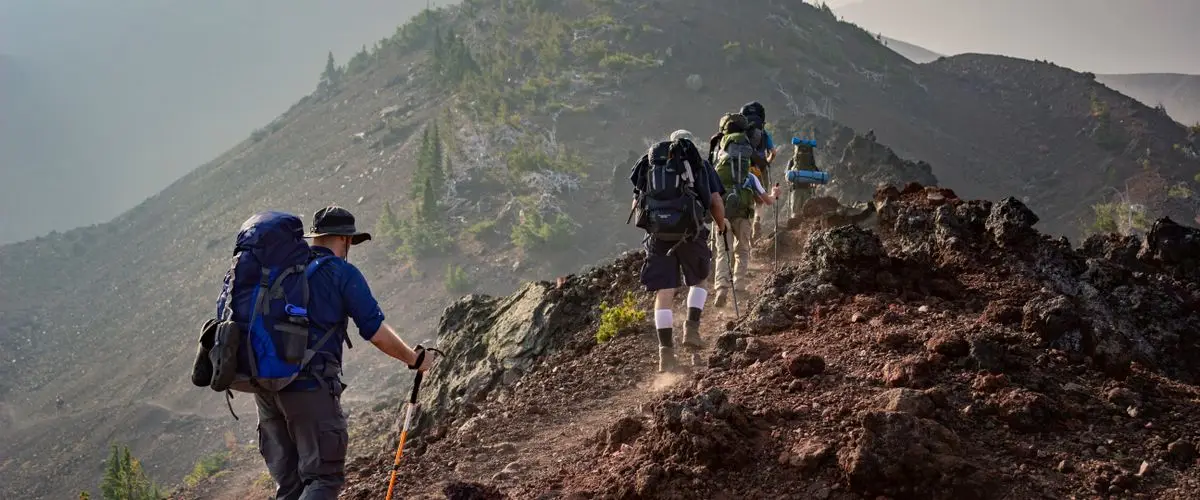
On long climbs lasting 20 minutes or more, trekking poles reduce the load on your legs by transferring 10 to 15 percent of the climbing effort to your upper body. Over the course of a long mountain race, this adds up to a significant energy saving. Poles are especially valuable in ultra-distance events where preserving your legs matters more than speed on any individual climb. Read our detailed trekking poles guide for specific recommendations.
Find your running with a group
1,100+ runners already train together. Free on iOS.
Good downhill running feels like a controlled fall. Your body should lean slightly forward, matching the angle of the slope, with your center of gravity positioned over your feet or slightly ahead. If you lean back and try to brake with each step, you send enormous forces through your knees and quads, leading to pain and early fatigue. The goal is to work with gravity rather than fighting against it.
Use quick, light footstrikes on descents. Land with your foot underneath or slightly in front of your center of gravity, not far out ahead. A high cadence of 180 or more steps per minute naturally shortens your stride and reduces the braking force on each step. Think of your feet tapping the ground rapidly rather than pounding into it. The lighter your foot contact, the less impact your joints absorb.
Tension is the enemy of good downhill running. When you tense your shoulders, grip your fists, and lock your legs, you absorb more impact and tire faster. Consciously relax your shoulders, shake out your hands periodically, and let your arms swing naturally for balance. Relax your ankles so they can adapt to uneven ground. The best downhill runners look almost effortless because they have learned to stay loose while maintaining control.
Find a hill with a moderate gradient of 8 to 12 percent and a length of 200 to 400 meters. Run up at a hard but sustainable effort, then jog or walk down for recovery. Start with 4 repeats and build to 8 over several weeks. This drill builds climbing-specific cardiovascular fitness and leg strength that directly translates to trail race performance.
Dedicate specific training sessions to downhill practice on soft, forgiving terrain like a grassy slope or dirt trail. Start at moderate speed and gradually increase as your confidence grows. Focus on one technique element per session: cadence on week one, body position on week two, eye positioning on week three. This progressive approach builds skill without overwhelming you or causing excessive muscle soreness.
Your quads need eccentric strength to handle long descents. Eccentric squats are the gold standard: lower yourself slowly over 4 to 5 seconds, then stand up at normal speed. Do 3 sets of 10, twice per week. Single-leg step-downs from a box are another excellent exercise. Lower yourself slowly off a 20 to 30 centimeter box on one leg. These exercises build the specific strength your quads need to absorb the impact of downhill running without breaking down.
Landing with your foot far out in front of your body creates a braking force with every step. This slows you down, wastes energy, and sends shock waves through your knees, hips, and lower back. The fix is simple: increase your cadence. Faster steps naturally produce shorter strides and reduce the braking effect dramatically.
The beginning of a climb feels deceptively easy because you are fresh. But pace that feels moderate at the bottom of a 20-minute climb can become unsustainable by minute eight. Start climbs slower than you think you should. Build into the effort gradually. This negative-split approach to climbing is how the best trail runners tackle long ascents. For more on pacing strategy, see our trail training plan.
Most trail runners spend their training energy on climbing fitness and ignore downhill skills. This is a mistake. Descents cause more muscle damage and injuries than climbs. Runners who are strong climbers but weak descenders lose massive time on the downs and finish races with destroyed quads. Dedicate at least one session per week to practicing downhill technique, and include eccentric strength work in your routine.
Find trail running partners in your city. Learn technique from experienced runners.
Join 1,100+ runners
Routes, training plans and tips to run better. No spam.
We respect your privacy. Unsubscribe anytime.