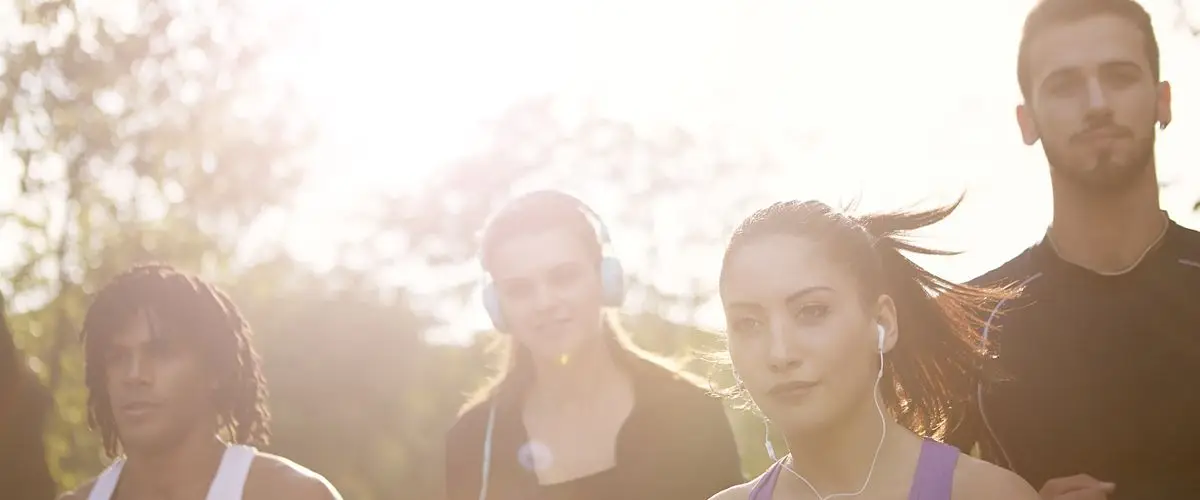
Something is changing in the world of fitness. Something that statistics keep confirming week after week. People are leaving gyms. Not to stay on the couch, but to go outside. And they are not going alone. They are going in groups. They are going to run together (World Athletics).
Social running is not a passing fad. It is the natural response to a society that has been suffering a silent loneliness crisis for years. We work from home, socialize through screens, and one day we realize that we need something real. Something physical. Something human. And it turns out that putting on running shoes and heading out with another person is the simplest and most powerful answer to that need.
In this article we will analyze the data, the psychological and sociological reasons, and the practical ways to join a movement that is transforming how we understand exercise. Because in 2026, fitness is no longer just about the body. It is about community (ACSM).
From Gym to Park: The Paradigm Shift
For decades, fitness was synonymous with the gym. Monthly memberships, machines, instructor-led classes, headphones on and zero real human contact. It worked. Or so we thought. But dropout rates always told a different story: 80% of people who sign up for a gym in January quit before May. Something is broken when 8 out of 10 people abandon what they started with such enthusiasm.
What is missing is connection. Humans are not designed to exercise alone in a closed room. Our ancestors ran in groups to hunt. They walked in tribes to migrate. Movement was always collective. Solitary exercise in a gym is a historical aberration that we have been practicing for barely 50 years.
That is why social running is exploding. Not because it is new, but because it is natural. People are returning to what always worked: moving with others. And running is the perfect vehicle because it is free, happens outdoors, requires no equipment and can be practiced at any level.
The rise of urban running clubs
Five years ago, running clubs were for serious athletes. You had to be fast, have race times, know about training methodology. Today, urban running clubs are the new neighborhood coffee shop. They are social spaces where what matters is not your pace but your attitude. Madrid has more than 40 active informal clubs. Barcelona has over 30. Valencia, Seville, Bilbao... the list keeps growing.
These clubs look nothing like the old ones. They are inclusive, informal and social-first. They meet to run, yes, but also to have breakfast afterward, to share playlists, to celebrate birthdays while running. The run is the excuse. The community is the product. Check out our guide to the best apps for group running and find your tribe.
Social media as a catalyst
Instagram and TikTok have played a fundamental role in this explosion. Running clubs have become viral content. Videos of groups running at dawn through city centers, stories of post-run breakfasts, reels of people meeting their best friends through running. The algorithm does the rest: the more people see it, the more people want to try it.
But there is something deeper. Social media shows something that many people needed to see: that running is not just suffering in silence. That it can be fun, social, even glamorous. That cultural reinterpretation of running has opened the doors to millions of people who would never have described themselves as runners.
The Data That Proves It
This is not a subjective impression. The numbers are overwhelming:
- Race participation: Registrations for 5K and 10K races in Spain have increased 62% compared to 2023. The events that sell out fastest are those with a social component (after-parties, group photos, festive atmosphere).
- Social app growth: Downloads of running apps with social features have tripled in two years. CorrerJuntos has grown 280% in monthly active users in the last year alone.
- Federation licenses: The Royal Spanish Athletics Federation reports a 45% increase in new licenses since 2022, with the biggest growth in the 25 to 40 age bracket.
- Parkrun Spain: Parkrun events in Spain have gone from 12 locations to 48 in three years, averaging 150 participants per event.
- Gym cancellations: Gym membership cancellations increased 18% in 2025, while outdoor physical activity grew 35%.
But the most revealing data comes from motivation surveys. When you ask new runners why they started, the number one answer is not losing weight or training for a marathon. It is meeting people. It is belonging to something. It is feeling part of a community. Discover all the benefits of group running (WHO).
The profile of the social runner
The social runner of 2026 breaks every stereotype. They are not necessarily thin, fast or young. Most are between 28 and 45 years old. They work in an office or remotely. They live in a city. Their primary motivation is social, not competitive. They run between 3 and 4 times per week, of which at least 2 are in a group. They share their workouts on social media. And interestingly, they spend more on post-run breakfasts than on running shoes.
This profile is crucial for understanding the trend. We are not talking about serious athletes now running in groups. We are talking about an entire generation of non-runners who discovered running thanks to the social component. Community is the gateway.
The economic impact
Social running is creating its own economy. Running shops that organize weekly meetups have seen their sales increase by 40%. Cafes near runner meeting points have adapted their hours and menus. Sportswear brands are signing running clubs as ambassadors instead of individual athletes. Even the real estate sector is starting to value proximity to popular running routes as a bonus.
Find your ideal running partner
CorrerJuntos meetups connect you with runners at your pace in your area.
Why Social Running Works
All right, the data is clear. But what is behind those numbers? Why is running with others so effective that it is redefining an entire industry? The answer lies at the intersection of psychology, neuroscience and sociology.
The loneliness crisis as a driver
We live in the most digitally connected and most socially isolated era in history. Remote work eliminated the coffee break chat. Messaging apps replaced phone calls. Social media replaced meetups. And one day you realize you have 500 followers and zero friends to grab a drink with.
Social running fills that void in a way that no other activity can match. It combines intense physical exercise (which releases endorphins), real social contact (which releases oxytocin), shared achievements (which release dopamine) and regular encounters (which build trust). It is the perfect social activity because it has structure, purpose and a repeatable ritual. Discover more about how to meet people through sports.
The amplified accountability effect
When you have arranged to run with someone at 7 in the morning, you cannot cancel without feeling guilty. That social commitment is the most powerful motivator that exists. Far more powerful than any reminder app, any training plan or any goal on the calendar.
But in 2026, accountability has evolved. It is no longer just about not letting one person down. It is about not letting your tribe down. When you belong to a running club, your absence is noticed. People ask about you. They miss you. And that creates a virtuous cycle: the more you go, the more involved you become, the more you care, the more you go. Read more about why group running is addictive.
The social identity of the runner
Something fascinating is happening: being a runner has become a social identity. It is not just something you do, it is something you are. And social identities are powerful because they are self-protecting. If you consider yourself a runner, making decisions consistent with that identity (waking up early to train, eating well, prioritizing rest) becomes natural, not forced.
Social running amplifies this effect because the identity is externally reinforced. Your group sees you as a runner. Your Instagram shows you as a runner. Your friends outside of running know you as a runner. All that social validation turns the habit into something unbreakable.
The democratization of sport
Social running has democratized sport in an unprecedented way. You do not need money to run. You do not need expensive equipment. You do not need a minimum skill level. You do not need previous experience. You just need to show up. And in a world where fitness had become elitist (boutique classes at 30 euros, supplements at 80 euros, gear at 200 euros), running for free with a group in your neighborhood is a revolution.
That accessibility is a fundamental part of why the trend is growing so fast. There are no economic barriers, no skill barriers, no age barriers. The only requirement is wanting to leave the house. And that is something millions of people are deciding to do every week.
How to Join the Movement
If you have read this far, you are probably thinking: I want to try it. Perfect. Here is a practical guide to taking the first step, ordered from easiest to most committed.
- Download CorrerJuntos: The app shows you meetups near you, filtered by pace and level. You can join one without commitment and see how you feel. The matching algorithm suggests compatible runners. It is the easiest way to start because it eliminates uncertainty.
- Try parkrun: Free 5K events every Saturday at 9 in the morning. No pre-registration, no pressure, all levels. The perfect entry point because the structure is already created: you just have to show up at the meeting point.
- Find an urban club: Instagram is the best search engine for running clubs. Search your city plus running club and dozens will appear. Choose one whose vibe attracts you (some are more competitive, others more social) and go to a trial session.
- Invite someone from your circle: A coworker, a neighbor, a friend you have not seen in a while. Suggest going for a walk or jog for 30 minutes. No pace or distance pressure. Just moving together. Sometimes your first running partner is closer than you think.
- Sign up for a local race: Not to compete, but to experience it. 5K races are perfect for beginners. The community atmosphere at the start line, during the course and at the finish is contagious. Many social runners say it all started at a local race.
The most important thing: do not wait to be fit before joining. That is the most common and most absurd mistake. Nobody waits until they can play guitar before signing up for lessons. You do not need to be a runner to join a running group. The group is precisely what will turn you into a runner.
What to expect at your first meetup
If you have never run with a group, it is normal to feel nervous. These are the most common questions and their honest answers:
- What if I am the slowest? There is always someone who matches the pace of newcomers. Good groups make sure nobody is left behind. And if you do happen to finish last, that is exactly the experience you need: discovering that nobody judges you and the group waits for you.
- Do I have to run the full distance? No. You can alternate jogging and walking. Nobody will look at you funny. Seriously. Everyone has been there.
- Do I need to bring anything special? Comfortable shoes, sports clothes and water. Nothing else. Leave the GPS watch, the heart rate strap and the excuses at home.
- What happens after the run? The best part. Most groups meet for breakfast, coffee or simply a chat. That is where real friendships are forged. Do not rush home after the run. Stay and socialize.
Social running is not a passing trend. It is a necessary correction in a world that had become too individualized. People need to move with others. They need to sweat with others. They need to laugh with others while panting up a hill. And when you try that for the first time, you understand why millions of people are choosing the park over the gym, community over solitude, and social running over individualist fitness.
2026 will be remembered as the year running stopped being a solo sport and became the most powerful way to connect with other human beings while taking care of your body and mind. The only question is: are you going to join the movement or are you going to keep running alone?
Frequently Asked Questions
Why is social running trending in 2026?
Because it combines physical exercise with human connection, something people need more than ever after years of digital isolation. Data shows a 340% increase in searches for running clubs and meetups since 2023. People do not just want to get fit, they want to belong to something.
What is the difference between social running and group running?
Social running is a broader concept. It is not limited to running together: it includes the online community, post-run brunch meetups, social events, quedadas apps and the culture that forms around it. It is a lifestyle, not just a workout.
How can I join the social running movement?
The easiest way is to download an app like CorrerJuntos and search for meetups in your area. You can also join a parkrun on Saturdays, find local clubs or simply ask a coworker if they want to go for a run. The first step is showing up.
Is social running only for experienced runners?
Quite the opposite. Most new members of running communities are beginners. Social running is especially valuable for those starting out because it offers motivation, structure and companionship from day one. You do not need to be fast, you just need to be willing to share.
What social running apps are available?
CorrerJuntos is the leading social running app in Spain, with a meetups map and meetup organization. There is also Strava with its clubs, Nike Run Club with guided sessions, and Adidas Running with community features. Each has its own focus but all share the social philosophy.
Are running clubs really growing?
Yes, exponentially. In Spain, the Athletics Federation reports a 45% increase in licenses since 2022. Informal clubs and WhatsApp groups have grown even more. Cities like Madrid, Barcelona and Valencia have dozens of active clubs with waiting lists.
Why do people prefer running in community over the gym?
The gym offers machines; social running offers human relationships. After years of pandemic and remote work, people seek real connections. Running with others combines exercise, socialization and belonging in a single activity. Plus it is free and happens outdoors.