Contents
Why a GPS watch changes the way you run
The GPS running watch market in 2026 is more competitive than ever. Garmin continues to dominate with its mature ecosystem, COROS has revolutionised value for money, Polar maintains its scientific approach to training and Apple Watch is trying to win over the most demanding runners. With so many options and price ranges from 130 to over 900 euros, finding the right watch can be overwhelming (World Athletics) (ACSM).
The good news is that in 2026 you can get a GPS watch with excellent performance for under 200 euros. The technology has been democratised: multi-band GPS, latest-generation optical heart rate sensors and advanced training metrics are no longer exclusive to premium models. The real question is not whether you need a GPS watch for running (yes, you do if you train regularly), but how much you should spend based on your goals.
A GPS watch transforms your training in several ways. First, it gives you objective data: current pace, distance covered, heart rate and time. Without this data, you are running blind. Second, it lets you plan: knowing your estimated VO2max, accumulated training load and recovery status helps you train smart and avoid injuries. Third, it motivates you: seeing your progress week by week, comparing workouts and sharing activities on Strava creates a continuous improvement cycle.
In this guide we have analysed the best GPS watches on the market organised by price range so you can find the one that best fits your wallet and your needs. For a more general guide on how to choose, check our article How to choose a GPS running watch. And to see the full catalogue with updated prices, visit our GPS running watches section.
Best GPS watch under 200 euros
The sub-200 euro segment has improved spectacularly in the last two years. Watches in this price bracket already include multi-band GPS, decent optical sensors and enough battery life for a full marathon. They are the perfect option for runners just starting out, recreational runners who go out 2-3 times a week, or anyone who wants a reliable GPS watch without grand ambitions.
What you lose compared to more expensive models is mainly display quality (MIP dominates over AMOLED here), some advanced training metrics, offline music and premium materials. But for running, for recording your kilometres accurately and monitoring your heart rate, these watches deliver handsomely.

COROS PACE 3 - The value-for-money king
~199 euros (frequent deals)The COROS PACE 3 is, without question, the GPS watch with the best value for money on the running market in 2026. Originally launched at around 230 euros, it is frequently found below 200 euros on sale, making it an absolute bargain.
At just 39 grams (nylon strap) or 30 grams (silicone strap), it is one of the lightest GPS watches available. The 38-hour GPS battery is premium-tier: nearly double that of Garmin watches costing 150 euros more. Multi-band GPS is accurate, and the COROS EvoLab platform includes advanced metrics like Running Power, Training Load, Base Fitness and Recovery Timer -- all at no extra subscription cost.
The MIP touchscreen will not win beauty contests, but it is perfectly readable in sunlight and uses very little battery. Strava integration is direct and automatic. The COROS ecosystem has matured significantly and the app is clean, intuitive and improves with every update.
Strengths: Exceptional battery, featherweight, accurate multi-band GPS, free advanced metrics, unbeatable price.
Limitations: MIP display without vibrant colour, no offline music, no NFC payments, smaller ecosystem than Garmin.

Polar Pacer - Accessible training science
~179 eurosThe Polar Pacer is Polar's most affordable proposition for serious runners. For under 180 euros it offers accurate GPS (single-band, though), a Precision Prime optical heart rate sensor, and access to the Polar Flow ecosystem with its well-regarded training metrics.
Where the Polar Pacer shines is in training science. The Running Index gives you an aerobic performance estimate with every run, Training Load Pro analyses your cardio, muscular and perceived training load, and Nightly Recharge evaluates overnight recovery by measuring autonomic nervous system tone. These are metrics that on other brands you only find in 300+ euro models.
With 35 hours of GPS battery and a weight of 40 grams, it is a light and long-lasting option. The MIP display is functional, though the resolution is lower than the COROS PACE 3. The lack of multi-band GPS can be noticeable in the city among buildings, but in parks, tracks and open roads the accuracy is good.
Strengths: Very competitive price, advanced training metrics (Polar Flow), Nightly Recharge, good battery.
Limitations: Single-band GPS, limited display resolution, smaller ecosystem than Garmin or COROS.
Best GPS watch between 200 and 350 euros
The 200 to 350 euro range is where you find the most balanced watches on the market. This is where AMOLED displays, more complete ecosystems, offline music and advanced training metrics start to appear. It is the sweet spot for intermediate runners who train 3-5 times a week, race in popular events and want to get more from their data.
Find your running with a group
1,100+ runners already train together. Free on iOS.
The difference from the tier below is felt most in the display, software ecosystem and smartwatch features. If you only need accurate GPS and basic data, the previous range is enough. If you want the full experience, this is where you find watches that will not leave you wanting more.

Garmin Forerunner 265 - The most complete running watch for the price
~349 eurosThe Garmin Forerunner 265 is probably the most balanced running watch of 2026. It combines a stunning AMOLED display with every Garmin training metric, offline music via Spotify, and a solid 24-hour GPS battery.
The 1.3-inch AMOLED screen at 416x416 pixels is simply gorgeous. Colours are vibrant, blacks are pure, and sunlight legibility is better than you would expect from an AMOLED display thanks to an intelligent Always-On mode that dynamically reduces brightness. Once you try AMOLED, it is hard to go back to MIP.
Garmin Connect is the most complete training analysis platform on the market. Training Readiness tells you each morning whether you are ready for a hard session or should rest. HRV Status analyses your overnight heart rate variability to assess your fitness state. Morning Report summarises your sleep, recovery and weather to help plan your day. Race Predictor estimates your times for 5K, 10K, half marathon and marathon based on your VO2max and training history.
Offline music lets you store Spotify, Deezer or Amazon Music playlists directly on the watch. Pair Bluetooth headphones and run without needing your phone. Garmin Pay lets you pay with your watch after a run. These features do not affect athletic performance, but they vastly improve the everyday experience.
For a detailed comparison against its main rival, read our article Garmin Forerunner 265 vs COROS PACE 3.
Strengths: Outstanding AMOLED display, complete Garmin Connect ecosystem, offline music, Garmin Pay, elite-level metrics.
Limitations: Lower battery than COROS PACE 3 (24h vs 38h), higher price, some optional premium features behind a paywall.

COROS PACE Pro - The quality leap from COROS
~299 eurosThe COROS PACE Pro is COROS's answer to the Garmin Forerunner 265. For the first time in a mid-range COROS watch we get an AMOLED display, and they pair it with the battery life the brand is famous for: 38 hours in GPS mode with AMOLED active -- a figure that beats most competitors with a similar screen.
It keeps the COROS DNA: lightweight (36 grams with nylon strap), accurate multi-band GPS and the EvoLab platform with every advanced metric at no subscription cost. The 1.3-inch AMOLED screen is bright, with good viewing angles and responsive touch. The visual experience is a huge leap over the PACE 3.
COROS has significantly improved its software ecosystem. The app now offers adaptive training plans, long-term performance trend analysis and better integration with platforms like Strava and TrainingPeaks. It still lacks offline music and NFC payments, but for those who prioritise pure training over smartwatch features, that is not a problem.
The combination of AMOLED + 38 hours GPS battery + 299 euros is hard to beat. It is the ideal option for those who wanted a COROS with a beautiful display without sacrificing battery or paying Garmin prices.
Strengths: AMOLED with 38-hour battery, featherweight, multi-band GPS, competitive price versus Garmin 265.
Limitations: No offline music, no NFC, smaller ecosystem than Garmin, younger brand with a smaller community.
Best premium GPS watch (350+ euros)
Watches over 350 euros are designed for demanding runners who want every possible feature, the best materials and maximum battery life. Here you find full-colour topographic maps, materials like titanium and sapphire crystal, batteries that last weeks and advanced smartwatch functions.
The honest question is: is it worth spending 500-800 euros on a running watch? If running is your main sport, you train 5+ times a week and you race regularly, the answer is yes. The daily user experience is noticeably superior, the larger display makes reading data mid-run easier, full-colour maps are fantastic for trail and the enormous battery eliminates charging anxiety. If you run more casually, the watches in the previous range will give you 90% of the features for half the price.

Garmin Forerunner 965 - The best Garmin for running
~549 eurosThe Garmin Forerunner 965 is a Forerunner 265 on steroids. Larger AMOLED display (1.4 inches), downloadable full-colour topographic maps, 31-hour GPS battery, titanium bezel and every Garmin software feature without exception.
Full-colour maps are the key differentiator. You can download topographic maps of any region and navigate with turn-by-turn directions right from your wrist. For trail running, exploring new routes or simply not getting lost in an unfamiliar city, it is a feature you will not want to give up once you have tried it. The visualisation on the AMOLED screen is spectacular: trails, contour lines, points of interest -- all with impressive detail.
Training features are identical to the 265 in software, but the experience is elevated by the larger screen and superior battery. 31 hours of GPS is enough for a 100-kilometre ultra without worry. In smartwatch mode, it lasts up to 23 days without charging. The titanium bezel gives it a premium finish that you feel on your wrist.
It includes WiFi for automatic activity sync and map downloads, something the 265 lacks. Offline music works just as well, and Garmin Pay is available in Spain with an increasing number of compatible banks.
Strengths: Large AMOLED screen with colour maps, 31h GPS battery, titanium bezel, WiFi, the full Garmin ecosystem.
Limitations: High price, 53 grams (heavier than COROS), the jump from the 265 is more about experience than software features.
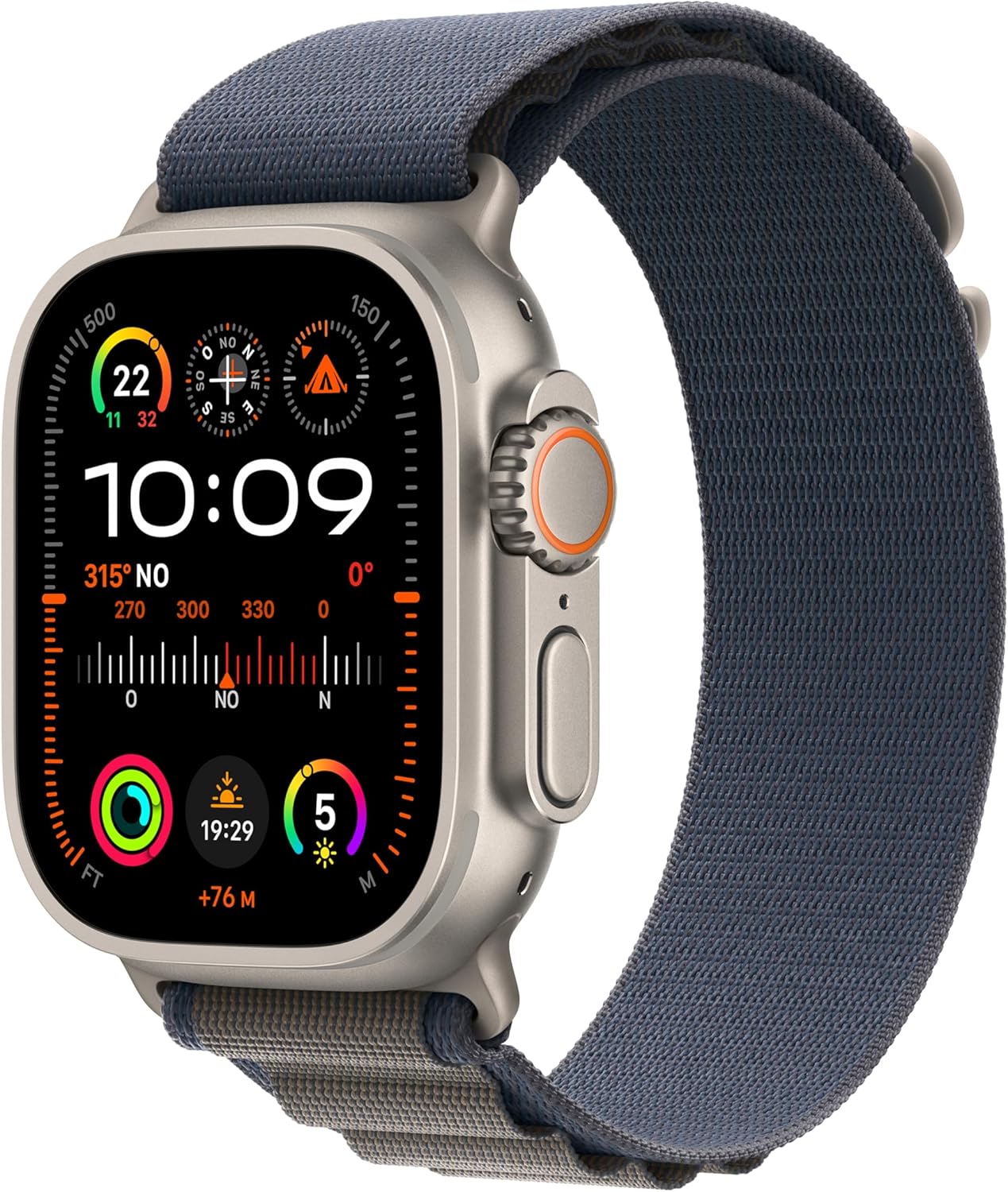
Apple Watch Ultra 2 - The most powerful smartwatch for iPhone runners
~799 eurosThe Apple Watch Ultra 2 is Apple's most serious play for runners. With its 49 mm titanium case, 2,000-nit OLED display, dual-frequency GPS and up to 12 hours of GPS workout battery (36 hours in low power mode), it is a rugged, beautiful and functional running watch.
Integration with the Apple ecosystem is, naturally, flawless. Notifications, calls, messages, Apple Pay, App Store on your wrist, crash and fall detection, menstrual cycle tracking, ECG... as a smartwatch it has no rival. The native Workout app has improved significantly and includes metrics like Running Power, cadence, ground contact time and vertical oscillation.
Where the Apple Watch Ultra 2 falls short versus Garmin and COROS is in battery life (12 hours GPS versus 24-38 from the competition), depth of training metrics (it lacks Training Load, Training Readiness and night-time HRV analysis at the Garmin level) and the running-specific ecosystem (it does not connect directly to many training platforms). If your priority is pure running, Garmin or COROS are more focused options. If you want the best smartwatch on the market that also works well for running, the Ultra 2 is the answer.
Strengths: The best smartwatch on the market, incredible display, titanium build, full Apple ecosystem, Siri.
Limitations: Limited battery for ultras and long trails, less deep training metrics than Garmin, iPhone-only, high price.
Quick comparison table
Every model we analysed at a glance so you can compare key specs and decide quickly. For the full catalogue with more models and updated prices, visit our GPS running watches section.
| Model | GPS Battery | GPS | Display | Weight | Price | Ideal for |
|---|---|---|---|---|---|---|
| Polar Pacer | 35 h | Single-band | MIP | 40 g | ~179 euros | Tightest budget |
| COROS PACE 3 | 38 h | Multi-band | MIP touch | 39 g | ~199 euros | Best value for money |
| COROS PACE Pro | 38 h | Multi-band | AMOLED | 36 g | ~299 euros | AMOLED with COROS battery |
| Garmin FR 265 | 24 h | Multi-band | AMOLED | 47 g | ~349 euros | Complete ecosystem |
| Garmin FR 965 | 31 h | Multi-band | AMOLED | 53 g | ~549 euros | Maps + peak performance |
| Apple Watch Ultra 2 | 12 h | Multi-band | OLED | 61 g | ~799 euros | Premium smartwatch + running |
What features you actually need
Manufacturers pack their spec sheets with dozens of features to justify high prices. But the reality is that there are essential features, useful features and features you will probably never use. Let us separate the wheat from the chaff so you do not overpay for things you do not need.
Accurate GPS: the foundation of everything
GPS is the reason a running watch exists. Without accurate GPS, all other data (distance, pace, speed) is wrong. In 2026, look for watches with multi-band GPS (also called dual-band or L1+L5). This technology uses two signal frequencies simultaneously to reduce errors caused by buildings, trees and hilly terrain. The difference from single-band GPS is noticeable in the city: a basic GPS might record 5.2 km on a 5K run, while multi-band will get closer to the real 5.0 km. Every model we have recommended except the Polar Pacer includes multi-band GPS.
Optical heart rate: training by zones
The optical heart rate sensor on your wrist lets you train by effort zones without needing a chest strap. Accuracy has improved enormously in recent years: current sensors from Garmin (Elevate v4), COROS and Polar are reliable for daily training, including high-intensity intervals. For clinical data or elite competition, a chest strap like the Polar H10 remains superior, but for 95% of runners the optical sensor is more than enough. Heart rate is essential for estimating VO2max, calculating training zones and measuring recovery.
Training load and recovery
Training load metrics (Training Load on Garmin, Training Load on COROS, Training Load Pro on Polar) tell you whether you are training enough, too much or just right. Combined with recovery data (Recovery Time on Garmin, Recovery Timer on COROS, Nightly Recharge on Polar), they help you plan when to push hard and when to rest. These features are especially useful when preparing for a race and needing to balance volume and intensity without falling into overtraining. They are available on every 200+ euro model we have analysed.
Offline music: necessity or luxury?
The ability to store music from Spotify, Deezer or Amazon Music directly on the watch and connect Bluetooth headphones lets you run without carrying your phone. It is a feature that improves convenience, especially on long workouts or races where you do not want to worry about your phone. However, it is not essential: many runners prefer running without music or carry their phone anyway for safety. In our list, only the Garmin Forerunner 265, Garmin Forerunner 965 and Apple Watch Ultra 2 include offline music.
Maps and navigation: when you really need them
Full-colour topographic maps on your wrist are a fantastic feature for trail running, mountain races and exploring new routes in unfamiliar cities. They let you follow a downloaded track with turn-by-turn directions and see your position on a real map. For road runners who always run the same routes in their city, maps are a dispensable extra. For trail runners and adventurers, they are nearly essential. Only the Garmin Forerunner 965 and Apple Watch Ultra 2 include full maps among the models we analysed.
Mistakes when buying a GPS watch
After analysing hundreds of watches and talking with thousands of runners, these are the most common running mistakes we see when buying a GPS running watch. Avoiding them will save you money and frustration.
- Buying the most expensive model thinking it will make you a better runner. A 549-euro Garmin Forerunner 965 does not make you faster than a 199-euro COROS PACE 3. What makes you a better runner is training consistently and intelligently. The watch is a tool, not a shortcut. Buy the one that fits your budget and use its features to the fullest before thinking about upgrading.
- Ignoring battery life. A watch that dies halfway through a race or marathon is a frustrating experience. Always check the battery life in GPS mode (not smartwatch mode, which is always much longer) and make sure it covers your longest activity with margin. If you run 4-5 hour marathons, you need at least 8-10 hours of GPS.
- Obsessing over advanced metrics as a beginner. If you have just started running, you do not need Training Load, HRV Status or Running Power. What you need is pace, distance, heart rate and time. Advanced metrics make sense once you have a training base and want to optimise. Do not pay extra for features you cannot yet interpret.
- Not considering watch weight. A 65-gram watch feels very different on your wrist during a 3-hour race than a 35-gram one. If you are sensitive to weight or run long distances, pay attention to this spec. COROS watches are generally the lightest on the market.
- Buying an Apple Watch solely for running. The Apple Watch is an exceptional smartwatch that also works for running, not a running watch that doubles as a smartwatch. If your priority is running and your budget is limited, a Garmin or COROS will give you a better sport experience for less money. The Apple Watch makes sense if you want it as a full daily watch that also handles running well.
- Not trying the strap before buying. You are going to wear this watch for hours on your wrist, sweating. An uncomfortable strap ruins the experience. Nylon straps breathe better and are more comfortable on long runs. Silicone straps are easier to clean but can irritate sensitive skin. If possible, try the watch in a shop before buying online.
- Waiting forever for the next version. There will always be a new model in a few months. If you need a GPS watch now, buy one now. Current models are excellent and the improvement between generations is increasingly incremental. A COROS PACE 3 bought today will serve you well for 3-5 years.
For a more detailed guide on what to look for at each price range, check our full article on how to choose a GPS running watch.
Frequently asked questions
Why is battery life important in a GPS running watch?
Battery life determines how many hours you can record activity with GPS active. If you run a marathon that could take 4-5 hours, you need at least 6-8 hours of autonomy with margin. For ultras or long trails, you want 25+ hours. Additionally, good smartwatch-mode battery life (7-14 days) means you do not have to charge daily, allowing uninterrupted sleep and recovery tracking. Watches like the COROS PACE 3 with 38 hours of GPS are ideal for those who do not want to worry about charging.
How does GPS accuracy affect my training?
Accurate GPS correctly records your distance and pace, which is essential for training by pace zones and comparing sessions reliably. Multi-band GPS (dual-band L1+L5) improves accuracy in challenging environments like narrow streets with tall buildings or dense forests. Single-band GPS can have distance errors of up to 3-5%, while multi-band brings the error below 1%. If you train intervals by pace or are preparing for a race with a time goal, GPS accuracy matters a great deal.
Do I need a GPS watch to run, or is my phone enough?
Your phone with apps like Strava or Nike Run Club works well for casual runners who go out 1-2 times a week. However, a GPS watch offers clear advantages: real-time wrist data, better GPS accuracy (especially with multi-band), an integrated heart rate sensor, advanced metrics and the comfort of not carrying your phone. If you run 3 or more times a week and want to improve, a GPS watch starting at 179 euros is a worthwhile investment. Check our guide to the best running apps if you still use your phone.
Garmin, COROS or Polar: which brand is best for running?
It depends on your priorities. Garmin has the most complete ecosystem (Garmin Connect is the best analysis app), the largest community, more smartwatch features and the best third-party integration. COROS excels in battery, weight and value for money, offering advanced metrics without a subscription. Polar specialises in training science with very precise recovery metrics. All three are excellent for running; the choice depends on whether you prioritise ecosystem (Garmin), battery and price (COROS) or pure training data (Polar).
What metrics really matter on a running watch?
The essential metrics every runner should use are: current pace (min/km), distance, heart rate, time and cadence (steps per minute). Beyond that, the most useful are estimated VO2max (indicates your aerobic fitness level), Training Load (accumulated training load) and recovery status. Metrics like vertical oscillation, ground contact time or running power are interesting but secondary for most runners. The most important advice: use a few metrics consistently rather than accumulating data you never analyse.
Touchscreen or physical buttons on a running watch?
Physical buttons are more reliable during a run: they work with gloves, sweaty hands and will not accidentally activate in the rain. Touchscreens are more intuitive for navigating menus and configuring the watch day to day. The best current watches, such as the Garmin Forerunner 265 and COROS PACE Pro, combine both: you use buttons to control workouts and the touchscreen to explore menus. If you can only choose one, physical buttons are the safer option for running.
What is the best cheap GPS watch to start running?
In 2026, the COROS PACE 3 is the best budget GPS running watch. For approximately 199 euros (on sale) it offers accurate multi-band GPS, 38 hours of GPS battery, just 39 grams and advanced metrics included without a subscription. It is more watch than most beginners need, and will still serve you well as you progress to intermediate level. As an even more affordable alternative, the Polar Pacer at 179 euros is a solid option with accurate GPS and excellent recovery metrics. Find both and more models in our GPS running watches section.