
Running in the rain can be one of the most liberating experiences in the sport, but only if you are wearing the right jacket. A rain jacket that is too heavy turns you into a portable sauna. One that is too thin soaks through in ten minutes. And one with no ventilation leaves you just as wet on the inside as the outside, only from sweat instead of rain. Choosing the right rain jacket is a delicate balance between waterproofing, breathability, weight and, of course, price (World Athletics).
In this guide we have analyzed the 8 best running rain jackets available in 2026. Each model has been evaluated based on its water column rating, breathability (MVTR), weight, packability, ventilation and reflective elements. Whether you train every day in the rain or just need something for emergencies on trail races, you will find the right jacket here. To round out your wet-weather kit, we also recommend our guide to running apparel where we cover all the layering basics (ACSM).
Waterproof vs water-resistant: the key difference
The first thing you need to understand before buying a running rain jacket is the difference between waterproof and water-resistant. They are two completely different things, and confusing them is the most common mistake among runners who end up soaked to the bone in a jacket they thought would protect them.
Water-Resistant
A water-resistant fabric has a DWR (Durable Water Repellent) finish that causes droplets to bead and roll off the surface rather than soaking into the material. It works well in light drizzle and for short periods, typically between 15 and 30 minutes. After that, or in heavier rain, water starts to penetrate the fabric. Water-resistant jackets tend to be lighter, more breathable and much cheaper than fully waterproof options. They are ideal if you run in areas with little rainfall or as a windbreaker with added protection.
Waterproof
A waterproof rain jacket has an internal membrane that physically blocks water from passing through. The standard measure is the water column, expressed in millimeters. From 10,000 mm onwards a jacket is considered waterproof for high-intensity activities like running. The best models with Gore-Tex exceed 28,000 mm. Additionally, seams must be heat-taped to prevent leaks at the fabric joints. A truly waterproof jacket will keep you dry even in torrential rain for hours.
For running, full waterproofing is only necessary if you train regularly in heavy rain or race long-distance trail events where exposure to the elements can last several hours. If you only need something for occasional drizzle, a water-resistant windbreaker is more practical and comfortable. Check our running apparel guide to see all the outer layer options.
Membrane types: Gore-Tex and proprietary alternatives
The membrane is the heart of any waterproof rain jacket. It is an ultra-thin layer, invisible to the naked eye, positioned between the outer fabric and the inner lining. Its function is twofold: prevent rainwater from entering from outside and allow sweat vapor to escape from inside. The quality of this membrane directly determines the quality of the jacket.
Gore-Tex: the industry standard
Gore-Tex is the best-known waterproof membrane and, for many, the best. Manufactured by W. L. Gore & Associates, it contains over 9 billion pores per square centimeter. Each pore is 20,000 times smaller than a water droplet yet 700 times larger than a vapor molecule, which allows perspiration to escape while keeping rain out. For running, the most interesting version is Gore-Tex ShakeDry: it eliminates the outer fabric layer and exposes the membrane directly, making it extremely lightweight, breathable and able to dry with a couple of shakes. The downside is that it is more fragile and more expensive.
Proprietary brand membranes
Major outdoor and running brands have developed their own membranes to avoid depending on Gore-Tex and to offer more competitive pricing. The most relevant ones for running are:
- Salomon AdvancedSkin Shield: A 2.5-layer membrane with excellent waterproofing-to-breathability ratio. Used in the Bonatti line, it offers 20,000 mm water column at a lower price than Gore-Tex.
- The North Face Futurelight: A nanospun membrane that offers breathability superior to standard Gore-Tex. Available in the Flight series, it is TNF's flagship for high-intensity trail running.
- adidas Rain.RDY: Adidas's rain-running technology combining a waterproof membrane with taped seams. Found in the Terrex trail line.
- Montane Pertex Shield: An ultralight 2.5-layer membrane widely used in minimalist trail jackets. Very good breathability for its weight.
Breathability and MVTR: what the numbers mean
Breathability in a rain jacket is measured by MVTR (Moisture Vapor Transmission Rate), expressed in grams of water vapor that the membrane lets through per square meter over 24 hours (g/m2/24h). It is the most important figure after the water column rating, and arguably the most relevant for runners, because a runner generates an enormous amount of sweat and body heat even at easy paces.
Find your running with a group
1,100+ runners already train together. Free on iOS.
MVTR ranges and their practical meaning
- 5,000-10,000 g/m2/24h: Basic breathability. Acceptable for walking or very easy running in cold temperatures. Insufficient for moderate or high-intensity running. You will feel damp inside.
- 10,000-20,000 g/m2/24h: Medium breathability. Works well for moderate-pace running (5:00-6:00 min/km) in temperatures of 5-15 degrees. Most mid-range rain jackets sit in this range.
- 20,000-30,000 g/m2/24h: High breathability. Suitable for intense training paces (sub 5:00 min/km) or warmer temperatures. This is where the best running rain jackets sit.
- Over 30,000 g/m2/24h: Premium breathability. Only fabrics like Gore-Tex ShakeDry or equivalents reach these numbers. Ideal for racing or high-intensity training in the rain.
Keep in mind that real-world breathability while running also depends on mechanical ventilation: pit zips, side openings, mesh panels and the overall cut of the jacket. A rain jacket with medium MVTR but good ventilation openings can be more comfortable than one with high MVTR but sealed tight like a bag. For a deeper understanding of the full layering system, visit our guide to running technical apparel.
The 8 best running rain jackets 2026
After analyzing dozens of models, here is our selection of the 8 best running rain jackets in 2026. We have included options for every budget, from the premium Gore Wear R7 to the most affordable Decathlon option. Each model has its strengths and is designed for a different type of runner.

1. Gore Wear R7 GTX ShakeDry
~200 EURBest for: Serious runners who train regularly in the rain
The R7 ShakeDry is, simply put, the best running rain jacket on the market. ShakeDry technology exposes the Gore-Tex membrane directly to the outside, eliminating the outer fabric layer that normally covers it. The result is a jacket that weighs just 110 grams, breathes like almost nothing else and dries literally with a couple of shakes. Water does not soak into the outer fabric because there is no outer fabric: droplets simply slide off the membrane.
The main downside is durability. Without a protective outer layer, the membrane degrades faster with backpack friction, abrasion and frequent washing. If you look after it and reserve it exclusively for running, it will last 2-3 seasons. But if you use it constantly with a trail pack, its lifespan shrinks. The other obvious downside is the price: 200 euros is not cheap for a 110-gram jacket. But if you run in the rain regularly, every gram and every degree of breathability counts.
Check price on Amazon
2. Salomon Bonatti WP
~130 EURBest for: Trail runners and runners seeking versatility
The Salomon Bonatti is the rain jacket we recommend to most runners. It offers 20,000 mm waterproofing with the AdvancedSkin Shield 2.5-layer membrane, 20,000 MVTR breathability, weighs just 180 grams and packs into its own pocket down to the size of a fist. It is the definition of versatility: equally effective for a road run in the rain or a mountain trail race where conditions change by the hour.
The cut is specifically designed for running, with articulated sleeves that do not pull when you swing your arms and a length that covers the lower back without reaching the hips. The hood is adjustable and cap-compatible. Its only weak point compared to the Gore Wear is breathability: at very high paces you will notice more internal condensation. But at 70 euros less and with greater durability, the Bonatti is the best investment for most runners.
Check price on Amazon
3. Nike Windrunner
~90 EURBest for: Urban runners with occasional rain
The Nike Windrunner is the tried-and-true classic. It is not the most technical jacket on the market nor the lightest, but it has something that many premium rain jackets fail to deliver: an excellent fit across a huge range of body types. Nike has spent decades refining this pattern and it shows. The cut is slightly relaxed to allow layers underneath, the sleeves are the right length and the hood stays put when you run.
At 10,000 mm water column, the Windrunner sits at the lower end of what is considered waterproof for running. It handles moderate rain perfectly for an hour of training, but in torrential rain or runs longer than 90 minutes you will start to feel moisture. The side ventilation zips help a lot with breathability, which is not its strongest suit. It is the best option for the urban runner who goes out 3-4 times a week and needs rain protection without breaking the bank.
Check price on Amazon
4. The North Face Flight Series Lightriser
~160 EURBest for: Ultra-distance trail runners and mountain running
The Flight Series Lightriser from The North Face is a jacket designed from the ground up for competitive trail running. It uses the Futurelight membrane, one of the most breathable on the market thanks to its nanospun structure. At 145 grams and a packed size that fits in the palm of your hand, it comfortably meets the mandatory gear requirements of any ultra-trail race.
The design includes side panels with higher breathability in the zones that produce the most heat and sweat, a helmet-compatible hood that does not restrict peripheral vision, and 360-degree reflective elements for night racing. The Futurelight membrane holds up well against hydration while running pack abrasion and trekking pole contact. Its weak point is the price, though for what it offers it is justified if you race trail regularly.
Check price on Amazon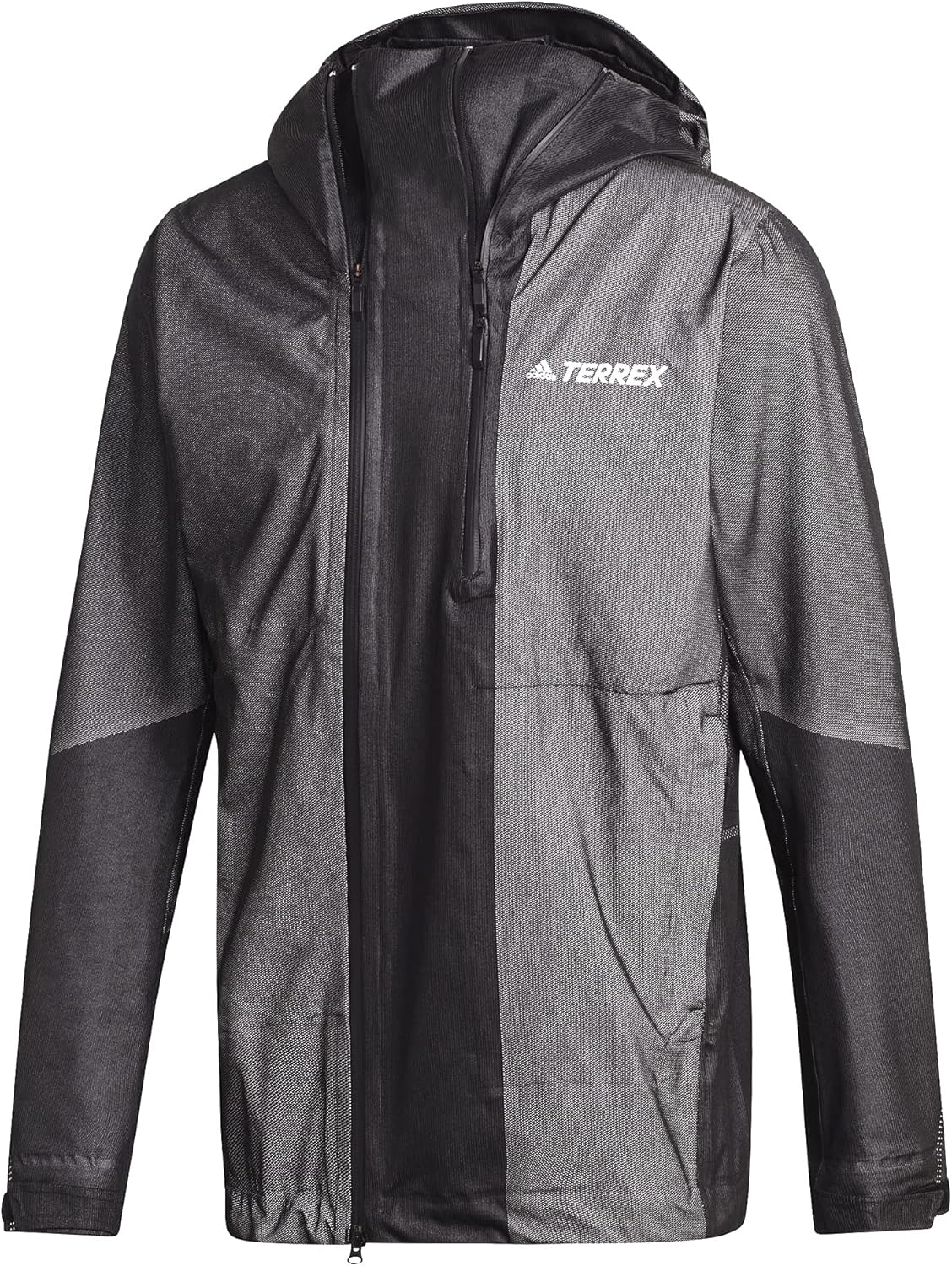
5. adidas Terrex Agravic Rain
~120 EURBest for: Trail runners on a controlled budget
The Terrex Agravic Rain is the adidas proposition for trail running in wet weather. It uses Rain.RDY technology with 2.5 layers, offering 20,000 mm water column and taped seams. The weight of 195 grams is competitive for its protection level and the jacket packs into a rear zippered pocket compact enough to fit in a trail vest.
The pit vents are a smart design choice that compensates for an MVTR that is not the highest on this list. The cut is athletic without being restrictive and the sleeves have elastic cuffs that seal nicely at the wrist without squeezing. The outer material is somewhat more abrasion-resistant than average, making it a good choice if you regularly wear a pack. In the 100-130 euro range, it is hard to find anything better for trail.
Check price on Amazon6. Decathlon Kiprun Rain
~40 EURBest for: Beginners and budget-conscious runners
If your budget is limited, the Kiprun Rain from Decathlon is the best investment you can make. For 40 euros you get a 185-gram rain jacket with 10,000 mm water column, taped seams, compact packability and reflective elements. It is not the most breathable in the world (8,000 MVTR), but for runs of up to an hour in moderate rain it does the job perfectly.
The finish and materials are obviously inferior to the premium options: the zipper is more basic, the fabric feel is less refined and the hood does not have the same level of adjustment. But the performance gap does not justify paying three or four times more for a runner who goes out 2-3 times a week. Decathlon has improved the Kiprun line dramatically in recent years and this jacket is the proof. If you are just starting to run, start here and upgrade when you need to.
Check running rain jackets on Amazon
7. Montane Minimus Lite
~140 EURBest for: Minimalists and FKT / fast race runners
The Montane Minimus Lite is the jacket for the runner who wants to carry the least weight possible. At just 105 grams it is the lightest in our selection, even lighter than the Gore Wear R7. It uses a Pertex Shield 2.5-layer membrane that delivers exceptional breathability at 25,000 MVTR, making it one of the most comfortable jackets for running at high paces.
The trade-off for that extreme lightness is a waterproofing rating of 15,000 mm, lower than the premium options but more than sufficient for most situations. The fabric is extremely thin, which means long-term durability is not its strong suit. It is a jacket for carrying as an emergency layer in races or for training sessions where the chance of rain is moderate. It packs so small it fits in a shorts pocket. For runners obsessed with weight, it is a dream.
Check price on Amazon
8. Arc'teryx Norvan LT
~280 EURBest for: Elite runners and ultramarathoners
The Arc'teryx Norvan LT represents the best you can buy in a running rain jacket. It uses Gore-Tex with C-Knit technology, which adds a circular-knit interior backer that improves next-to-skin comfort and reduces the rustling noise of the jacket while running (a detail that seems minor until you run 4 hours in the rain with a jacket that crinkles). At 130 grams it offers 28,000 mm waterproofing and 30,000 MVTR breathability.
The build quality from Arc'teryx is legendary: every seam is taped with millimetric precision, the zippers are the finest quality available and the cut is engineered by textile specialists with decades of experience. The StormHood adjusts over any cap or helmet without restricting your field of vision. The 280 euro price tag is steep, but if you look after it the jacket will last 5 or more seasons while maintaining performance. It is an investment, not an expense, for the runner who runs year-round regardless of the weather.
Check price on AmazonQuick comparison table
This table summarizes the key specs of all 8 jackets so you can compare them at a glance. Scroll horizontally on mobile to see all columns.
| Model | Price | Weight | Water column | MVTR | Membrane | Packable |
|---|---|---|---|---|---|---|
| Gore Wear R7 GTX ShakeDry | ~200 EUR | 110 g | 28,000 mm | >35,000 | Gore-Tex ShakeDry | Yes |
| Salomon Bonatti WP | ~130 EUR | 180 g | 20,000 mm | 20,000 | AdvancedSkin Shield | Yes |
| Nike Windrunner | ~90 EUR | 210 g | 10,000 mm | 10,000 | Nike Storm-FIT | No |
| TNF Flight Lightriser | ~160 EUR | 145 g | 25,000 mm | 25,000 | Futurelight | Yes |
| adidas Terrex Agravic Rain | ~120 EUR | 195 g | 20,000 mm | 15,000 | Rain.RDY | Yes |
| Decathlon Kiprun Rain | ~40 EUR | 185 g | 10,000 mm | 8,000 | Kiprun proprietary | Yes |
| Montane Minimus Lite | ~140 EUR | 105 g | 15,000 mm | 25,000 | Pertex Shield | Yes |
| Arc'teryx Norvan LT | ~280 EUR | 130 g | 28,000 mm | 30,000 | Gore-Tex C-Knit | Yes |
How to layer for running in the rain
The rain jacket is only the outer layer of a system that, if you want to be truly comfortable running in the rain, needs to be well thought through from the inside out. The most common mistake is wearing a waterproof jacket over a cotton t-shirt: the rain does not get through, but the sweat has nowhere to go and you end up just as wet. The rain layering system has three levels.
Base layer: wick the sweat
The base layer sits directly against your skin. It should be made from synthetic fabric (polyester, polyamide) or merino wool. Its job is to absorb sweat from your skin and transfer it to the next layer for evaporation. Never, under any circumstances, wear cotton as a base layer for running in the rain. Cotton absorbs moisture, stays wet and heavy, and in combination with a rain jacket creates an unbearable sauna effect. A basic technical t-shirt costing 10-15 euros is all you need.
Mid layer: insulation (only in cold weather)
If the temperature is below 8-10 degrees, add a thin mid layer between the base layer and the rain jacket. A thin fleece or lightweight thermal jacket works well. This layer traps body heat while allowing sweat to continue its journey outward. Do not use a mid layer that is too thick: you generate a lot of heat while running and an excessive layer will cause overheating. If the temperature is above 10 degrees, base layer plus rain jacket is the ideal setup. For more on the layering system, check our guide to running in winter.
Outer layer: shield from the rain
The rain jacket is the outer layer. Its job is to prevent rain from reaching the inner layers and, at the same time, allow the sweat vapor generated by your body and transported by the base layer to escape to the outside. That is why breathability (MVTR) is so important: a jacket that is waterproof but not breathable traps all the sweat inside and you lose the advantage of wearing a good base layer.
Jacket vs vest: when you need each one
Not every rainy day calls for a full rain jacket. Sometimes a waterproof vest is enough, more comfortable and lighter. The key is understanding what each one protects and under what conditions each option makes sense.
When to choose a waterproof vest
- Light rain or drizzle: A vest protects the torso (where most of your body heat is) while leaving the arms free for better ventilation.
- Mild temperatures (12+ degrees): In warm rain you do not need to cover your arms. A vest prevents the overheating that a sealed jacket would cause.
- High-intensity training paces: The faster you run, the more heat you generate. A vest provides essential protection without trapping as much heat as a jacket.
- As an emergency layer on trail: A packable vest weighing 80-100 grams takes up half the space of a rain jacket and can bail you out if the weather turns.
When you need a full rain jacket
- Heavy or prolonged rain: If the rain is heavy or you will be exposed for more than 45 minutes, you need sleeves to protect your arms.
- Strong wind: Lateral wind drives rain against unprotected arms. In wind, a vest is insufficient.
- Cold temperatures (below 8 degrees): In the cold, wet arms cause significant heat loss. A full jacket is essential.
- Trail races with mandatory gear: Most trail races require a full jacket with hood on the mandatory gear list. A vest does not count.
Packable vs everyday rain jacket
Another important decision is whether you need a packable rain jacket that you can stash and carry just in case, or one you wear as a go-to garment whenever it rains. Each approach has its advantages and involves different trade-offs.
Packable rain jacket
A packable rain jacket folds down to fit inside its own pocket or into a pouch the size of an orange. It is ideal for carrying in a trail vest, a waist belt or even a large shorts pocket. The best packable models (Gore Wear R7, Montane Minimus Lite) weigh between 100 and 150 grams and take up barely any space. The trade-off is that they tend to have thinner fabrics, fewer pockets and a more minimalist construction. They are perfect as an emergency layer or for days when the forecast is uncertain.
Everyday rain jacket
If you live in an area where it rains frequently and you go out running in your jacket several times a week, a more robust and full-featured model may be worthwhile. These jackets tend to be slightly heavier (180-250 grams), have more pockets, a more abrasion-resistant outer fabric and a slightly roomier cut that allows greater range of motion over the long haul. The Salomon Bonatti WP and the adidas Terrex Agravic Rain sit at the ideal sweet spot between packable and everyday use.
Care, washing and reproofing
A running rain jacket is an investment that can last years if you care for it properly. But if you treat it like a regular t-shirt, the waterproofing will degrade within months. Here is everything you need to know to keep your jacket in perfect condition.
How to wash a running rain jacket
- Close all zippers and release any velcro before putting the jacket in the washing machine. Open zippers can damage the fabric during the spin cycle.
- Use cold or warm water (maximum 30 degrees) and a detergent designed for waterproof membranes. If you do not have one, a small amount of mild liquid soap. Never use standard detergent with fabric softener: softener clogs the membrane pores and destroys the waterproofing.
- Delicate cycle with a gentle spin. An aggressive spin cycle can deform the taped seams.
- Never use bleach or any whitening product. They destroy both the membrane and the outer DWR treatment.
- Air dry or tumble dry on low heat. The moderate heat from a dryer partially reactivates the DWR treatment. Do not hang in direct sunlight for hours: UV rays degrade the membranes.
When and how to reproof
The DWR treatment on the outer fabric wears off with use, washing and exposure to dirt. The sign that you need to reproof is clear: when water stops beading and rolling off the surface and starts soaking into the outer fabric (known as "wetting out"). This does not mean the membrane has failed, just that the first line of defense has lost effectiveness.
- DWR sprays (such as Nikwax TX.Direct Spray or Grangers Performance Repel): Easy to apply, spray onto the clean dry garment, let dry. Lasts between 3 and 5 washes.
- Wash-in DWR (such as Nikwax TX.Direct Wash-In): Greater coverage and penetration, ideal for a full reproof. Add to the washing machine dispenser and wash on a delicate cycle.
- Frequency: With regular use (2-3 times per week), reproof every 3-4 months. With occasional use, once a year is sufficient.
How to choose a rain jacket for your type of running
With so many options on the market, the best way to get it right is to start with your type of running and your typical conditions. Here is our recommendation by runner profile, which you can complement with our running apparel guide to complete your kit.
Casual urban runner (2-3 runs/week)
If you run in the city, mostly on pavement, and only need protection from light to moderate rain, the Nike Windrunner (~90 EUR) or the Decathlon Kiprun Rain (~40 EUR) are your best bets. You do not need 28,000 mm water column or 35,000 MVTR if your longest run is an hour and you can take shelter at any moment.
Regular runner in a rainy area (4-5 runs/week)
If you live somewhere with frequent rain and train almost daily, invest in something of higher quality. The Salomon Bonatti WP (~130 EUR) offers the best balance: waterproof, breathable, durable and reasonably priced. It will last years of heavy use without losing performance.
Trail runner and racer
For trail running you need lightness, compact packability and maximum protection. The The North Face Flight Lightriser (~160 EUR) or the adidas Terrex Agravic Rain (~120 EUR) are excellent options. If you race ultras and budget is no issue, the Arc'teryx Norvan LT (~280 EUR) is unbeatable.
Elite runner / weight obsessive
If every gram counts, the Montane Minimus Lite (~140 EUR, 105 g) or the Gore Wear R7 ShakeDry (~200 EUR, 110 g) are the lightest on the market with genuine protection. The difference between them comes down to breathability (ShakeDry wins) versus durability (Minimus Lite holds up better).
Common mistakes when buying a running rain jacket
Before making your purchase, review this list of mistakes we see constantly among runners. Avoiding them will save you money and frustration.
- Buying for maximum waterproofing without checking breathability: A jacket with 28,000 mm but only 5,000 MVTR will leave you drenched in sweat within 15 minutes of running. Breathability is just as important as, or more important than, waterproofing for running.
- Choosing a size too large: An oversized rain jacket flaps in the wind, creates aerodynamic drag and causes chafing. Pick your regular size or, at most, one size up if you plan to layer underneath in winter.
- Using fabric softener when washing: Fabric softener is the number-one enemy of waterproof membranes. It clogs the micropores of the membrane and destroys the outer DWR treatment. A single wash with softener can ruin a 200-euro jacket.
- Ignoring ventilation: Pit zips and side vents are not a cosmetic extra; they are essential for releasing excess heat while running. Prioritize models with good mechanical ventilation options.
- Storing the jacket wet and packed: After use, spread the jacket out and let it dry completely before packing it away. Storing a damp jacket in its stuff sack breeds mold and degrades the membrane.
- Buying a hiking jacket for running: Hiking rain jackets are designed for slow paces. They are heavier, less breathable and have a roomier cut. A running-specific rain jacket has an athletic cut, reduced weight and breathability tuned to exercise intensity.
Frequently asked questions about running rain jackets
What is the difference between waterproof and water-resistant in a running jacket?
A waterproof jacket has a sealed membrane that completely blocks water penetration, with a water column rating above 10,000 mm. A water-resistant jacket has a DWR treatment that repels droplets for a limited time but will eventually soak through in heavy or prolonged rain. For running in heavy rain for more than 30 minutes you need a waterproof jacket with taped seams.
What water column rating do I need in a running rain jacket?
For running in moderate to heavy rain you need at least 10,000 mm water column. Gore-Tex jackets typically offer 28,000 mm or more, which is more than enough. For light rain or drizzle, 5,000 mm may be sufficient, but if you live in a rainy area or run long distances, invest in something rated 15,000 mm or above. The higher the water column, the greater the pressure the fabric can withstand before letting water through.
Can I just run in a waterproof vest instead of a full jacket?
A waterproof vest protects the torso and is ideal for light rain, high-intensity runs where you generate lots of heat, or as an emergency layer on trail. However, it does not protect the arms and loses effectiveness with lateral rain or strong wind. If you regularly run in heavy rain, you need a full jacket with sleeves. The vest is a supplement, not a substitute.
How often should I reproof a running rain jacket?
It depends on usage. If you run in your jacket 2-3 times per week, reproof every 3-4 months. If you use it occasionally, once a year is enough. The sign that it needs treatment is when water stops beading on the surface and starts soaking into the fabric. Use a DWR spray designed for waterproof membranes (such as Nikwax TX.Direct), never fabric softener in the wash.
Is Gore-Tex better than proprietary membranes from other brands?
Gore-Tex is the market benchmark for consistency and durability, especially the ShakeDry version for running. But proprietary membranes like Salomon's AdvancedSkin Shield, The North Face Futurelight or Montane's Pertex Shield offer comparable performance at a lower price. The main difference is that Gore-Tex has very strict quality control and decades of track record, while proprietary membranes vary more across models and generations.
Is it worth spending over 150 euros on a running rain jacket?
It depends on how often you run in the rain. If you live in a rainy area and train 4-5 times per week, a premium jacket costing 150-200 euros with Gore-Tex ShakeDry or a high-end membrane will last years, breathe much better and weigh less. If you only use it occasionally, a model costing 40-90 euros like the Kiprun Rain from Decathlon or the Nike Windrunner does the job perfectly without emptying your wallet.
How do I wash a running rain jacket without damaging the membrane?
Always machine wash on a cold or warm setting (maximum 30 degrees), delicate cycle, without fabric softener or bleach. Use a detergent designed for waterproof membranes or, failing that, a small amount of mild liquid soap. Close all zippers before washing. Air dry or tumble dry on low heat. After washing, reactivate the DWR by ironing on low heat with a cloth between the iron and the fabric, or by using a reproofing spray.